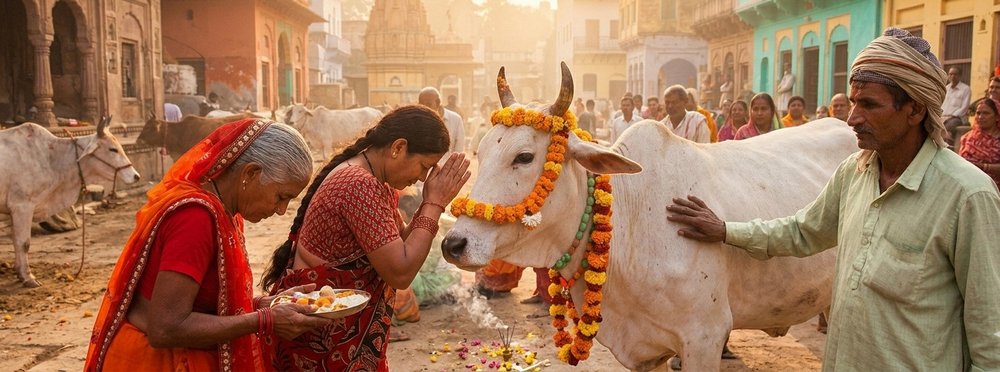
Few contradictions in modern life are as cleanly revealing as what happens to a cow in India when she stops producing milk.
The cow holds sacred status in Hinduism, symbolizing purity, nurturing, and the sanctity of life. Her reverence is baked into ritual and cultural identity, and across much of India, slaughtering her is illegal. What’s striking is that even in states with those bans, very few explicitly prohibit the consumption of beef. The prohibition targets the act of killing, not the appetite it serves. That distinction, quiet and carefully maintained, is doing a great deal of work.
When a cow’s milk production wanes, she becomes a financial burden. Rather than being cared for until natural death, she’s sold. Often through intermediaries. Often across state lines. The owner didn’t commit the slaughter, the reasoning goes.”I sold the cow; that is not a sin.” The moral ledger is balanced through distance and technicality. She is killed regardless. The belief system remains, in its own accounting, intact.
Piety Meets Pragmatism
This kind of ethical architecture isn’t unique to India. The medieval Catholic Church considered charging interest on loans a sin. Lenders found their way around it by routing transactions through Jewish intermediaries, who operated outside Church law. Christians could lend and profit while remaining technically clean. The sin was outsourced, the economy moved forward, and the moral framework held together—provided nobody followed the logic all the way to its conclusion.
That last condition is the one that’s always quietly in place. These arrangements survive not because they’re airtight, but because there’s a collective agreement not to press them too hard.
What makes the Indian cow paradox particularly uncomfortable is how visible it is. The animal isn’t abstract. She’s worshipped, named, garlanded at festivals. And then she’s sold, and most people understand where she goes. The chain from reverence to slaughterhouse is short, kept intact only by an unspoken agreement to stop following it at a certain point.
Moral duty cannot be oursourced. The cow’s owner isn’t a hypocrite in any simple sense. He’s a person navigating the space between belief and solvency, doing what people have always done. But the underlying problem doesn’t dissolve because of that. Most philosophical traditions, including the one that elevated the cow to sacred status in the first place, hold that setting a harmful outcome in motion and stepping back isn’t the same as innocence. Moral responsibility doesn’t transfer cleanly with a bill of sale.
What the cow paradox really exposes is how fragile ideals become under economic strain, and how quickly any belief system, sufficiently pressured, will find a way to accommodate that pressure while preserving the appearance of principle. That isn’t a uniquely Indian failure. It’s a human one. The uncomfortable part isn’t that the loophole exists. It’s how rarely anyone closes it.
Leave a Reply