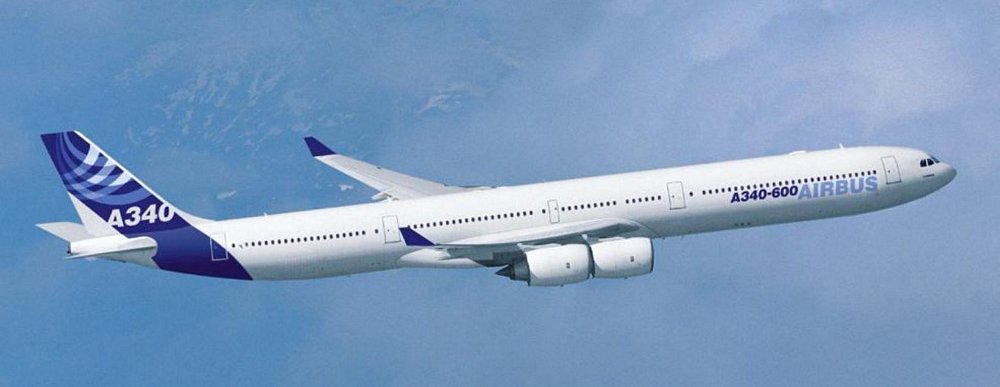
If ever there were a textbook example of the risks of launching an ambitious project years, even decades, before knowing whether the world would still want it, the Airbus A340 aircraft is it. It stands as a true victim of the shifting economic tides between its conception and market launch.
Conceived in an era when four engines were synonymous with reliability, airlines operated with seemingly vast budgets, and regulators remained deeply skeptical of twinjets crossing oceans, this long-haul aircraft entered service as a relic before it had a chance to prove otherwise.
Airbus’s vision for the A340 took shape in the mid-1970s, a time when aviation adhered to traditional doctrines with near-religious fervor. Twin-engine reliability remained under suspicion, and Extended-range Twin-engine Operational Performance Standards (ETOPS), the still-in-blueprint regulatory framework dictating how far twin-engine aircraft could stray from emergency landing sites, severely restricted their range. Fuel efficiency was more of a luxury than a necessity, and airlines wielded significantly more pricing power than they do today. Determined to avoid twinjet constraints, Airbus forged ahead with a four-engine design, ensuring unrestricted intercontinental routes while sidestepping ETOPS limitations entirely.
The A340 is a Monument to Misjudged Ambition
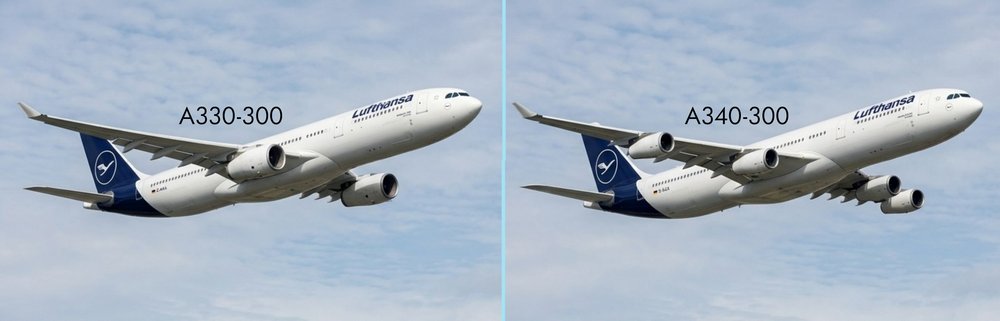
To Airbus’s credit, its risk managers were not naive. Their hedge was simple yet shrewd: develop the A340 alongside a twin-engine counterpart, the A330. Faced with uncertainty about the aviation industry’s future trajectory, they created two aircraft with nearly identical airframes but distinct operational roles, one tailored for long-haul missions, the other optimized for medium-haul efficiency. The A340, with its four engines, would conquer the world’s longest routes unburdened by ETOPS restrictions, while the A330, with just two, would handle shorter yet commercially vital segments. Both aircraft shared a high degree of design commonality, including identical wings, and were assembled in the same factories using the same production lines. This strategy streamlined manufacturing and maintenance while granting airlines unprecedented flexibility in fleet planning. If the A340 struggled, the A330 could still succeed, and succeed it did.
By the early 1990s, as the A340 finally entered commercial service, the world had already moved on. Advances in engine technology had erased old concerns about twin-engine reliability, transforming twinjets from a calculated gamble into an industry inevitability. Airlines, newly fixated on cost-cutting, saw no reason to pay for four engines when two could offer equal dependability at a dramatically lower operating cost.
The A340’s fundamental flaw was that it entered service already obsolete. The market had already evolved past the need for it. Boeing’s 777 and Airbus’s own A330 delivered nearly identical capabilities at significantly lower costs. When Singapore Airlines, widely regarded as one of the industry’s most influential fleet strategists, abruptly retired its new A340-300s in favor of the Boeing 777, the message was unmistakable. The rest of the industry quickly reassessed its commitments to the quadjet.
The Market Did Not Kill the A340—It Simply Outgrew It
Boeing’s final, decisive blow came with the 777-300ER. Offering the same long-haul capabilities but with vastly superior efficiency, this twinjet eliminated any lingering doubts about the necessity of four engines. Airbus scrambled to salvage its position, launching stretched A340-500 and A340-600 variants, but the damage was irreversible.
Adding insult to financial injury, the 777-300ER featured a standard 3-3-3 economy-class seating layout, immediately making more efficient use of cabin space compared to the A340’s (and A330’s) more passenger-friendly 2-4-2 configuration. Airbus had long promoted the comfort of its twin-aisle layout, fewer middle seats and better aisle access, but the industry had already shifted decisively toward revenue optimization. Boeing’s twinjet could seat more passengers per row, and as airlines grew more aggressive with capacity planning, the denser 3-4-3 configuration became the new standard on the 777, maximizing profitability per flight.
Faced with the harsh reality of economics steamrolling passenger comfort, airlines defected en masse. Boeing had delivered not just a fuel-efficient aircraft, but one that redefined how airlines extracted profit from every available square foot of cabin space.
The A340 Was Designed for an Era That Had Already Slipped Away
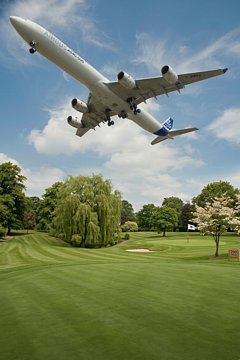 Despite the 777-300ER’s dominance in high-capacity, ultra-long-range operations, the Airbus A330 carved out its own space in the market. Continuous design improvements somewhat enhanced its operational flexibility, cost efficiency, and versatility, allowing it to thrive as a preferred choice for airlines needing reliable performance across a broad range of routes. Over time, its long-haul capabilities increasingly aligned with the missions originally envisioned for the A340, solidifying its role as an indispensable aircraft for medium- and long-haul operations.
In the end, the A340’s demise was not the result of incompetence, but of irrelevance. It was neither a failure nor an error in the traditional sense. It was comfortable, reliable, and capable. But it was designed for an era that had already begun to slip away and released into a market that had ruthlessly reshaped its priorities. In an industry where decades of forecasting can make or break billion-dollar programs, misjudging future trends is not just an inconvenience. It is a slow-motion catastrophe.
The A340 fell victim not to its own deficiencies, but to the relentless march of progress. In other words, the A340 did not fail because it was bad. It failed because everything else got better.
That is a cautionary tale, not of human folly, but of time’s merciless indifference, dismantling even the best-laid schemes with a quiet, unceremonious shrug.
Leave a Reply