• Skip to content
  • Skip to primary sidebar

Right Attitudes

Ideas for Impact

Meetings

You are Your Presentation, Your Slides Aren’t

November 18, 2006 By Nagesh Belludi 3 Comments

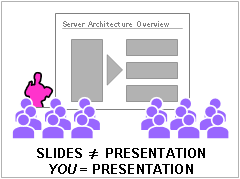
You, not Your Slides, are Your PresentationLast week, I attended a training seminar where the speaker stood by the side of a projection screen and behind a table where he had his laptop. He hardly moved from his position during the hour-long seminar. He was short and was barely visible from the back of the thirty-people room, as shown in the illustration. Despite his interesting content and compelling arguments, he was physically disconnected from his audience.
One of the common mistakes speakers make is that they regard their slides as the core of their presentation—they give their slides the center stage during their presentations. Sometimes they stand behind a podium or by the side of a projection screen and command very little attention from the audience.

Here are a few tips to help you engage your audience.

  • Get a handheld or a clip-on microphone and a remote control to advance your PowerPoint or Keynote slides. Walk around the room and establish a positive rapport with your audience.
  • Maintain a relaxed body language and tone, smile and engage the audience in discussions. A relaxed stance and engaging conversations quickly establish your authority over the subject matter and your credibility with the audience.
  • Maintain eye contact with all the members of your audience. Observe their body language for non-verbal feedback to your presentation content.
  • Have a friend or family member attend your presentation and request that he or she observe your non-verbal communication, viz., your appearance, enthusiasm, tone and volume, gestures, eye contact, audience engagement, pauses, and pace of delivery.

As you prepare for your next public speaking assignment or presentation, remember that your slides or handouts just augment your presentation and support your line of reasoning. You are the presentation; you should be the focus.

Wondering what to read next?

  1. Unlock the Power of Communication: Start with the End in Mind!
  2. Albert Mehrabian’s 7-38-55 Rule of Personal Communication
  3. Serve the ‘Lazy Grapefruit’
  4. Lessons from the Japanese Decision-Making Process
  5. Jargon Has Its Place in Business Communication

Filed Under: Effective Communication Tagged With: Meetings, Presentations

How to Prepare for Meetings

October 26, 2006 By Nagesh Belludi Leave a Comment

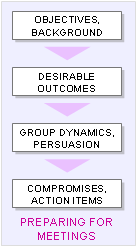
Preparing to Attend MeetingsMeetings are important organizational tools. Whether as one-on-one conversations or as larger all-employee information sharing sessions, meetings are integral components of getting work done. Despite some obvious benefits, most meetings are not very productive and are longer than necessary. One of the primary reasons for the lower productivity of meetings is that attendees come unprepared.

Assume you have consented to attend a meeting because your participation is critical to the objective of the meeting. What questions will you ask to prepare for the meeting?

  • Have I read the meeting agenda? What is the objective of the meeting? What is my role? How will I contribute to the meeting?
  • What segment of the meeting is relevant to me? Can I join late or leave early if I am not required throughout the length of the meeting?
  • Is this a follow-up to a previous meeting? What action items had I agreed on then? What results will I present? What questions will arise?
  • What relevant pre-reading material should I seek?
  • What research do I need to do? Whom on my team should I talk to regarding items on the agenda?
  • What is the desirable outcome? What is the undesirable outcome? Is there a compromise?
  • What positions am I prepared to take on key issues being discussed in this meeting? What facts and charts will I present to support my position?
  • Who are the other attendees? What positions are they likely to take on key issues? Why? What are the likely group dynamics: who will support me, who will oppose my positions? What counter arguments will I present?
  • What other attendees should I talk to prior to the meeting to garner support to my position? Can I invite additional attendees to the meeting to help support my position? How will I persuade other people to see my point of view?
  • What action items am I willing to take? Do I have the necessary resources? Will I participate in follow-up meetings, if scheduled?

Meetings are all about sharing thoughts in a collective setting. They are only as good as the ideas that attendees bring to the discussions. By asking the above questions, you will contribute to focused, productive meetings. You owe it to yourself, the meeting leaders and to your fellow-attendees.

Wondering what to read next?

  1. How to Be a Great Conversationalist: Ask for Stories
  2. Don’t Underestimate Others’ Willingness to Help
  3. How to … Gracefully Exit a Conversation at a Party
  4. Many Creative People Think They Can Invent Best Working Solo
  5. The Curse of Teamwork: Groupthink

Filed Under: Managing People, Sharpening Your Skills Tagged With: Meetings

« Previous Page

Primary Sidebar

Popular Now

Anxiety Assertiveness Attitudes Balance Biases Coaching Conflict Conversations Creativity Critical Thinking Decision-Making Discipline Emotions Entrepreneurs Ethics Etiquette Feedback Getting Along Getting Things Done Goals Great Manager Innovation Leadership Leadership Lessons Likeability Mental Models Mindfulness Motivation Parables Performance Management Persuasion Philosophy Problem Solving Procrastination Psychology Relationships Simple Living Social Skills Stress Suffering Thinking Tools Thought Process Time Management Winning on the Job Wisdom

About: Nagesh Belludi [hire] is a St. Petersburg, Florida-based freethinker, investor, and leadership coach. He specializes in helping executives and companies ensure that the overall quality of their decision-making benefits isn’t compromised by a lack of a big-picture understanding.

Get Updates

Signup for emails

Subscribe via RSS

Contact Nagesh Belludi

RECOMMENDED BOOK:
How to Talk to Anyone

How to Talk to Anyone: Leil Lowndes

Communication consultant Leil Lowndes discusses 92 tricks to become a better conversationalist and improve social relationships---body language, words to say, telephone techniques, social tactics.

Explore

  • Announcements
  • Belief and Spirituality
  • Business Stories
  • Career Development
  • Effective Communication
  • Great Personalities
  • Health and Well-being
  • Ideas and Insights
  • Inspirational Quotations
  • Leadership
  • Leadership Reading
  • Leading Teams
  • Living the Good Life
  • Managing Business Functions
  • Managing People
  • MBA in a Nutshell
  • Mental Models
  • News Analysis
  • Personal Finance
  • Podcasts
  • Project Management
  • Proverbs & Maxims
  • Sharpening Your Skills
  • The Great Innovators

Recently,

  • Finding Joy in Everyday Moments: Book Summary of Cyndie Spiegel’s ‘Microjoys’
  • Beware the Dangerous Romance of Rebellion
  • The Fallacy of Outsourced Sin: The Cow Paradox in India
  • Inspirational Quotations #1151
  • Don’t Ruin Your Brilliant Idea by Talking About It
  • Gandhi’s Wheel, Apple’s Spin: The Paradox of Apple’s ‘Think Different’ Campaign
  • Book Summary: Hadley Freeman’s ‘Life Moves Pretty Fast’—How ’80s Movies Wrote America’s Story

Unless otherwise stated in the individual document, the works above are © Nagesh Belludi under a Creative Commons BY-NC-ND license. You may quote, copy and share them freely, as long as you link back to RightAttitudes.com, don't make money with them, and don't modify the content. Enjoy!