• Skip to content
  • Skip to primary sidebar

Right Attitudes

Ideas for Impact

Meetings

Avoid the Lectern in Presentations

September 30, 2016 By Nagesh Belludi Leave a Comment

Standing behind a lectern while presenting can make you seem stiff, unemotional, and disconnected. A lectern creates a barrier between you and your audience—it not only blocks out two-thirds of your body, but also restricts your natural hand gestures. The lectern may even entice you to lean on or hold it, making you look tense and uneasy.

By walking around the room and getting closer to your audience, you establish a bigger presence in the room and are harder to ignore. You encourage your audience to move their heads and eyes to follow you around the room, so they’re less likely to doze off during your presentation. Your watchful eyes may also prevent them from using their tablets and phones.

Walking about can make your presentation appear like a natural conversation and thus help you overcome any public speaking anxiety. You can also better gauge your audience’s reactions.

  • Always present standing up, even if you’re presenting to an audience of one or two. Standing while presenting not only lets you make better eye contact with your audience, but also helps you breathe and project your voice more clearly. You will appear to have more influence since your audience will be literally “looking up to you.”
  • Move around naturally. Mix it up to avoid looking nervous. Don’t always walk from the front to the back or from side to side.
  • Make your movements look relaxed and confident. Do not tap your foot, rock, sway, swing, or dance on the spot. Don’t try anything over-the-top, dramatic, or flashy.
  • Keep an open posture at all times; avoid crossing your arms or creating a symbolic barrier between you and the audience. Use hand gestures selectively for emphasis—do not gesture so much that your body language poses a distraction.
  • Stop moving and pause briefly after making each important point. As I mentioned in a previous article, pauses can help you emphasize your message and gather your next thoughts. In addition, the audience gets a chance to absorb your point.
  • When responding to a question, move closer to the person who asked the question.

Idea for Impact: When presenting, walk around the room naturally and interact with your audience. Moving around the room not only helps you keep eye contact with the audience, but also emphasizes an air of confidence, openness, and authority. You’ll also look more conversational, interesting, and memorable.

Wondering what to read next?

  1. Unlock the Power of Communication: Start with the End in Mind!
  2. Never Give a Boring Presentation Again
  3. A Little-Known Public-Speaking Tip
  4. How to … Gracefully Exit a Conversation at a Party
  5. Jargon Has Its Place in Business Communication

Filed Under: Effective Communication Tagged With: Etiquette, Meetings, Networking, Presentations

Stop asking, “What do you do for a living?”

September 2, 2016 By Nagesh Belludi 4 Comments

I despise being asked “What do you do for a living?” when I first meet someone.

I didn’t like being asked “What does your dad do?” while growing up in India.

Many people routinely use this question as a conversation-starter with strangers. It could be argued that they intend to learn of somebody’s area of expertise or interests and then engage them in a meaningful chat.

However, this question is often about indirectly sizing up the other’s socioeconomic status. People may be assessing, “How valuable are you? How much money do you make? What is your social status? What is your financial status? Are you richer, smarter, and more powerful than I am? Am I above you or below you in the socioeconomic ladder? Are you worth my time?”

Look, we live in a judgmental world where a person’s identity is at first ascertained by what he or she does for a living. Nevertheless, when becoming acquainted with someone in an informal setting, conversations shouldn’t be about inquiring after the other’s livelihood or about scrutinizing the other’s standing in society.

Chatting with somebody in “socializing situations” should be less about discerning the details of the other’s life and more about building a bit of familiarity to initiate stimulating conversations, debates, discussions, and exchange of ideas about topics of mutual interest—prospects that will all be missed if the initial interaction starts with annoying cross-examinations.

So, let’s try to make a conversation without seeking to interrogate one another.

If you’re looking for clues to a person’s passions or areas of interest to engage them in conversation, start with simple questions such as “how do you know Maria and Joe,” “is this your first time in Chicago,” or “what does your name mean?” Wait for personal details to flow into the conversation naturally. Or, wait further into the conversation before popping the “what do you do?” question.

Wondering what to read next?

  1. How to … Gracefully Exit a Conversation at a Party
  2. Ghosting is Rude
  3. Witty Comebacks and Smart Responses for Nosy People
  4. How to Be a Great Conversationalist: Ask for Stories
  5. Don’t Be Interesting—Be Interested!

Filed Under: Effective Communication, Sharpening Your Skills Tagged With: Conversations, Etiquette, Meetings, Networking, Social Life, Social Skills

How to Exit a Conversation Gracefully

September 1, 2015 By Nagesh Belludi Leave a Comment

Stuck in a boring conversation that you desperately want to escape but can’t see a way to without appearing discourteous?

How about trying a method parodied in the Seinfeld episode “The Stranded”: arrange for a friend or coworker to interject upon your wave of a hand, pattern of coughs, or some other silly gesture.

You probably feel that it’s impolite to leave a conversation after talking to somebody for a few minutes. You’d rather endure an uninteresting conversation and hang in there than leave rudely. You may not feel comfortable enough to exit courteously. Instead, you nod your head, exchange listless comments, or let your eyes wander around the room seeking an opening to leap to another person. You even look at your wristwatch and wonder if it’s stopped working.

Idea for Impact: The key to exit a conversation gracefully is to do so quickly and decisively

Here’s an ideal way to exit a conversation: at an appropriate moment, without interrupting the speaker, say something like, “It’s been interesting talking to you; I’d better go around and mingle” or, “Excuse me, let me say hello to the hosts.” If you’re stuck in a conversation over the phone or in an office, just say, “I’ve got to get back to work; let’s resume this discussion later” or, “I’ve really got to go; I’ll talk to you soon.” If you are sitting down, you can imply that you want to leave by simply standing up.

Avoid making up some insincere pretext to get out of the conversation. Try not to claim, “I have an appointment” when you don’t—the other can check if you really do. “Let me refill my drink” is not only overused but also silly when you just walk over to another person. The same is true for declaring, “I need to go to the restroom,” and going anywhere but to the restroom.

Often, a simple “excuse me” is adequate—don’t feel compelled to proffer an explanation or justify your exit. Be decisive and direct.

Related Tips from Previous Articles

  • Meet people in their offices rather than in yours—you’ll have more control over your participation. American industrialist Henry Ford applied this technique; he once remarked, “I go to them to save time. I’ve found that I can leave the other fellow’s office a lot quicker than I can get him to leave mine.”
  • When you initiate a conversation, you can get out of it more easily if you start with, “Quick question … I am on my way to [somewhere], I thought I’d ask a quick question ….”
  • When somebody stops by your office, consider greeting the person with “I must send [a report] in an hour. I’ve only got a minute or two. Do you have a quick question?”
  • While introducing people, help them pursue a conversation. In addition to presenting them to each other, add a snippet of information about a topic of common interest. This will help them connect and pursue a discussion.
  • Engage everybody around you in a conversation. Some people have difficulty overcoming their shyness and participating. Ask them about their interests or invite them to relate their experiences. Be careful not to pry too deep.

Wondering what to read next?

  1. Don’t Let the Latecomers Ruin Your Meeting
  2. A Great Email Time-Saver
  3. What Happens When You Talk About Too Many Goals
  4. How to Be a Great Conversationalist: Ask for Stories
  5. How to Decline a Meeting Invitation

Filed Under: Effective Communication Tagged With: Etiquette, Meetings

Save Time by Meeting in Others’ Offices [Effective Meetings]

April 12, 2009 By Nagesh Belludi Leave a Comment

Henry Ford Saved Time by Meeting Others in Their Offices

Here is a productivity technique practiced by Henry Ford, founder of the Ford Motor Company and automobile engineering pioneer.

One of his executives noticed that Ford almost always conferred with his managers in their offices instead of his own. Since, as the owner of the company, Ford could easily command them to come to him, the executive was curious about the reason for this practice. “I go to them to save time,” explained Ford. “I’ve found,” he said “that I can leave the other fellow’s office a lot quicker than I can get him to leave mine.”

Takeaway: If you tend to struggle to control the amount of time you spend in attending meetings and handling unwanted interruptions, offer to meet others in their offices. This technique discourages drop-ins and gives you a better handle on your participation: you could leave easily when you are contributing to the meeting.

Wondering what to read next?

  1. How to Stop “Standing” Meetings from Clogging Up Your Time
  2. Don’t Let the Latecomers Ruin Your Meeting
  3. A Great Email Time-Saver
  4. Micro-Meetings Can Be Very Effective
  5. How to Decline a Meeting Invitation

Filed Under: Effective Communication, Managing People Tagged With: Meetings, Time Management

Albert Mehrabian’s 7-38-55 Rule of Personal Communication

October 4, 2008 By Nagesh Belludi

7-38-55 Rule of Personal Communication

In communication, a speaker’s words are only a fraction of his efforts. The pitch and tone of his voice, the speed and rhythm of the spoken word, and the pauses between those words may express more than what is being communicated by words alone. Further, his gestures, posture, pose and expressions usually convey a variety of subtle signals. These non-verbal elements can present a listener with important clues to the speaker’s thoughts and feelings and thus substantiate or contradict the speaker’s words.

The most commonly and casually cited study on the relative importance of verbal and nonverbal messages in personal communication is one by Prof. Albert Mehrabian of the University of California in Los Angeles. In the 1970s, his studies suggested that we overwhelmingly deduce our feelings, attitudes, and beliefs about what someone says not by the actual words spoken, but by the speaker’s body language and tone of voice.

In fact, Prof. Mehrabian quantified this tendency: words, tone of voice, and body language respectively account for 7%, 38%, and 55% of personal communication.

The non-verbal elements are particularly important for communicating feelings and attitude, especially when they are incongruent: if words and body language disagree, one tends to believe the body language.

Pre-Wiring Presentations: Preventing Surprise Reactions If a speaker’s words and body language differ, listeners are more likely to believe the nonverbal communication of the speaker, not his words. For example, if a person states, “I don’t have a problem with you!” while avoiding eye-contact, looking anxious, and maintaining a closed body language, the listener will probably trust the predominant form of communication, which according to Prof. Mehrabian’s findings is non-verbal (38% + 55%), rather than the literal meaning of the words (7%.)

I have two arguments against the oversimplified interpretation of the “7-38-55 Rule.” In the first place, it is very difficult to quantify the impact of tone of voice and body language on the effectiveness of communication. Secondly, such quantifications are very subjective and cannot be applied as a rule to all contexts. Prof. Mehrabian himself has cautioned,

“Total Liking = 7% Verbal Liking + 38% Vocal Liking + 55% Facial Liking. Please note that this and other equations regarding relative importance of verbal and nonverbal messages were derived from experiments dealing with communications of feelings and attitudes (i.e., like—dislike). Unless a communicator is talking about their feelings or attitudes, these equations are not applicable.”

This study is a convenient—if not accurate—reminder that nonverbal cues can be more valuable and telling than verbal ones. Therefore, to be effective and persuasive in our verbal communication—in presentations, public speaking, or personal communication—it is essential to complement our words with the right tone and voice and the appropriate body language.

Wondering what to read next?

  1. How to Be a Great Conversationalist: Ask for Stories
  2. Why Amazon Banned PowerPoint
  3. How to … Make a Memorable Elevator Speech
  4. Lessons from Procter & Gamble: ‘One-Page Memo’ to Sell an Idea
  5. Say It Straight: Why Clarity Beats Precision in Everyday Conversation

Filed Under: Effective Communication Tagged With: Meetings, Presentations, Social Skills, Writing

Remembering Names at a Meeting

February 9, 2008 By Nagesh Belludi Leave a Comment

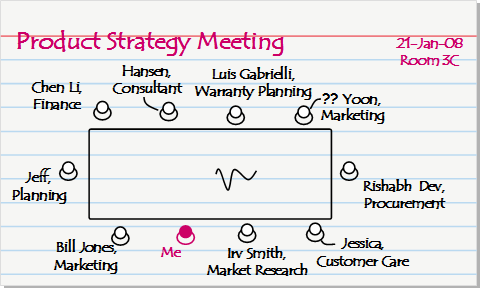
Ever wonder how a waiter/waitress serving an eight-seat table at a restaurant remembers each guest’s food orders? At many restaurants, the order-sheets contain a layout of the table and a letter or number associated with every seat. As each guest orders food, the waiter/waitress writes down the order along with the letter or number associated with that guest’s seat.

At Southwest Airlines, flight attendants go to every seat, ask customers for their choice of beverage, and record the passenger’s choice on a seat-map.

Remembering Names around a Table at a Meeting

Blogger Adam Gurno presents an extension of the two practices listed above for remembering names around a table at a meeting.

  1. Draw a quick map of the table/layout of the meeting. Place yourself on it, to give yourself a reference point.
  2. As people introduce themselves around the table, fill them in. If you feel last names are necessary add those too, but don’t do it at the expense of writing down someone else’s name. You can guess at the last names later. If you miss one, leave it blank and fill it in as soon as you can – if someone else refers to them, etc, etc.
  3. If everyone introduces themselves, try and jot down as much information as possible. If you think that you will run across them later, include information that will help you recognize them down the road.
  4. Refer back to the map during the meeting when you are going to need to speak. This way you will be prepared with a person’s name.

Positive impressions are invaluable. As we discussed in a previous blog article, remembering names is an important social skill—mastering this skill can offer a distinct advantage in networking and building relationships.

Wondering what to read next?

  1. Dining Out: Rule of Six
  2. How to … Gracefully Exit a Conversation at a Party
  3. Stop asking, “What do you do for a living?”
  4. Unlock the Power of Communication: Start with the End in Mind!
  5. Never Give a Boring Presentation Again

Filed Under: Sharpening Your Skills Tagged With: Etiquette, Meetings, Networking

An Essential Secret of Great Speakers: Pauses in Talking

November 1, 2007 By Nagesh Belludi Leave a Comment

Seven Steps to Better Presentations

Jeffrey Veen of Adaptive Path, and now, Google, lists seven steps for better presentations here. Here is a summary.

  1. Tell stories
  2. Show picture and use good metaphors
  3. Don’t apologize for something out of order or for a mistake.
  4. Start strong
  5. End strong too
  6. Stand away from the podium and out from behind the presenter table
  7. Pause while speaking

Pausing While Speaking

Often, speakers and presenters talk quickly—sometimes to an extent that the audience cannot clearly understand the speakers’ words. Perhaps these speakers are nervous. Or, they may be excited about their speeches and hence, are in a rush to express their ideas.

An effective speaker uses lots of pauses in speeches. By pausing after important segments along a speech, a speaker can gather his/her thoughts. And, the audience gets a chance to absorb the contents of the speech.

On the other hand, some speakers tend to be slow, especially if they are contemplative. These speakers quickly lose the attention of the audience.

How to Improve Pausing in Speaking

  1. While listening to radio or watching television, observe the speeches of newsreaders, stand-up comedians, broadcasters or background-narrators. Observe how they pause along their talking.
  2. Choose a few newspaper- or magazine-articles and read them out aloud as you would in a speech. At each punctuation mark—a comma, period, semicolon, etc., —pause before you proceed to the next phrase or sentence. Record your speech on a tape-recorder or on your computer (use Audacity software, a freeware) and review.
  3. As you prepare for an important presentation or speech, write down the entire text of your speech with plenty of punctuations. Practice your speech, record and review.

Concluding Thoughts

Audiences typically remember a very small portion of what they hear in speeches and presentations. By using plenty of pauses and pacing yourself, you can improve your ability to articulate and help your audience appreciate your thoughts.

Wondering what to read next?

  1. Unlock the Power of Communication: Start with the End in Mind!
  2. Presentation Skills #4: On Handouts
  3. Avoid the Lectern in Presentations
  4. Jargon Has Its Place in Business Communication
  5. A Little-Known Public-Speaking Tip

Filed Under: Effective Communication Tagged With: Meetings, Networking, Presentations

Ethel Romm on Building Consensus

April 1, 2007 By Nagesh Belludi Leave a Comment

Building Consensus for Decision-making

Ethel Grodzins Romm was the President and CEO of NITON Corporation, a maker of scientific equipment. NITON is currently part of Thermo Fisher Scientific (NYSE: TMO.) Ethel is an accomplished engineer, entrepreneur and author.

Guy Kawasaki features Ethel Romm in his book ‘Hindsights: The Wisdom and Breakthroughs of Remarkable People.’ In her interview for this book, Ethel emphasizes the need for leaders to build consensus instead of enforcing their will.

Ethel Romm on Building Consensus

“Business is a garden of forked paths, and when we can’t agree on which one to take, then I make the call. There are occasions when you have to say, ‘I’m the president, and it’s got to go this way,’ but that’s the weakest appeal of all.”

“If it’s everybody’s decision—if everyone has helped to make it, or talked you out of something—then we’re all rowing together. Bosses say, ‘Go!’; leaders say, ‘Let’s go!'”

Sometimes, it is difficult for managers “to see why or how they are inefficient. They believe that they are succeeding—after all, nobody mutinies. They fail to understand that when you are the boss, everyone salutes you and follows your orders, regardless of your personality.”

“Thus, they are misled into believing that their meanness or callousness is keeping everyone in line. They can easily get the idea that if they don’t command, control, and coerce, the place will fall apart. The feedback is all wrong.”

Call for Action

Building Consensus for Decision-making Quite often, members of a team may realize that they have very little influence on the decision-making process and withdraw from active participation. However, the team buy-in on the decision to ensure prompt follow-up on expected contributions. Building consensus as part of the decision-making process, therefore, is one of the core team skills—for team members and team leaders.

Listen to every idea offered during a team conversation. Do not ignore or sidestep any ideas or concerns. Do not criticize or show objection. Instead, seek clarifications and discuss: “That is a great idea. And, one of the challenges we will face is…. How shall we work around that? What if we modify…? How about…?” Differences of opinion are natural and expected. Work on reaching decisions by building on the agreements.

As Dwight Eisenhower said, “Pull the string, and it will follow wherever you wish. Push it, and it will go nowhere at all.

Wondering what to read next?

  1. How to Stop “Standing” Meetings from Clogging Up Your Time
  2. Books in Brief: The Power of Introverts
  3. The Right Way to End a Meeting
  4. How to … Gracefully Exit a Conversation at a Party
  5. The Curse of Teamwork: Groupthink

Filed Under: Managing People Tagged With: Meetings

Presentation Skills #4: On Handouts

March 22, 2007 By Nagesh Belludi 1 Comment

Handouts or takeaways can enhance the core content of a presentation or speech and serve as sources of information for reference and recall. Here are a few guidelines to consider for distributing handouts.

  • As a general guideline, do not distribute handouts prior to a presentation if the audience is likely to become absorbed in the handouts and ignore your verbal presentation. For instance, if you are training college students on interviewing skills, consider distributing your handouts after the seminar.
  • When the audience is likely to be more serious or needs to study charts or illustrations to participate meaningfully, do distribute your handouts before commencing your presentation. Your audience can follow along your verbal presentation and make notes on the handouts.

Handouts for Pre-reading

Quite often, handouts may also serve as pre-reading material to help the audience study the content beforehand and prepare for your presentation. Suppose that you will lead a presentation for approval of a new steering wheel design. If you distribute a PowerPoint file with illustrations and key features of your new design, the electronics, dashboard, manufacturing and assembly teams can review your design ahead of time. This facilitates brainstorming and informed decision-making during the design approval presentation.

Survey your Audience

Survey the audience prior to your presentation. Depending on the nature of your audience and the purpose of your interaction, distribute handouts when appropriate.

Wondering what to read next?

  1. Unlock the Power of Communication: Start with the End in Mind!
  2. An Essential Secret of Great Speakers: Pauses in Talking
  3. Never Give a Boring Presentation Again
  4. Why They Don’t Understand You and What to Do About It
  5. Jargon Has Its Place in Business Communication

Filed Under: Effective Communication Tagged With: Meetings, Networking, Presentations

Unlock the Power of Communication: Start with the End in Mind!

February 12, 2007 By Nagesh Belludi 1 Comment

How can you ensure your message hits the mark when you’re about to deliver a speech, prepare a presentation, write a report, draft a résumé, or compose an email? The secret lies in a simple yet powerful technique: beginning at the end.

Instead of diving straight into the content, take a moment to step into the shoes of your recipients or audience. Shift your perspective and view your communication from the outside in. To kickstart this process, ask yourself a series of intriguing questions about the outcome you desire. Don’t hold back—jot down every potential outcome that comes to mind without filtering or limiting your creativity.

Let’s say you’re gearing up for a captivating speech. Picture yourself standing before your audience and delve into their minds. Who are they? What burning questions do they have? What nuggets of knowledge or insights will truly resonate with them? Envision the impact you want to make. What do you hope your listeners will take away from your speech? What action do you want them to take after hearing your words?

Once you’ve gathered a rich array of intended outcomes, it’s time to prioritize and distill the essence of your message. Zero in on the core conclusions you wish to convey to your audience. This is where the magic happens. Now, take a step back and embark on a journey backward. Begin assembling your ideas, anecdotes, and compelling statistics that bolster your conclusions. Weave them into a seamless tapestry of thoughts that guide your audience to those pivotal “aha” moments.

By starting with the end in mind, you gain a distinct advantage—a great perspective that empowers you to shape the direction of your thoughts as you prepare your communication. This approach allows you to discard ideas that don’t align with your desired messages, enabling you to deliver a focused and impactful presentation.

Idea for Impact: communication is an art that revolves around your audience. When you begin at the end, you effectively zero in on the messages you want to convey to your listeners or readers. It’s like fine-tuning a symphony, ensuring every note strikes a chord in their hearts and minds.

Wondering what to read next?

  1. Never Give a Boring Presentation Again
  2. What Happens When You Talk About Too Many Goals
  3. Avoid the Lectern in Presentations
  4. Jargon Has Its Place in Business Communication
  5. A Little-Known Public-Speaking Tip

Filed Under: Effective Communication Tagged With: Communication, Etiquette, Meetings, Networking, Presentations

« Previous Page
Next Page »

Primary Sidebar

Popular Now

Anxiety Assertiveness Attitudes Balance Biases Coaching Conflict Conversations Creativity Critical Thinking Decision-Making Discipline Emotions Entrepreneurs Ethics Etiquette Feedback Getting Along Getting Things Done Goals Great Manager Innovation Leadership Leadership Lessons Likeability Mental Models Mindfulness Motivation Parables Performance Management Persuasion Philosophy Problem Solving Procrastination Psychology Relationships Simple Living Social Skills Stress Suffering Thinking Tools Thought Process Time Management Winning on the Job Wisdom

About: Nagesh Belludi [hire] is a St. Petersburg, Florida-based freethinker, investor, and leadership coach. He specializes in helping executives and companies ensure that the overall quality of their decision-making benefits isn’t compromised by a lack of a big-picture understanding.

Get Updates

Signup for emails

Subscribe via RSS

Contact Nagesh Belludi

RECOMMENDED BOOK:
The Power of a Positive No

The Power of a Positive No: William Ury

Harvard's negotiation professor William Ury details a simple, yet effective three-step technique for saying 'No' decisively and successfully, without destroying relationships.

Explore

  • Announcements
  • Belief and Spirituality
  • Business Stories
  • Career Development
  • Effective Communication
  • Great Personalities
  • Health and Well-being
  • Ideas and Insights
  • Inspirational Quotations
  • Leadership
  • Leadership Reading
  • Leading Teams
  • Living the Good Life
  • Managing Business Functions
  • Managing People
  • MBA in a Nutshell
  • Mental Models
  • News Analysis
  • Personal Finance
  • Podcasts
  • Project Management
  • Proverbs & Maxims
  • Sharpening Your Skills
  • The Great Innovators

Recently,

  • Finding Joy in Everyday Moments: Book Summary of Cyndie Spiegel’s ‘Microjoys’
  • Beware the Dangerous Romance of Rebellion
  • The Fallacy of Outsourced Sin: The Cow Paradox in India
  • Inspirational Quotations #1151
  • Don’t Ruin Your Brilliant Idea by Talking About It
  • Gandhi’s Wheel, Apple’s Spin: The Paradox of Apple’s ‘Think Different’ Campaign
  • Book Summary: Hadley Freeman’s ‘Life Moves Pretty Fast’—How ’80s Movies Wrote America’s Story

Unless otherwise stated in the individual document, the works above are © Nagesh Belludi under a Creative Commons BY-NC-ND license. You may quote, copy and share them freely, as long as you link back to RightAttitudes.com, don't make money with them, and don't modify the content. Enjoy!