• Skip to content
  • Skip to primary sidebar

Right Attitudes

Ideas for Impact

Authenticity

Sadness Isn’t a Diagnosis

April 10, 2026 By Nagesh Belludi Leave a Comment

Situational Sadness and Medicalization of Grief Most people know what it feels like to be knocked sideways by life. A disappointment, a loss, a stretch where nothing seems to go right. There’s a temptation to give it a clinical name, to call it depression, because a diagnosis makes the feeling seem containable—something with edges that can be treated and resolved.

Sadness and depression aren’t the same thing, and collapsing the distinction doesn’t help either condition. Sadness is proportionate and traceable. It has a cause, and it lifts as circumstances shift or time passes. Depression doesn’t follow that logic. It’s persistent, often causeless, and resistant to the things that normally restore equilibrium.

That distinction matters more than it might seem. When ordinary sadness gets labelled as illness, it erodes the resilience that carries people through hard periods. Deciding you’re unwell changes how you respond—you’re less likely to stay functional, less likely to grieve cleanly, more likely to treat every difficult feeling as a symptom requiring management rather than an experience requiring time.

Acknowledging sadness for what it is takes honesty. It means accepting discomfort without inflating it, and recognising that feeling low after something painful isn’t a malfunction. It’s the appropriate response to a difficult experience.

Not everything that hurts is a disorder. Sometimes it’s just life, and the way through it is forward.

Wondering what to read next?

  1. Therapeutic Overreach: Diagnosing Ordinary Struggles as Disorders
  2. Should You Read a Philosophy Book or a Self-Help Book?
  3. Blame Your Parents for Your Current Problems?
  4. The Best Way To Change Is To Change Your Behavior First
  5. Therapy That Reopens Wounds is Not Healing but Harm

Filed Under: Health and Well-being, Living the Good Life, Mental Models Tagged With: Authenticity, Emotions, Meaning, Psychology, Resilience, Therapy, Wellbeing

The Only Cure for Imposter Syndrome Is Evidence

April 3, 2026 By Nagesh Belludi Leave a Comment

The Only Cure for Imposter Syndrome Is Evidence Imposter syndrome has a specific texture. It’s not ordinary self-doubt—it’s the persistent fear of being found out. That despite the title, the track record, the results, something is undeserved, and sooner or later someone will notice.

The only way through it is evidence, gathered honestly.

Look back at the last year or two with a specific question: where did you demonstrate real ability, and where did sustained effort produce something worthwhile? Not a general sense of having worked hard, but concrete instances—the project that succeeded, the problem you solved, the moment someone relied on your judgment and it held up. These are data points, and they’re useful precisely because they’re verifiable.

That evidence does two things. It builds a credible account of your own competence, and dismantles the hidden assumptions that imposter syndrome runs on. Those assumptions rarely survive contact with a clear-eyed record of what you’ve actually done.

The goal isn’t uncritical self-confidence. There’s almost always room to improve, and acknowledging that is part of what makes the exercise credible. The point is to hold two things simultaneously: justifiable pride in what you’ve earned, and enough humility to keep improving.

Idea for Impact: Imposter syndrome fades when the evidence outweighs the feeling. So build the evidence.

Wondering what to read next?

  1. Your time is far from being wasted!
  2. Risk More, Risk Earlier
  3. The Setting Shapes the Story
  4. Wide Minds, Bright Ideas: Book Summary of ‘Range: Why Generalists Triumph’ by David Epstein
  5. Optionality is the Ultimate Hack

Filed Under: Career Development, Mental Models, Sharpening Your Skills Tagged With: Authenticity, Confidence, Personal Growth, Productivity, Psychology, Skills for Success, Thinking Tools

Values Are Easier to Espouse Than to Embody: Howard Schultz Dodges the Wealth Tax

March 13, 2026 By Nagesh Belludi Leave a Comment

Howard Schultz Leaves Washington Over Wealth Tax For Florida Yet another rich guy is fleeing a Democrat-controlled state over a new wealth tax. Starbucks founder Howard Schultz has announced he’s leaving Washington for Miami, just hours after lawmakers advanced a bill targeting residents earning over $1 million per year.

The irony is hard to miss: the man who sold us overpriced coffee now finds the tax bill too bitter to swallow.

This episode reveals a tension between values and their embodiment. Authenticity, after all, isn’t consistency of behavior but consistency of motive. Schultz may genuinely wish for equality, but not at the expense of his autonomy. And the rhetoric of social justice, it turns out, is far easier to tolerate when it’s someone else’s pocket being picked.

When public-facing values collide with private incentives, the resulting “exit” reveals something philosophically honest: even the most liberal-leaning icons often view capital as a tool they, rather than the government, are best equipped to deploy. The move to Florida isn’t just about money. It’s a vote for autonomy over how wealth is used.

There’s a name for this: Moral Licensing. When individuals believe they’ve “done enough” through public advocacy or charitable foundations, they feel entitled to act in their own interest elsewhere. Public advocacy creates a psychological surplus that justifies private retreat. Schultz’s mind balances the scales with a simple rationale: I’ve given enough.

Idea for Impact: This isn’t a tidy moral tale but a reminder that humans are allergic to compulsion. The liberal dream of redistribution collides with the liberal instinct for self-preservation. Schultz’s move is less hypocrisy than evidence that values are easier to espouse than to embody.

Wondering what to read next?

  1. Virtue Deferred: Marcial Maciel, The Catholic Church, and How Institutions Learn to Look Away
  2. Why Groups Cheat: Complicity and Collusion
  3. The Enron Scandal: A Lesson on Motivated Blindness
  4. Making Exceptions “Just Once” is a Slippery Slope
  5. Ethics Lessons From Akira Kurosawa’s ‘High and Low’

Filed Under: Business Stories, Great Personalities, Living the Good Life Tagged With: Authenticity, Conviction, Entrepreneurs, Ethics, Integrity, Mental Models, Money, Motivation, Politics, Psychology, Values

Lessons from Dwight Eisenhower: Authentic Leaders Demonstrate Accountability

February 9, 2016 By Nagesh Belludi Leave a Comment

In a previous article about how you can control just your efforts and not the outcomes of those efforts, I detailed Dwight Eisenhower’s weather-induced dilemma on the eve of the Allied invasion of Normandy in June 1944.

The Success of the Normandy Invasion Was Not Entirely in Eisenhower’s Control

Despite a year of intense planning and preparation under Eisenhower’s leadership, the Allied invasion’s success ultimately depended on the weather across the English Channel. Their landings hinged on suitable weather—something entirely beyond their control.

Eisenhower tentatively planned to send his troops across the English Channel on 5-June. On 4-June, however, the troops predicted cloudy skies, rain, and heavy seas that threatened the invasion. Although the following day’s weather was not necessarily ideal, it was comparatively more suitable than the 5-June, so Eisenhower postponed the invasion by a day. If he did not invade on 6-June, the tides would not favor an invasion for another two weeks, which would possibly give the Germans enough time to get wind of the Allies’ plan.

Early in the morning of 5-June, Eisenhower gathered his advisers’ and military officers’ opinions on whether to launch the attack despite the less-than-suitable weather. He sat quietly in deep contemplation. One of his advisers later recalled, “I never realized before, the loneliness and isolation of a commander at a time when such a momentous decision has to be taken, with full knowledge that failure or success rests on his judgment alone.”

After five minutes, Eisenhower gazed at his advisers and said, “Well, we’ll go!”

With those words, Eisenhower launched the D-Day invasion of Europe on 6-June. After issuing those marching orders, events passed from Eisenhower’s control. He then realized that the invasion’s success was no longer in his hands. Its outcome depended on 160,000 allied troops, thousands of commanders, and hundreds of lieutenants. Eisenhower had done everything in his power to coordinate their efforts and create conditions conducive to the mission’s success. After issuing his orders, all he could do was let those conditions come to fruition on their own terms. After all his efforts, he could not control the outcomes—he let go of the outcomes.

An Authentic Leader in Action: Eisenhower’s Character, Responsibility, & Accountability

That evening, on his way to visit American and British paratroopers (pictured above) who were headed into battle that night, Eisenhower told his driver, “I hope to God I’m right.”

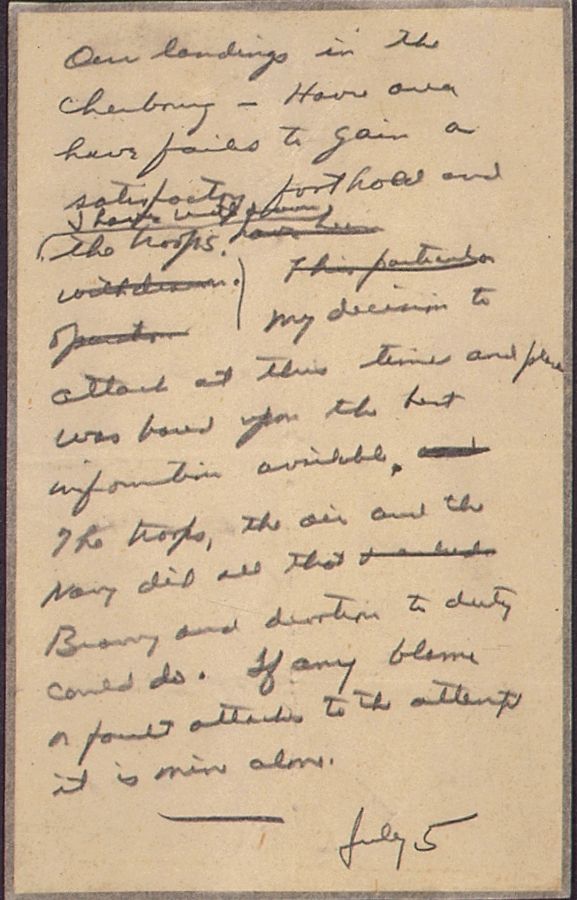
Just before he went to bed at night, Eisenhower scribbled a note and tucked it into his wallet. He thought he would use this letter if the invasion went wrong. (Eisenhower mistakenly dated the note July 5 instead of June 5.)

Our landings in the Cherbourg-Havre area have failed to gain a satisfactory foothold and I have withdrawn the troops. My decision to attack at this time and place was based upon the best information available. The troops, the air and the Navy did all that bravery and devotion to duty could do. If any blame or fault attaches to the attempt it is mine alone.

Dwight Eisenhower's note to use if the Normandy Invasion went wrong, 5-June-1945

Observe that Eisenhower crossed out “This particular operation” and wrote “My decision to attack.” This demonstrates Eisenhower’s assertive and responsible leadership in action. He wrote, “any blame or fault … is mine alone” and underscored the phrase “mine alone.” He did not use passive language or try to camouflage failure with phrases like, “as fate would have had it,” “unaccommodating weather,” “forecast not met,” “mistakes were made,” or “we tried really hard, but ….”

Eisenhower was an authentic leader in action—a leader who was ready and willing to accept unshrinking responsibility for his actions and their results.

Eisenhower won his wager with the weather. The invasion of Normandy was successful and proved to be a turning point in World War II. Eisenhower never used the note he had prepared on the eve of the attack. It is now on display at Dwight D. Eisenhower Library and Museum in Abilene, Kansas.

Authentic Leaders Demonstrate Accountability

As exemplified by Dwight Eisenhower’s leadership as the Supreme Allied Commander during World War II, authentic leaders recognize the accountability that comes with their roles. They accept absolute responsibility for the expected outcomes—both good and bad—no matter what the situation is. They don’t blame unfavorable circumstances, the external environment, employees, superiors, customers, or anybody else.

Wondering what to read next?

  1. Moral Self-Licensing: Do Good Deeds Make People Act Bad?
  2. The Cost of Leadership Incivility
  3. One of the Tests of Leadership is the Ability to Sniff out a Fire Quickly
  4. A Sense of Urgency
  5. Power Corrupts, and Power Attracts the Corruptible

Filed Under: Leadership, Sharpening Your Skills Tagged With: Attitudes, Authenticity, Character

Primary Sidebar

Popular Now

Anxiety Assertiveness Attitudes Balance Biases Coaching Conflict Conversations Creativity Critical Thinking Decision-Making Discipline Emotions Entrepreneurs Etiquette Feedback Getting Along Getting Things Done Goals Great Manager Innovation Leadership Leadership Lessons Likeability Mental Models Mindfulness Motivation Networking Parables Performance Management Persuasion Philosophy Problem Solving Procrastination Psychology Relationships Simple Living Social Skills Stress Suffering Thinking Tools Thought Process Time Management Winning on the Job Wisdom

About: Nagesh Belludi [hire] is a St. Petersburg, Florida-based freethinker, investor, and leadership coach. He specializes in helping executives and companies ensure that the overall quality of their decision-making benefits isn’t compromised by a lack of a big-picture understanding.

Get Updates

Signup for emails

Subscribe via RSS

Contact Nagesh Belludi

RECOMMENDED BOOK:
Tap Dancing to Work

Tap Dancing to Work: Warren Buffett

Insights into Warren Buffett's investment strategies and his philosophies on management, philanthropy, public policy, and even parenting. Articles by Carol Loomis, Bill Gates, and others.

Explore

  • Announcements
  • Belief and Spirituality
  • Business Stories
  • Career Development
  • Effective Communication
  • Great Personalities
  • Health and Well-being
  • Ideas and Insights
  • Inspirational Quotations
  • Leadership
  • Leadership Reading
  • Leading Teams
  • Living the Good Life
  • Managing Business Functions
  • Managing People
  • MBA in a Nutshell
  • Mental Models
  • News Analysis
  • Personal Finance
  • Podcasts
  • Project Management
  • Proverbs & Maxims
  • Sharpening Your Skills
  • The Great Innovators

Recently,

  • Inspirational Quotations #1149
  • Sadness Isn’t a Diagnosis
  • Optionality is the Ultimate Hack
  • Life Isn’t Fair, Nor Does It Pretend To Be: What ‘Tokyo Story’ Teaches Us About Disappointment
  • Inspirational Quotations #1148
  • The Only Cure for Imposter Syndrome Is Evidence
  • The Inopportune Case of the Airbus A340 Aircraft: When Tomorrow Left Yesterday Behind

Unless otherwise stated in the individual document, the works above are © Nagesh Belludi under a Creative Commons BY-NC-ND license. You may quote, copy and share them freely, as long as you link back to RightAttitudes.com, don't make money with them, and don't modify the content. Enjoy!