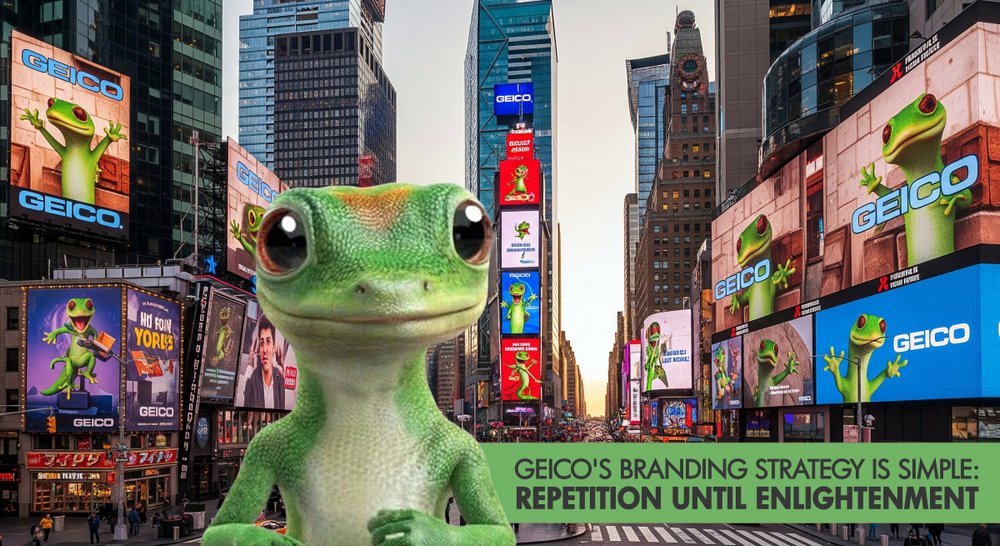
GEICO is renowned for its relentless and quirky advertising. Its auto insurance campaigns feature a memorable, rotating cast of mascots, most famously a talking gecko with a British accent proclaiming the catchy “15% in 15 minutes.” Also prominent are a group of cavemen, hilariously offended by the notion that buying insurance is “so easy, even a caveman could do it,” and a cheerful camel celebrating Hump Day. These ads are everywhere: television, radio, online—even pre-rolls before YouTube videos. The repetition isn’t accidental—it’s strategic. GEICO has laced its brand into consumers’ consciousness by brute repetition. We’re not so much convinced by GEICO as held hostage by its consistency. And it works. We know them. We might even trust them—begrudgingly.
That’s a prime example of the Mere Exposure Effect. Coined by psychologist Robert Zajonc, this mental model describes the human tendency to prefer things simply because we’ve encountered them before. It’s a cognitive shortcut: familiarity breeds comfort, and comfort breeds trust—not because the thing is better, but because it’s known.
Exposure: The Unseen Influence
Consider also the example of Empire Today, a company that sells installed carpet, hardwood, and vinyl flooring. But what it sells most effectively is its phone number. “800-588-2300 Empire Today!” is a jingle that’s been broadcast across U.S. television and radio since the 1970s. It’s not catchy in the traditional sense. It’s simply repeated so often that it becomes part of the mental wallpaper. We don’t need to know what Empire does to know how to reach them. That’s the power of exposure.
 McDonald’s has long leaned on jingles like “I’m Lovin’ It,” which, while not musically profound, have been repeated for decades. This repetition creates emotional anchoring. We associate the tune with the brand, and that association influences behavior. Ba-da-ba-ba-ba.
But repetition is a blade that dulls quickly. When exposure becomes saturation, we turn away. The trick is knowing when to stop before we reach for the mute button. This effect isn’t limitless—it’s a tightrope.
And it doesn’t just live in advertising. It’s stitched into daily life. We reach for the song we’ve played thirty times because it feels safe. We favor faces we recognize in crowds because unfamiliarity feels like risk. Familiarity smooths the world’s sharp edges. We call it instinct, but often it’s just recall with better PR.
How Repetition Rewires Your Preferences
We’re drawn not only to the thing itself, but to its repetition, its stability. Something consistent across time and place—same colors, same voice, same message—feels trustworthy. And when others start echoing that message, the effect deepens. Exposure transforms into consensus, and suddenly what’s familiar becomes what’s “right.”
We don’t choose what we like as much as we think. We gravitate toward what we’ve seen, heard, and scrolled past enough times for our brains to say, “Sure, why not.” The Mere Exposure Effect doesn’t shout—it accumulates. And by the time we realize how much it’s shaped our tastes, we’ve already bought in.
Idea for Impact: Familiarity breeds trust, often without scrutiny. Over-familiarity channels the lazy mind. We stop questioning not when we’re convinced, but when we’re accustomed.
.jpg "'Open An Autobiography' by Andre Agassi (ISBN 0307388409)")
 Agassi casts himself as a victim of his circumstances, expressing a weariness with the grind—a sentiment many can relate to. While few may hate their jobs
  We tend to see
  Watch out for anyone who demands you jump through hoops just to be treated with basic decency.
 Marketers have adapted this insight with varying degrees of boldness. Dove, the personal care brand under Unilever, redefined beauty norms by spotlighting authenticity. Its
  Yet the Pratfall Effect
  Ask anyone who has ever written something that actually worked—a punchy social post, a compelling blog entry, a persuasive ad, or even a user manual that finally made sense—and they’ll tell you: it didn’t begin with confidence or inspiration. It started with motive.
  There’s a peculiar cruelty in the well-meant, the kind that cloaks harm in sentiment and justifies injury with declarations of virtue.
 Recent news of Carnival Cruise Group’s decision to ban two “influencers” after a run of negative reviews has sparked a
 It’s heartening to see Steve Ballmer and Bill Gates