• Skip to content
  • Skip to primary sidebar

Right Attitudes

Ideas for Impact

Search Results for: sam walton

Books I Read in 2015 & Recommend

December 23, 2015 By Nagesh Belludi Leave a Comment

In addition to a number of Rick Steves’ and Lonely Planet books for my summer-long travels across Europe, here are a few books that I read in 2015 and recommend.

  • Biography / Business: Brad Stone’s The Everything Store: Jeff Bezos and the Age of Amazon is an engrossing chronicle of the obsessive hard-driving personality of its founder-CEO and the company that has played the pivotal role in the shift from brick-and-mortar retail to online retail.
  • 'Onward: How Starbucks Fought for Its Life without Losing Its Soul' by Howard Schultz, Joanne Gordon (ISBN 1609613821)Biography / Leadership: Starbucks founder Howard Schultz’s Onward: How Starbucks Fought for Its Life without Losing Its Soul is an interesting depiction of Starbucks’ turnaround after Schultz returned as CEO in 2008. Read Onward for a case study of the founder’s syndrome in action and a self-congratulatory portrait of a charismatic entrepreneur and brilliant corporate cheerleader. Read my summary.
  • Biography / Business: Ashlee Vance’s Elon Musk: Tesla, SpaceX, and the Quest for a Fantastic Future is a biography of America’s current most audacious entrepreneur and Silicon Valley’s most prominent innovator. While the book details Musk’s bold leadership decisions, it also serves as a great reminder of how an extreme personality and intense success are not without their costs. Read my comments.
  • Decision-Making: Phil Rosenzweig’s Left Brain Right Stuff delineates distinct but complementary skills required for making winning decisions: logical analysis and calculation (left brain skills) and as well as the willingness to take risks, push boundaries, and go beyond what has been done before (right brain skills.)
  • 'Surely You're Joking, Mr. Feynman!' by Richard Feynman, Ralph Leighton (ISBN 0393316041)Biographies / Mental Models: Physicist and Nobel Laureate Richard Feynman’s scientific curiosity knew no bounds. His academic life, acuity, life-philosophy, and ability to communicate science are inspirational to anyone pursuing his/her own life’s fulfillment. The following biographies capture his many scientific achievements, playfulness, varied interests and hobbies, and—perhaps most notably—his many eccentricities.
    • Surely You’re Joking
    • What Do You Care What Other People Think
    • Genius Richard Feynman
    • The Pleasure of Finding Things Out
  • 'Sam Walton: Made In America' by Sam Walton (ISBN 0553562835)Biography / Business: Sam Walton’s bestseller autobiography Made in America is very educational, insightful, and stimulating. Walton inspired legions of other entrepreneurs who thrive on managing costs and prices to gain competitive advantage. Read about an important lesson from this book about cost and price as a competitive advantage.
  • Decision-Making: Suzy Welch’s 10-10-10 Rule advocates considering the potential positive and negative consequences of all decisions in the immediate present, the near term, and the distant future: or in 10 minutes, 10 months, and 10 years. Read my summary.
  • Biography / Mental Models: Walter Isaacson’s A Benjamin Franklin Reader is an excellent collection of the writings of Benjamin Franklin, one of America’s most beloved founding fathers. Franklin was a polymath renowned for his lifelong quest for self-improvement.
  • 'The Art of Stillness: Adventures in Going Nowhere' by Pico Iyer (ISBN 1476784728)Philosophy: Pico Iyer’s The Art of Stillness argues the importance of taking a timeout from busyness. Iyer contends, “In an age of speed … nothing could be more invigorating than going slow. In an age of distraction, nothing could feel more luxurious than paying attention.” Read my summary.
  • Biographies / Art / Philosophy: Steven Naifeh and Gregory Smith’s Van Gogh: The Life and Michael Howard’s Van Gogh: His Life & Works in 500 Images paint a vivid picture of the artistic genius and the troubled personal life of Vincent van Gogh. Ever Yours is an absorbing anthology of correspondence between Vincent and his brother Theo. Ever Yours sheds light on Vincent’s shifting moods, turbulent life, and philosophical evolution as an artist.
  • Management: Ken Blanchard and Spencer Johnson’s One Minute Manager is a best-selling introductory business book about goal-setting and giving feedback. Read my summary.
  • Biographies: Tenzing Norgay’s autobiography Man of Everest and Yves Malartic’s Tenzing of Everest portray the personal triumph of a poor and illiterate but ambitious, deeply religious explorer.

On a related note, read my article about reading hacks: How to Process that Pile of Books You Can’t Seem to Finish. Also see books I read in 2014 & recommend.

Filed Under: Leadership Reading, Sharpening Your Skills Tagged With: Books for Impact, Skills for Success

What Opportunities Are You Overlooking?

October 13, 2015 By Nagesh Belludi Leave a Comment

What Opportunities Are You Overlooking?

In 1975, a young Bill Gross, now America’s most prominent bond-focused mutual fund manager, passed up two opportunities to invest in businesses that would later become two of the world’s most prominent companies.

'The Four Filters Invention of Warren Buffett and Charlie Munger' by Bud Labitan (ISBN B001U3YK9S) Gross turned down two “smart and intelligent” men who approached his PIMCO fund for a $10 million loan for their textile business. “It seemed like a funny company, had a dilapidated industrial complex in the Northeast, a See’s Candies store … Blue Chip Stamps … not much else,” Gross later remembered of not being impressed by the applicants’ prospects. The two men, Warren Buffett and Charlie Munger, built their textile company, Berkshire Hathaway, into one of the largest companies in the world. In 2008, Buffett became the world’s wealthiest person.

'Sam Walton: Made In America' by Sam Walton (ISBN 0553562835) The following week in 1975, Bill Gross visited an entrepreneur named Sam Walton in Bentonville, Arkansas. Walton, then in his late-fifties, had sought a loan from PIMCO to expand his family-run discount store. Walton was renowned for his frugal lifestyle and his crusade to cut costs. Walton and his two sons received Gross at the airport in an old pickup truck. Gross later recalled turning Walton down based on appearances: “[They] would drive me around town and show me the Walmart, all the while with their dog named Dan … they’d yell, ‘Get ’em, Dan, get ’em, Dan,’ when a dog or cat would cross the street … [Walton and his sons] seemed like very high character, reputable people, but the store and idea were [not very impressive.]” By the time Sam Walton passed away in 1992, he had built Walmart into a formidable retailer and had become the world’s wealthiest man.

Parenthetically, two weeks later in 1975, Gross lent $5 million to a rail-car leasing company called Itel after visiting the company’s headquarters in a high-rise building and being impressed, among other things, by thick carpets and “good looking secretaries.” Itel went bankrupt six months after Gross made the loan.

Reflecting upon these experiences, Gross recalled a famous remark made in 1912 by legendary financier J. P. Morgan: that credit lending should be based not on wealth, but on character.

Idea for Impact: What Could You Regret?

While in hindsight it’s easy to empathize with Gross’s regret of missing the opportunities to invest early in Berkshire Hathaway and Walmart and his overlooking the character and promise of their entrepreneurs, it’s difficult to comprehend how Gross could have then objectively predicted the enormous potential in either company.

Narratives of such missed opportunities, though, should make you wonder what opportunities you could be overlooking today that months, years, or decades from now, you could come to regret with the perspective that comes with time or upon mature reflection.

Filed Under: Sharpening Your Skills Tagged With: Biases, Regret

Inspirational Quotations #597

September 13, 2015 By Nagesh Belludi Leave a Comment

Maxim for life: You get treated in life the way you teach people to treat you.
—Wayne Dyer (American Motivational Writer)

Let flattery, the handmaid of the vices, be far removed.
—Cicero (Roman Philosopher)

I have always been driven to buck the system, to innovate, to take things beyond where they’ve been.
—Sam Walton (American Entrepreneur)

Constant exposure to dangers will breed contempt for them.
—Seneca the Younger (Lucius Annaeus Seneca) (Roman Philosopher)

It is better to do the most trifling thing in the world than to regard half an hour as trifle.
—Johann Wolfgang von Goethe (German Poet)

Wisdom, compassion, and courage are the three universally recognized moral qualities of men.
—Confucius (Chinese Philosopher)

The value of an idea has nothing whatever to do with the sincerity of the man who expresses it.
—Oscar Wilde (Irish Poet)

Anger will never disappear so long as thoughts of resentment are cherished in the mind. Anger will disappear just as soon as thoughts of resentment are forgotten.
—Buddhist Teaching

Our dependence outweighs our independence, for we are independent only in our desire, while we are dependent on our health, on nature, on society, on everything in us and outside us.
—Henri Frederic Amiel (Swiss Philosopher)

I have full cause of weeping, but this heart shall break into a hundred thousand flaws or ere I’ll weep.
—William Shakespeare (British Playwright)

The soul contains the event that shall befall it, for the event is only the actualization of its thoughts; and what we pray to ourselves for is always granted.
—Ralph Waldo Emerson (American Philosopher)

Filed Under: Inspirational Quotations

Inspirational Quotations #555

November 23, 2014 By Nagesh Belludi Leave a Comment

Vigilance in watching opportunity; tact and daring in seizing upon opportunity; force and persistence in crowding opportunity to its utmost of possible achievement—these are the martial virtues which must command success.
—Austin Phelps (American Presbyterian Clergyman)

You begin by always expecting good things to happen.
—Tom Hopkins (English Sportsperson)

Success is the satisfaction of feeling that one is realizing one’s ideal.
—Anna Pavlova (Russian Dancer)

I have been true to the principles of nonviolence, developing a stronger and stronger aversion to the ideologies of both the far right and the far left and a deeper sense of rage and sorrow over the suffering they continue to produce all over the world.
—Joan Baez (American Singer)

After a certain point, money is meaningless. It ceases to be the goal. The game is what counts.
—Aristotle Onassis (Greek Businessperson)

Thinking begins only when we have come to know that reason, glorified for centuries, is the stiff-necked adversary of thought.
—Martin Heidegger (German Existential Philosopher)

First health, then wealth, then pleasure, and do not owe anything to anybody.
—Catherine II of Russia (Russian Empress)

All business proceeds on beliefs, or judgments of probabilities, and not on certainties.
—Charles William Eliot (American Educator)

Your best teacher is your last mistake.
—Ralph Nader (American Activist)

My idea of education is to unsettle the minds of the young and inflame their intellects.
—Robert Maynard Hutchins (American Educator)

Nothing else can quite substitute for a few well-chosen, well-timed, sincere words of praise. They’re absolutely free and worth a fortune.
—Sam Walton (American Entrepreneur)

A man doesn’t begin to attain wisdom until he recognizes he is no longer indispensable.
—Richard Evelyn Byrd (American Aviator)

Filed Under: Inspirational Quotations

Inspirational Quotations #553

November 9, 2014 By Nagesh Belludi Leave a Comment

Time is like the wind, it lifts the light and leaves the heavy.
—Domenico Cieri (Mexican Writer)

The essence of morality is the subjugation of nature in obedience to social needs.
—John Morley, 1st Viscount Morley of Blackburn (British Political leader)

The man who does his work, any work, conscientiously, must always be in one sense a great man.
—William Mulock

Whatever the job you are asked to do at whatever level, do a good job because your reputation is your resume.
—Madeleine Albright (Czech-born American Diplomat)

Map out your future, but do it in pencil.
—Jon Bon Jovi (American Musician)

Outstanding leaders go out of the way to boost the self-esteem of their personnel. If people believe in themselves, it’s amazing what they can accomplish.
—Sam Walton (American Entrepreneur)

Service to a just cause rewards the worker with more real happiness and satisfaction than any other venture of life.
—Carrie Chapman Catt (American Civil Rights Leader)

No one has ever said it, but how painfully true it is that the poor have us always with them.
—Saki (Hector Hugh Munro) (British Short Story Writer)

The place where light and dark begin to touch is where miracles arise.
—Robert S. Johnson (American Military Leader)

I got a simple rule about everybody. If you don’t treat me right—shame on you!
—Louis Armstrong (American Musician)

Winter, spring, summer or fall|All you have to do is call|And I’ll be there,|You’ve got a friend.
—Carole King (American Singer)

Do not laugh at a person in misfortune.
—Chilon of Sparta

People are constantly clamoring for the joy of life. As for me, I find the joy of life in the hard and cruel battle of life—to learn something is a joy to me.
—August Strindberg (Swedish Playwright)

Bring the past only if you are going to build from it.
—Domenico Cieri (Mexican Writer)

“Come to the edge,” he said. They said, “We are afraid.” “Come to the edge,” he said. They came. He pushed them … and they flew!.
—Guillaume Apollinaire (Italian-born French Poet)

Filed Under: Inspirational Quotations

Telecommuting: Out of sight, Out of mind

May 7, 2010 By Nagesh Belludi Leave a Comment

Perils of telecommuting: Disconnectedness and diminished face time

For over four decades, employers have offered telecommuting and other flexible work arrangements to boost employee morale, promote work-life balance, and retain skilled workers. In spite of the ubiquity of electronic communication and accessibility to travel, a growing body of research has shown that it is significantly harder to build and maintain social relationships electronically than it is in person.

  • In the 1960s, Hewlett-Packard (HP) pioneered flexible work arrangements as part of its legendary “HP Way” culture. However, in year 2006, HP surprised employees and the HR industry by deciding to cutback telecommuting in one of its divisions to encourage employee interactivity, promote teamwork, and enable skilled workers to train the less-experienced employees.
  • A few years ago, an internal IBM study revealed that when teams went more than three days without a meeting, their happiness and productivity suffered. This promoted the “Making IBM Feel Small” initiative to promote face-to-face contact among its employees.

It’s important of show up and be “there”

Telecommuting - The importance of being 'there' Getting management to recognize you for your achievements and consider you for promotions and leadership positions has never been more challenging, especially at large companies. As I have mentioned in my previous articles, career success is no more about “who you know,” but rather about “who knows you” and what they know about you. Earning this recognition begins by showing up, “being there” and acting the part of a dedicated, enthusiastic employee.
Look, companies rarely promote employees who are not around to solve challenges and slug it out during tough times. For those of you who wish to graduate from individual contributor roles and get promoted to team-leader or management positions, telecommuting comes with a cost—reduced face time with your peers, management, and customers, and diminished opportunities to foster your management’s trust in your abilities. Therefore, telecommuting can be an impediment to climbing the corporate ladder.

Filed Under: Career Development, Sharpening Your Skills Tagged With: Likeability, Managing the Boss, Work-Life, Workplace

The Halo and Horns Effects [Rating Errors]

April 30, 2010 By Nagesh Belludi 1 Comment

Preamble: We are often unaware of the many biases and prejudices that influence our social judgments. Psychologists call these “bias blind spots.” We can overcome many of these subliminal biases by teaching ourselves to be aware of them. This is the second in a series of articles on the common rating errors. See my earlier article on the recency bias.

Unconscious Judgments of an Investment Broker

A 2007 study highlights two of the most common unconscious social judgment biases. Prof. Emily Pronin of Princeton University showed study participants one of two pictures of the same man whom she introduced as an investment broker. One picture showed a suited man with a highly regarded Cornell degree and the other showed the man in casual clothing with a degree from a nondescript college. The professor asked her participants how much of a theoretical $1,000 they would invest in each. The participants rated the suited man as more competent: on average, he got $535 on without having his background checked. In contrast, the causal dresser received just $352. Not only were the participants more likely to have the second broker’s credentials verified —but also they did not consider him as trustworthy.

The Halo Effect

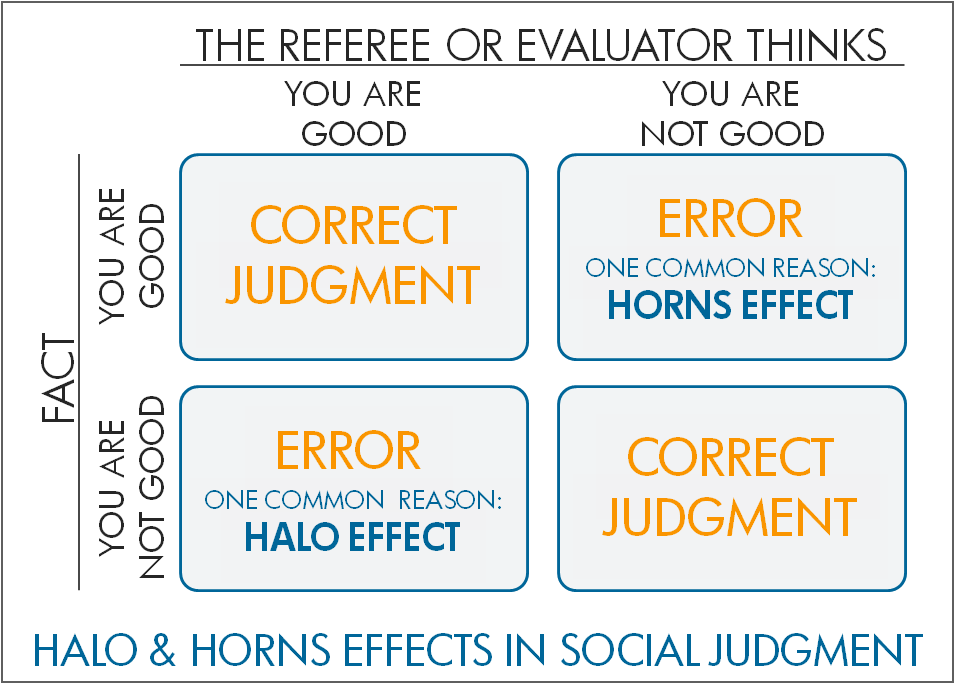
The “halo effect” captures what happens when a person who is judged positively based on one aspect is automatically judged positively on several others without much evidence. For instance, as a result of the halo effect,

  • attractive people are often judged as competent and sociable. Film stars and other celebrities are assumed pleasant and sharp-witted,
  • inexperienced interviewers tend to pay less attention to a candidate’s negative traits after discerning one or two positive traits in the first few minutes of a job interview,
  • charismatic professionals tend to get noticed and move up the corporate ladder faster, irrespective of their technical and leadership skills,
  • articulate speakers are likely to influence their audiences more even if their messages are poor in form and content.

Politicians, film and TV stars, sportspersons, celebrities and brand managers have learned to construct a halo effect and capitalize on their reputations. Apple’s iPod spawned positive impressions of other Apple products—the company took advantage of this halo effect and delivered excellent products in the iPhone and iPad. In another example, renowned fashion designers can set high prices for perfectly ordinary clothes.

Halo and Horns Effects in Social Judgment

The Horns Effect

The “horns” or “devil effect” is the concept by which a person who is judged negatively on one aspect is automatically judged negatively on several other aspects without much evidence. Clearly, this is the opposite of the halo effect.

For years, American car manufacturers have battled the mistaken public perception that cars made by Japanese companies are of significantly better quality. This misperception remains even when American car manufacturers use identical components from the same suppliers and assemble their cars using identical manufacturing processes. Even today, Japanese-brand cars resell for much higher prices than American-brand cars.

Call for Action

  • Reflect on your decision-making process to steer clear of biases. As human beings, we incessantly form opinions of people, objects, and events, both consciously and subconsciously. However, our judgment is rarely free of biases and our measures are not always comprehensive enough. Before reaching any important decision, be sure to collect all the relevant facts and reflect on whether your thought processes are free of the common biases.
  • Understand that perception is reality and be conscious of the image you are projecting. People judge the proverbial book by its cover. Your friends and family, workplace and society at large have a certain perception of who you are and what you can do, irrespective of the reality. As much as you would prefer to be evaluated based on who you actually are and what you can actually do, understand that your identity and prospects are based on others’ image of you. Do everything you can to connect people’s perception to the reality. Look and play your role. Begin by reading the seminal article on the topic of personal branding, “The Brand Called You,” written by renowned management author, Tom Peters.

Filed Under: Leading Teams, Sharpening Your Skills Tagged With: Biases, Mental Models

Inspirational Quotations #228

July 5, 2008 By Nagesh Belludi Leave a Comment

Don’t be a cynic and disconsolate preacher. Don’t bewail and moan. Omit the negative propositions. Challenge us with incessant affirmatives. Don’t waste yourself in rejection, or bark against the bad, but chant the beauty of the good.
—Ralph Waldo Emerson (American Philosopher)

When ideas fail, words come in very handy.
—Johann Wolfgang von Goethe (German Poet)

Nothing is so contagious as enthusiasm.—It is the real allegory of the tale of Orpheus; it moves stones, and charms brutes.—It is the genius of sincerity, and truth accomplishes no victories without it.
—Samuel Taylor Coleridge (English Poet)

Perfection does not come from belief or faith. Talk does not count for anything. Parrots can do that. Perfection comes through selfless work.
—Swami Vivekananda (Indian Hindu Mystic)

Ah, good taste! What a dreadful thing! Taste is the enemy of creativeness.
—Pablo Picasso (Spanish Painter)

Don’t be a cynic and disconsolate preacher. Don’t bewail and bemoan. Omit the negative propositions. Nerve us with incessant affirmatives. Don’t waste yourself in rejection, nor bark against the bad, but chant the beauty of the good. When that is spoken which has a right to be spoken, the chatter and the criticism will stop. Set down nothing that will help somebody.
—Ralph Waldo Emerson (American Philosopher)

I had no vision of the scope of what I would start. But I had confidence that as long as we did our work well and were good to our customers, there would be no limit to us.
—Sam Walton (American Entrepreneur)

I love you, not only for what you are, but for what I am when I am with you.
—Unknown

For SUCCESS, like HAPPINESS, cannot be pursued,
it is the unintended side effect of one’s personal
dedication to a course greater than oneself.
—Viktor Frankl (Austrian Physician)

Seek self-discipline with all your soul. Devote yourself to worship and save your soul. Be grateful that God gave you the gift of self-discipline, for you had no power over it. He inspired it within you with the command, “Be!”
—Jalal ad-Din Muhammad Rumi (Persian Muslim Mystic)

Nothing is so contagious as enthusiasm.—It is the real allegory of the tale of Orpheus; it moves stones, and charms brutes.—It is the genius of sincerity, and truth accomplishes no victories without it.
—Edward Bulwer-Lytton, 1st Baron Lytton (English Poet)

Again and again I therefore admonish my students in Europe and America: Don’t aim at success—the more you aim at it and make it a target, the more you are going to miss it. For success, like happiness, cannot be pursued; it must ensue, and it only does so as the unintended side effect of one’s personal dedication to a cause greater than oneself or as the by-product of one’s surrender to a person other than oneself. Happiness must happen, and the same holds for success: you have to let it happen by not caring about it. I want you to listen to what your conscience commands you to do and go on to carry it out to the best of your knowledge. Then you will live to see that in the long-run—in the long-run, I say!—success will follow you precisely because you had forgotten to think about it.
—Viktor Frankl (Austrian Physician)

Are you excited because things are going well, or are things going well because you’re excited?
—Anonymous

Filed Under: Inspirational Quotations

« Previous Page

Primary Sidebar

Popular Now

Anxiety Assertiveness Attitudes Balance Biases Coaching Conflict Conversations Creativity Critical Thinking Decision-Making Discipline Emotions Entrepreneurs Ethics Etiquette Feedback Getting Along Getting Things Done Goals Great Manager Innovation Leadership Leadership Lessons Likeability Mental Models Mindfulness Motivation Parables Performance Management Persuasion Philosophy Problem Solving Procrastination Psychology Relationships Simple Living Social Skills Stress Suffering Thinking Tools Thought Process Time Management Winning on the Job Wisdom

About: Nagesh Belludi [hire] is a St. Petersburg, Florida-based freethinker, investor, and leadership coach. He specializes in helping executives and companies ensure that the overall quality of their decision-making benefits isn’t compromised by a lack of a big-picture understanding.

Get Updates

Signup for emails

Subscribe via RSS

Contact Nagesh Belludi

RECOMMENDED BOOK:
So Good They Can't Ignore You

So Good They Can't Ignore You: Cal Newport

Computer scientist Cal Newport explains how blindly following one's passion is a poor career strategy. Developing precious skills can initiate a passionate pursuit and a meaningful career.

Explore

  • Announcements
  • Belief and Spirituality
  • Business Stories
  • Career Development
  • Effective Communication
  • Great Personalities
  • Health and Well-being
  • Ideas and Insights
  • Inspirational Quotations
  • Leadership
  • Leadership Reading
  • Leading Teams
  • Living the Good Life
  • Managing Business Functions
  • Managing People
  • MBA in a Nutshell
  • Mental Models
  • News Analysis
  • Personal Finance
  • Podcasts
  • Project Management
  • Proverbs & Maxims
  • Sharpening Your Skills
  • The Great Innovators

Recently,

  • Your Nerves Are Invisible & No One Can Tell: The Illusion of Transparency
  • A Winner is Merely a Quitter with a Better Sense of Timing: When Quitting Is the Win
  • Malaysian ‘Used’ Cooking Oil to Jet Fuel: How Corrupted Incentives Turn a Green Dream into Self-Defeating Theater
  • Inspirational Quotations #1156
  • The Hustle Delusion: Your Ambition is Another’s Insanity
  • Drop the Weasel Words, Stop Dodging Responsibility
  • Excellence Breeds Elitism If Left Unchecked: A Delta Air Lines Case Study

Unless otherwise stated in the individual document, the works above are © Nagesh Belludi under a Creative Commons BY-NC-ND license. You may quote, copy and share them freely, as long as you link back to RightAttitudes.com, don't make money with them, and don't modify the content. Enjoy!