• Skip to content
  • Skip to primary sidebar

Right Attitudes

Ideas for Impact

Search Results for: Albert Einstein

Inspirational Quotations #624

March 20, 2016 By Nagesh Belludi Leave a Comment

A successful man is he who receives a great deal from his fellow men, usually incomparably more than corresponds to his service to them. The value of a man, however, should be seen in what he gives, and not in what he is able to receive.
—Albert Einstein (German-born Theoretical Physicist)

Those who give the first shock to a state are naturally the first to be overwhelmed in its ruin. The fruits of public commotion are seldom enjoyed by the man who was the first to set it a-going; he only troubles the water for another’s net.
—Michel de Montaigne (French Philosopher)

The more powerful and original a mind, the more it will incline towards the religion of solitude.
—Aldous Huxley (English Humanist)

Faith is God felt by heart, not by reason.
—Blaise Pascal (French Catholic Mathematician)

The choicest pleasures of life lie within the ring of moderation.
—Martin Farquhar Tupper (English Poet)

Prosperity is not just scale; adversity is the only balance to weigh friends.
—Plutarch (Ancient Greek Historian)

And desire shall fail: because man goeth to his long home, and the mourners go about the streets.
—The Holy Bible (Scripture in the Christian Faith)

The depth of your mythology is the extent of your effectiveness.
—John C. Maxwell (American Christian Professional Speaker)

Humanity is never so beautiful as when praying for forgiveness, or else forgiving another.
—Jean Paul (German Novelist)

The great events of life often leave one unmoved; they pass out of consciousness, and, when one thinks of them, become unreal. Even the scarlet flowers of passion seem to grow in the same meadow as the poppies of oblivion.
—Oscar Wilde (Irish Poet)

Filed Under: Inspirational Quotations

Inspirational Quotations #621

February 28, 2016 By Nagesh Belludi Leave a Comment

A friend that you have to buy won’t be worth what you pay for him, no matter what that may be.
—George D. Prentice (American Journalist)

Failure is the opportunity to begin again more intelligently.
—Moshe Arens

Friendship lasts but for a day, business connections forever.
—Babylonian Proverb

Some men see things as they are and say, “Why?” I dream things that never were, and say, “Why not?”
—George Bernard Shaw (Irish Playwright)

As a solid rock is not shaken by the wind, wise people falter not amidst blame and praise.
—The Dhammapada (Buddhist Anthology of Verses)

Some people see things that are and ask, Why? Some people dream of things that never were and ask, Why not? Some people have to go to work and don’t have time for all that …
—George Carlin

Literature is an occupation in which you have to keep proving your talent o people who have none.
—Jules Renard (French Novelist)

One who fears failure limits his activities. Failure is only the opportunity more intelligently to begin again.
—Henry Ford (American Businessperson)

If we could read the secret history of our enemies, we should find in each man’s life, sorrow and suffering enough to disarm all hostility.
—Henry Wadsworth Longfellow (American Poet)

Contrary to what most of us believe, happiness does not simply happen to us. It’s something that we make happen, and it results from doing our best. Feeling fulfilled when we live up to our potentialities is what motivates differentiation and leads to evolution.
—Mihaly Csikszentmihalyi

Play the game for more than you can afford to lose… only then will you learn the game.
—Winston Churchill (British Head of State)

All progress has resulted from people who took unpopular positions.
—Adlai Stevenson (American Diplomat)

Any effort that has self-glorification as its final endpoint is bound to end in disaster.
—Robert M. Pirsig (American Writer)

If at first, the idea is not absurd, then there is no hope for it.
—Albert Einstein (German-born Theoretical Physicist)

Filed Under: Inspirational Quotations

What Is the Point of Life, If Only to Be Forgotten?

January 5, 2016 By Nagesh Belludi Leave a Comment

While traveling around the magical Norwegian Fjords and contemplating life one day last summer, I recalled a young man’s story. He had spent many years in an Indian prison despite being acquitted because everyone had forgotten about him.

Forgotten

In 1988, Pratap Nayak was arrested at the age of 14 after getting caught in a violent clash between two rival families in his village in the state of Orissa. A corrupted lower court promptly sentenced him to life imprisonment.

Thanks to the Indian judicial system’s sluggishness, it took six years for a High Court to pronounce Nayak innocent. Unfortunately, nobody informed him or the prison officials about this judgment and his lawyer had died during the intervening years. Nayak’s family had assumed helplessness and lost touch with both him and with the lawyer.

Nayak remained in jail for eight more years after acquittal until a prison system auditor realized that Nayak wasn’t supposed to still be in prison. When he was finally freed at age 28, he was astonished and said, “no one bothered about me … not even my own family.”

When Nayak was finally reunited with his impoverished family of bamboo craftsmen, his father cried, “How shall I take care of him? We don’t get enough to eat ourselves. Had he completed his education, he would have had a good job by now. They ruined his life.”

“Life’s but a walking shadow … then is heard no more”

Shakespeare’s Macbeth (Act 5, Scene 5, Lines 22–31) contains one of the most eloquent expressions of our lives’ cosmic insignificance:

Tomorrow, and tomorrow, and tomorrow
Creeps in this petty pace from day to day
To the last syllable of recorded time,
And all our yesterdays have lighted fools
The way to dusty death. Out, out brief candle!
Life’s but a walking shadow, a poor player
That struts and frets his hour upon the stage
And then is heard no more. It is a tale
Told by an idiot, full of sound and fury,
Signifying nothing.

What Difference Does It Make What We Do with Our Lives?

Whenever I’m enjoying the splendor of the mountains and the waters—as I did in the Norwegian Fjords—and marvel at how these natural elements came to be millions of years ago, I meditate upon the fact that what we identify as our lifespan is but a tiny sliver in the grand timeline of the cosmos. We’re born, we live, we die, and then, as Shakespeare reminds us in Macbeth, we are “heard no more.”

In the grand scheme of things, everything is pointless, irrelevant, and ultimately insignificant. Our lives are impermanent and almost everything that most of us accomplish during our lives will someday become obsolete and be forgotten.

Yet, we rouse ourselves out of bed every day and engage in various activities that are all somehow tied to a purpose or mission—a mission we’ve either consciously created for ourselves or subconsciously accepted as an assignment from somebody. Central to this mission is that we hope to bring about more meaning to the lives of people around us.

This mission imbues us with a sense of purpose—invariably, it is a manifestation of a strong desire within ourselves to bring value, meaning, and joy for others and ultimately for ourselves as well. Even the prospect of smiling, complimenting, or expressing gratitude to another person feels good and adds to our own happiness because we know we’re adding more meaning to the other’s life.

Idea for Impact: The Key to a Life Well-led Is to Make as Big a Difference as You Can

The utmost measure of a life well-led is how you use your unique talents to do the most good you can. Enrich your life by trying to make a difference. Better yet, try to make the biggest difference you can. Perhaps if you’re fortunate enough—as the Buddha, Mahatma Gandhi, Albert Einstein, Richard Feynman, Bill Gates were/are—your contribution can create ripple effects and create an enduring legacy that lasts long after you’re gone.

If you want to be remembered and appreciated for having contributed something to the world, strive to live in the service of others and make the largest possible positive difference you can. That’s the key to a life well-led.

Filed Under: Living the Good Life, Sharpening Your Skills Tagged With: Balance, Buddhism, Life Plan, Meaning, Mindfulness, Philosophy, Virtues

Inspirational Quotations #603

October 25, 2015 By Nagesh Belludi Leave a Comment

The object of most prayers is to wangle an advance on good intentions.
—Robert Brault

Never stop questioning.
—Albert Einstein (German-born Theoretical Physicist)

Necessity reconciles and brings men together; and this accidental connection afterwards forms itself into laws.
—Michel de Montaigne (French Philosopher)

Isn’t it fortunate how selective our recollections usually are.
—Malcolm Forbes (American Publisher)

It is not always by plugging away at a difficulty and sticking at it that one overcomes it; but, rather, often by working on the one next to it. Certain people and certain things require to be approached at an angle.
—Andre Gide (French Novelist)

Life begins on the other side of despair.
—Jean-Paul Sartre (French Philosopher)

It takes as much courage to have tried and failed as it does to have tried and succeeded.
—Anne Morrow Lindbergh (American Author, Aviator)

No one reaches a high position without daring.
—Publilius Syrus (Syrian-born Latin Writer)

Nature is an endless combination and repetition of a very few laws. She hums the old well-known air through innumerable variations.
—Ralph Waldo Emerson (American Philosopher)

Nature, who for the perfect maintenance of the laws of her general equilibrium, has sometimes need of vices and sometimes of virtues, inspires now this impulse, now that one, in accordance with what she requires.
—Marquis de Sade (French Political leader)

Praise from the common people is generally false, and rather follows the vain than the virtuous.
—Francis Bacon (English Philosopher)

The imagination is literally the workshop wherein are fashioned all plans created by man.
—Napoleon Hill (American Author)

Filed Under: Inspirational Quotations

These Celebrities and Hollywood Actors Didn’t Just Wait Around for Dream Jobs to Turn up

July 21, 2015 By Nagesh Belludi 1 Comment

“He who lives uprightly and experiences true difficulty and disappointment and is nonetheless undefeated by it is worth more than someone who prospers and knows nothing but relative good fortune.”
—Vincent van Gogh

Stories of superstars who struggled in their early careers are very inspiring

Some superstars had it made. They came from privileged backgrounds and had spectacular starts to their careers. They were lucky enough to attend the best schools, get the right pedigree, make the right connections, get an early break, or join the fast track to the top.

Other superstars were not so lucky in their early careers. Most of these men and women—particularly the archetypical self-made person—came from humble backgrounds and struggled to establish themselves. They found productive jobs to eke out a living, all the while never losing sight of their ambitions. They took every opportunity to learn and prove themselves. They worked hard to get a foot in the door, toiled in the trenches, learned everything about their trades, and painstakingly built their spectacular careers from the ground up. In sum, they didn’t just while their time away waiting for their desired jobs and dream gigs to show up.

Jack Nicholson, Robin Williams, Brad Pitt

Consider three Hollywood superstars who struggled during their early careers and worked modest jobs to earn their living but never abandoned their ambitions.

  • Hollywood legend Jack Nicholson (b. 1937) ran errands and worked as a messenger at Hollywood’s MGM animation studios before being “discovered.” He had moved from New Jersey to pursue his dream of becoming an actor and lived with his wannabe-actress mother (whom he thought was his sister until he was 36, a full ten years after her death.)
  • Comedian and Hollywood actor Robin Williams (1951–2014) gained precious experience in his twenties working as a mime artist in front of New York’s Museum of Modern Art while trying to find acting gigs. As a child, Williams hardly fit the stereotype of someone who would later pursue comedy. Born to a successful Ford executive, Williams grew up a shy, lonely child playing by himself in an empty room of his family’s mansion. He overcame his shyness only after taking drama classes in high school.
  • Celebrated actor and producer Brad Pitt (b. 1963) worked a variety of odd jobs while struggling to establish himself in Hollywood. To pursue his passion for the big screen, he moved to Los Angeles from Missouri two weeks before he was about to earn his degree in Journalism. He took acting lessons and made contacts. Within months, Pitt got uncredited roles in three films. For the next seven years, he gained increasing recognition in supporting roles on television and in films before securing leading roles that catapulted him to worldwide fame.

Examine the purpose of these examples viz. to emphasize that successful people find something productive to do while improving themselves and waiting for their big break. Take note of a crucial nuance: we are not discussing humble part-time or casual summer jobs that later-superstars held in their youth—e.g., Pope Francis worked as a bouncer in Buenos Aires, German Chancellor Angela Merkel as a barmaid in Leipzig, Bill Gates as a page in the United States Congress, Warren Buffett as a newspaper delivery boy in Washington, D.C.

Albert Einstein, Soichiro Honda, Stephen King

Other disciplines also present plenty of superstars who pursued their ambitions while holding humble first-jobs.

  • Physicist and philosopher Albert Einstein (1879–1955) spent two frustrating post-college years searching for a teaching job before becoming a clerk at the Swiss Patent Office in Bern. In between examining patent applications and during his spare time, he worked on physics problems. In his third year at the job, he wrote four groundbreaking papers that transformed physics.
  • When Japanese engineer and industrialist Soichiro Honda (1906–1991) moved to Tokyo at age 15 to find work as an auto mechanic, a repair shop owner hired him as a nanny to his infant. With a child in tow, Honda often meandered about the garage, observing and learning from the mechanics. When the child was asleep, Honda tinkered with engines and started giving suggestions to the mechanics. He strengthened his passion for automotive engines just as the nascent industrial base of Japan was finding a new enthusiasm for machines.
  • 'Carrie' by Stephen King (ISBN 0307743667) Best-selling author Stephen King (b. 1947) struggled for years after graduating from college. He and his writer-wife grappled financially and lived in a trailer home. He worked hard at building a career as a writer and developed ideas for many novels. King sold short stories to men’s magazines and worked small jobs to make a living. When working as a janitor in a school locker room, he was inspired to write a novel titled “Carrie”. Set in a girls’ locker room, Carrie features a schoolgirl who exercises her newly-discovered telekinetic powers to exact revenge on her bullies. Carrie turned into King’s first published novel and lent him his big break.

Idea for Impact: Self-disciplined people don’t wait for the right answer or the golden path to present themselves. They understand that the best way to get unstuck is to start somewhere, focus on action, keep themselves productive, amend their course if necessary, and do all this without losing sight of their goals and ambitions.

A note of caution: Stories of superstars’ successes are but cherry-picked examples

“Welcome to Hollywood. What’s your dream?
Everybody comes here. This is Hollywood, the land of dreams.
Some dreams come true, some don’t. But keep on dreamin’.
This is Hollywood. Always time to dream, so keep on dreamin’.”
—From “Pretty Woman” (1990)

More than we possibly realize, so much of life’s success in life has to do with luck (or fate or destiny.) As I’ve written previously, success is often more about being at the right place, at the right time, and with the right person than about possessing the right skills and working hard.

The above are merely examples of a few lucky superstars who made it big in Hollywood or in their chosen disciplines and followed their passions as careers.

For every Stephen Hawking or J. K. Rowling, there are thousands of wannabe writers whose creative writing doesn’t even pay enough to buy the notebooks they use.

For every Jack Nicholson, Robin Williams, or Brad Pitt, there are countless Hollywood wannabes struggling in the “Land of a Million Dreams.” What’s more, among actors who manage to find work, an even smaller fraction of them actually make a living doing it. Part-timers are paid so little that they must work at stores, restaurants, or bars at night and on weekends. The cost of living in Southern California has hit the roof; even professionally-done headshots cost hundreds of dollars. The celebrity impersonators and street performers on Hollywood’s Walk of Fame have even started aggressively pestering tourists and photographers for bigger tips.

Celebrity impersonators and street artists on Hollywood's Walk of Fame pestering tourists for bigger tips

In the la-la land of Los Angeles, chances are that any random person you meet is an aspiring actor, model, designer, musician, songwriter, screenplay writer, director, stunt-double, makeup artist, or is trying to get some gig in the entertainment industry. Each aspirant is taking classes, trying to make contacts, looking for auditions, hoping to land jobs, wishing to be “discovered” by an actor or noticed by a talent agent at a restaurant, club, or elsewhere.

Competition is brutal and the market for fame is saturated

In Hollywood, anything is possible and yes, “some dreams come true.” However, in reality, there’s an infinitesimal chance that any aspirant will ever get a break. Even still, thousands of hopefuls flock to Hollywood every year (and thousands of rejects move out.) After endless auditions, rejections, or false starts, they wake up to the harsh realities of competition and get jobs that are more gratifying than chasing a near-impossible dream.

“He that lives upon hope will die fasting.”
—Benjamin Franklin

If you have a passion for something that will not pay adequately, pursue it on the side. Here’s some sage advice from my mentor Marty Nemko:

Do what you love, but don’t expect to get paid for it. Want to be on stage? Act in community theater. Want to be an artist? Convince a restaurant to let you decorate its walls with your creations. To make money, pick a field that pays decently and has few liabilities. Chances are, that will lead to more career contentment than pursuing a long-shot dream as your career. Treating a long-shot dream as an avocation gives you most of its pleasure without forcing you to endure a life of poverty.

Filed Under: Career Development, Great Personalities, Sharpening Your Skills Tagged With: Attitudes, Celebrities, Entrepreneurs, Scientists, Writers

Inspirational Quotations #583

June 7, 2015 By Nagesh Belludi Leave a Comment

The best way to predict the future is to create it.
—Peter Drucker (Austrian-born Management Consultant)

Most men want knowledge, not for itself, but for the superiority which knowledge confers; and the means they employ to secure this superiority are as wrong as the ultimate object, for no man can ever end with being superior, who will not begin with being inferior.
—Sydney Smith (English Anglican Writer)

Thinking is not to agree or disagree. That is voting.
—Robert Frost (American Poet)

Affirmation without discipline is the beginning of delusion.
—Jim Rohn (American Entrepreneur)

Although words exist for the most part for the transmission of ideas, there are some which produce such violent disturbance in our feelings that the role they play in the transmission of ideas is lost in the background.
—Albert Einstein (German-born Theoretical Physicist)

Love is the only flower that grows and blossoms without the aid of seasons.
—Khalil Gibran (Lebanese-born American Philosopher)

Odd how the creative power at once brings the whole universe to order.
—Virginia Woolf (English Novelist)

It is the little bits of things that fret and worry us; we can dodge a elephant, but we can’t dodge a fly.
—Josh Billings (Henry Wheeler Shaw) (American Humorist)

There is only one meaning of life, the act of living itself.
—Erich Fromm (German Psychologist)

In solitude, where we are least alone.
—Lord Byron (George Gordon Byron) (English Romantic Poet)

Go as far as you can see; when you get there, you’ll be able to see farther.
—J. P. Morgan (American Businessperson)

There is a price which is too great to pay for peace, and that price can be put in one word. One cannot pay the price of self-respect.
—Woodrow Wilson (American Head of State)

Filed Under: Inspirational Quotations

Inspirational Quotations #581

May 24, 2015 By Nagesh Belludi Leave a Comment

I venerate old age; and I love not the man who can look without emotion upon the sunset of life, when the dusk of evening begins to gather over the watery eye, and the shadows of twilight grow broader and deeper upon the understanding.
—Henry Wadsworth Longfellow (American Poet)

When you accept yourself completely you do not have to maintain a phony front, drive yourself to “achieve” or feel insecure if people tune-in to you and what you are doing.
—Ken Keyes, Jr. (American Motivational Speaker)

Dreams are real as long as they last. Can we say more of life?
—Havelock Ellis (British Sexologist)

The greatest deception men suffer is from their own opinions.
—Leonardo da Vinci (Italian Polymath)

What I need is someone who will make me do what I can.
—Ralph Waldo Emerson (American Philosopher)

Justice consists in doing no injury to men; decency in giving them no offense.
—Cicero (Roman Philosopher)

The cat, having sat upon a hot stove lid, will not sit upon a hot stove lid again. But he won’t sit upon a cold stove lid, either.
—Mark Twain (American Humorist)

All good books are alike in that they are truer than if they had really happened and after you are finished reading one you will feel that all that happened to you and the afterwards it all belongs to you; the good and the bad, the ecstasy, the remorse, and sorrow, the people and places and how the weather was.
—Ernest Hemingway (American Author)

True art is characterized by an irresistible urge in the creative artist.
—Albert Einstein (German-born Theoretical Physicist)

Attach yourself to those who advise you rather than praise you.
—Nicolas Boileau-Despreaux

Out of suffering have emerged the strongest souls; the most massive characters are seamed with scars; martyrs have put on their coronation robes glittering with fire, and through their tears have the sorrowful first seen the gates of Heaven.
—Edwin Hubbell Chapin (American Universalist Preacher)

The good life is inspired by love and guided by knowledge.
—Bertrand A. Russell (British Philosopher)

Filed Under: Inspirational Quotations

Creativity by Synthesis (Combining Ideas): A Case Study on the Darwin & Mendel Theorems in Biology

April 14, 2015 By Nagesh Belludi Leave a Comment

One of the fascinating aspects of invention is tracking the continuity of ideas across an arc of time and tracing the progression of ideas over time. My previous article examined how blending antecedent ideas to form new ones led to the invention of the Gutenberg’s press, the rotary steam engine, and the Wright Brothers‘ first powered flight. In this article, we will explore a related mental model for creativity.

A fundamental component of creative thinking is combining whole ideas (or just certain elements of ideas) to create a new concept. When we synthesize—i.e. fuse ideas to forge new ones—we mirror the footsteps of some of humankind’s most imaginative breakthroughs.

James Maxwell’s work on electromagnetic radiation developed from the synthesis of seemingly unrelated concepts such as electricity, magnetism, light, and motion. His theory of electromagnetism was one of the most significant discoveries of the nineteenth century. Albert Einstein described Maxwell’s work on electromagnetism as “the most profound and the most fruitful that physics has experienced since the time of Newton.”

Even more profoundly, Darwin and Mendel’s work exemplifies the most groundbreaking synthesis of ideas. Combined more than four decades after their deaths, their ideas shaped the foundation of life sciences, as we know it. Allow me to elaborate.

Theory of the Descent of Man - Darwin's Theories of Evolution

Charles Darwin’s Theory of Evolution

The word “evolution” was first used in English as early as 1647. Long before that, pre-Socratic Greek philosopher Anaximander (611–546 B.C.E) speculated that humans must have evolved from an animal and that this evolution must have sprung from the sea. By the end of the 18th century, naturalists conjectured that different life forms develop progressively from more primitive forms. They also hypothesized that all life forms were interrelated. Erasmus Darwin (1731–1802,) Charles Darwin’s grandfather and a natural philosopher and physiologist, as well as the French naturalist Jean-Baptiste Lamarck (1744–1829) argued along those lines. However, most of their thoughts on evolution and the relatedness of all life forms were purely speculative.

'The Origin of Species' by Charles Darwin (ISBN 0451529065) Darwin’s most notable scientific contribution was his vast body of evidence supporting the aforementioned hypotheses. Even more significantly, Darwin identified natural selection as the mechanism that determines evolutionary change. In his seminal treatise, “Origin of Species” (1859,) Darwin distilled the theory of evolution through two foundational concepts:

  1. In any ecosystem, individuals of the same species are likely to differ in their measurable characteristics. Such variations tend to be inherited.
  2. Living beings—plants and animals—reproduce more quickly than nature can impart the resources for their survival. Individuals of a species must therefore compete in order to live and reproduce in a competitive ecosystem.

Charles Darwin’s work on evolution was really a synthesis of concepts from comparative anatomy, paleontology, geology, geography, and animal breeding.

Advancing his theories further, in “The Descent of Man” (1871,) Darwin described humans as an outcome of evolution. Humans have the same general anatomical and physiological principles as animals and are in fact an advanced animal form whose superior traits are a consequence of evolutionary progression. Darwin hypothesized that humans share a common ancestry with animals, more specifically evolving from primates.

The Big Gap in Darwin’s Theory: Lack of an Explanation for Heredity

'The Descent Of Man' by Charles Darwin (ISBN 1463645961) In the introduction to The Descent of Man, Darwin wrote, “It has often and confidently been asserted, that man’s origin can never be known: but ignorance more frequently begets confidence than does knowledge: it is those who know little, and not those who know much, who so positively assert that this or that problem will never be solved by science.”

Darwin’s theories about the evolution of humankind created an instant uproar among advocates of Christian theology and its concept of a wise, benevolent, and omnipotent Creator as laid out in the Book of Genesis. Since then, few scientific theories have been as hotly debated among nonscientists as evolution and its opponent, creationism (and recently, intelligent design.)

After The Descent of Man, it was more than a decade before Darwin’s work came to be scientifically established. Darwin’s work remained deficient—if natural selection was to have lasting effects, these advances had to be conserved and passed on from one generation to the next. He agreed with scientists who argued that his evolutionary theory failed to explain how variations are transmitted from parents to their offspring.

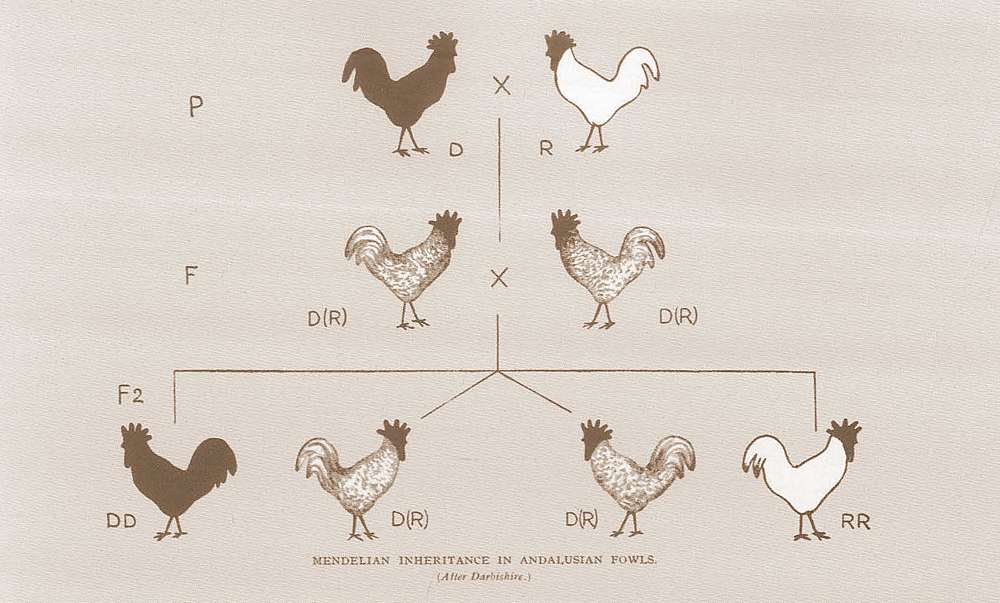
Mendelian Inheritance in Andalusian Fowls - Cross-breeding Experiments by Gregor Mendel

Cross-breeding Experiments by Gregor Mendel: Evidence of Heredity

Between 1856 and 1863, independent of Charles Darwin (1809–1882,) Moravian monk Gregor Mendel (1822–1884) conducted extensive pea plant breeding experiments in his monastery’s garden. He systematically studied what farmers had known for centuries: that crossbreeding animals and plants creates “hybrid” offspring with desirable traits. Based on his pea plant experiments, Mendel laid the foundational rules of genetic inheritance and heredity.

Synthesis of Darwin and Mendel’s Work as the Foundation of Life Sciences

It was not until the 1930s, long after both Darwin and Mendel’s deaths, that biologists started to study Mendel’s work on heredity in conjunction with Darwin’s theory of natural selection. Scientists were then able to understand how variation of characteristics is passed on to new generations and how evolution is a process of descent with modification. Mendel’s laws provided justification of inheritance, thereby completing Darwin’s theory of natural selection. Subsequently, Darwin’s theory became the basic mechanism of evolution—evolutionary genetics was established as biology’s central theorem and the bedrock concept of all life sciences. From that point on, Darwin became one of the most influential persons in human history.

Scientists continue to fine-tune humankind’s understanding of evolutionary biology as new evidence and fresh insights pour in from biochemistry, genetics, archaeology, neuroscience, and various other disciplines.

Filed Under: Mental Models, Sharpening Your Skills Tagged With: Creativity, Scientists, Thought Process

Inspirational Quotations #572

March 22, 2015 By Nagesh Belludi Leave a Comment

We must give more in order to get more, It is the generous giving of ourselves that produce the generous harvest.
—Orison Swett Marden (American New Thought Writer)

Success serves men as a pedestal; it makes them look larger, if reflection does not measure them.
—Joseph Joubert (French Essayist)

Great talents, such as honor, virtue, learning, and parts, are above the generality of the world, who neither possess them themselves, nor judge of them rightly in others; but all people are judges of the lesser talents, such as civility, affability, and an obliging, agreeable address and manner, because they feel the good effects of them, as making society easy and pleasing.
—Earl of Chesterfield

Never forget the three powerful resources you always have available to you: love, prayer, and forgiveness.
—H. Jackson Brown, Jr. (American Author)

Truth is the secret of eloquence and of virtue, the basis of moral authority; it is the highest summit of art and of life.
—Henri Frederic Amiel (Swiss Philosopher)

As you seek new opportunity, keep in mind that the sun does not usually reappear on the horizon where last seen.
—Robert Brault

A mind always employed is always happy. This is the true secret, the grand recipe, for felicity.
—Thomas Jefferson (American Head of State)

You cannot consistently perform in a manner which is inconsistent with the way you see yourself.
—Zig Ziglar (American Author)

A great many worries can be diminished by realizing the unimportance of the matter which is causing anxiety.
—Bertrand A. Russell (British Philosopher)

The creative person is willing to live with ambiguity. He doesn’t need problems solved immediately and can afford to wait for the right ideas.
—Abe Tannenbaum

Anger dwells only in the bosom of fools.
—Albert Einstein (German-born Theoretical Physicist)

The art of using moderate abilities to advantage often brings greater results than actual brilliance.
—Francois de La Rochefoucauld

Filed Under: Inspirational Quotations

Inspirational Quotations #458

January 13, 2013 By Nagesh Belludi Leave a Comment

Of all the ways of defining man, the worst is the one which makes him out to be a rational animal.
—Anatole France (French Novelist)

So long as I am acting from duty and conviction, I am indifferent to taunts and jeers. I think they will probably do me more good than harm.
—Winston Churchill (British Head of State)

The tragedy of human history is decreasing happiness in the midst of increasing comforts.
—Swami Chinmayananda (Indian Hindu Teacher)

Never let anybody guess that you have a mind of your own. Above all be pure.
—Virginia Woolf (English Novelist)

A person often meets his destiny on the road he took to avoid it.
—Jean de La Fontaine (French Poet)

When it is a question of money, everybody is of the same religion.
—Voltaire (French Philosopher)

We would often be sorry if our wishes were gratified.
—Aesop (Greek Fabulist)

The common idea that success spoils people by making them vain, egotistic and self-complacent is erroneous; on the contrary, it makes them for the most part, humble, tolerant and kind? Failure makes people cruel and bitter.
—W. Somerset Maugham (French Playwright)

The great danger of conversion in all ages has been that when the religion of the high mind is offered to the lower mind, the lower mind, feeling its fascination without understanding it, and being incapable of rising to it, drags it down to its level by degrading it.
—George Bernard Shaw (Irish Playwright)

If people are good only because they fear punishment, and hope for reward, then we are a sorry lot indeed.
—Albert Einstein (German-born Theoretical Physicist)

Filed Under: Inspirational Quotations

« Previous Page
Next Page »

Primary Sidebar

Popular Now

Anxiety Assertiveness Attitudes Balance Biases Coaching Conflict Conversations Creativity Critical Thinking Decision-Making Discipline Emotions Entrepreneurs Etiquette Feedback Getting Along Getting Things Done Goals Great Manager Innovation Leadership Leadership Lessons Likeability Mental Models Mentoring Mindfulness Motivation Networking Parables Performance Management Persuasion Philosophy Problem Solving Procrastination Relationships Simple Living Social Skills Stress Suffering Thinking Tools Thought Process Time Management Winning on the Job Wisdom

About: Nagesh Belludi [hire] is a St. Petersburg, Florida-based freethinker, investor, and leadership coach. He specializes in helping executives and companies ensure that the overall quality of their decision-making benefits isn’t compromised by a lack of a big-picture understanding.

Get Updates

Signup for emails

Subscribe via RSS

Contact Nagesh Belludi

RECOMMENDED BOOK:
The Art of War

The Art of War: Sun Tzu

The ancient Chinese master Sun Tzu reveals the essence of conflict and how to win by knowing yourself, knowing your enemy, and fighting only when you can win.

Explore

  • Announcements
  • Belief and Spirituality
  • Business Stories
  • Career Development
  • Effective Communication
  • Great Personalities
  • Health and Well-being
  • Ideas and Insights
  • Inspirational Quotations
  • Leadership
  • Leadership Reading
  • Leading Teams
  • Living the Good Life
  • Managing Business Functions
  • Managing People
  • MBA in a Nutshell
  • Mental Models
  • News Analysis
  • Personal Finance
  • Podcasts
  • Project Management
  • Proverbs & Maxims
  • Sharpening Your Skills
  • The Great Innovators

Recently,

  • Say It Straight: Why Clarity Beats Precision in Everyday Conversation
  • Inspirational Quotations #1144
  • The Spotlight Effect: Why the World Is Less Interested Than You Think
  • The Small Detail That Keeps a Conversation From Running Dry
  • Design for the 80% Experience
  • Inspirational Quotations #1143
  • The Hot-Desking Lie: How It Killed Focus and Gutted Collaboration

Unless otherwise stated in the individual document, the works above are © Nagesh Belludi under a Creative Commons BY-NC-ND license. You may quote, copy and share them freely, as long as you link back to RightAttitudes.com, don't make money with them, and don't modify the content. Enjoy!