Blog reader Sasawat from Bangkok (Thailand) asks:
“I recently joined a multinational chemicals company that uses a performance appraisal system. I supervise seven engineers. To help me do their performance evaluations at the end of the year, should I maintain a diary to record their projects and actions?”
Most managers rely on employee performance in the period immediately preceding the performance evaluation deadline. Unfortunately, they do not weigh performance from throughout the year (or quarter, if their organizations use a quarterly review system.) Some employees exploit this behavior by slacking-off during most of the year and by shaping-up in the weeks before a performance evaluation is due.
 A log or a diary will help managers record employee projects and behaviors in one location. Clearly, recording significant and relevant examples of employee performance helps managers write objective performance summaries.
Recording events in a dairy every week, however, becomes overwhelming when you have seven employees. Instead, ask each employee to keep a diary of his/her achievements. Review this information with your employee once every week. Give regular, specific feedback, both affirmative and corrective. This ensures that you keep yourself informed of your employee’s work and demonstrates that you care about his/her current work and achievements.
When a performance evaluation is due, study the employee’s diary along with your notes, if any from your weekly meetings. You should not have to dig through your files or seek reports from various sources. You will have accumulated all the data you will need, in one place, to help you prepare for an effective performance evaluation statement and discussion.
 Look out for deer crossing signs in areas of high deer population. Slow down and be more vigilant.
 The entire incident, from the moment I spotted the deer to when I hit the deer, happened in less than two seconds. Here is the sequence of events; see the accompanying illustration. (I used present tense to recall the incident.)
 In retrospect, I was very fortunate that I survived the accident.
 All of us have an innate desire to be appreciated and valued for our contributions at work, home and elsewhere. However, we often fail to recognize the positive contributions of people around us. We neglect opportunities to talk about them in positive regard, appreciate their work and encourage them.
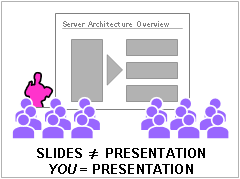 Last week, I attended a training seminar where the speaker stood by the side of a projection screen and behind a table where he had his laptop. He hardly moved from his position during the hour-long seminar. He was short and was barely visible from the back of the thirty-people room, as shown in the illustration. Despite his interesting content and compelling arguments, he was physically disconnected from his audience.