• Skip to content
  • Skip to primary sidebar

Right Attitudes

Ideas for Impact

Inspirational Quotations #235

August 24, 2008 By Nagesh Belludi Leave a Comment

If we had no winter, the spring would not be so pleasant; if we did not sometimes taste of adversity, prosperity would not be so welcome.
—Anne Bradstreet (English Poet)

The fundamental cause of the trouble is that in the modem world the stupid are cocksure while the intelligent are full of doubt.
—Bertrand A. Russell (British Philosopher)

Memories are tucked away, but not forgotten.
—Anonymous

October. This is one of the peculiarly dangerous months to speculate in stocks. The others are July, January, September, April, November, May, March, June, December, August, and February.
—Mark Twain (American Humorist)

It is unbecoming for young men to utter maxims.
—Aristotle (Ancient Greek Philosopher)

To change one’s life: Start immediately. Do it flamboyantly. No exceptions.
—William James (American Philosopher)

When you are inspired by some great purpose, some extraordinary project, all your thoughts break their bonds: Your mind transcends limitations, your consciousness expands in every direction, and you find yourself in a new, great, and wonderful world. Dormant forces, faculties and talents become alive, and you discover yourself to be a greater person by far than youever dreamed yourself to be.
—Patanjali (Indian Hindu Philosopher)

The sun, though it passes through dirty places, yet remains as pure as before.
—Francis Bacon (English Philosopher)

One man all by himself is nothing. Two people who belong together make a world.
—Hans Margolius
Filed Under: Inspirational Quotations

Never Surprise Your Boss [Managing Your Boss #2]

August 20, 2008 By Nagesh Belludi Leave a Comment

Bosses Dislike Surprises–Positive or Negative

The world of work is awash with relentless changes, troubles and crises. In the midst of these uncertainties, your boss does not need surprises from you or any of her employees.

Bear in mind that your boss’s output is the aggregate of the outputs of all the members of her organization. She must be in complete control of her goals and be able to answer her boss’s questions about the status of her organization’s projects and progress made on the latest crises. Consequently, she does not expect to be blindsided by good or bad news on your projects. She needs to know the status of each of your significant projects, and the challenges and opportunities therein.

Keep Your Boss in Line

A surprise is simply the difference between a previously-identified goal of a project and its apparent result. Give your boss a heads-up: have a conversation with her about forthcoming opportunities or mounting problems as soon as you perceive these variations in the output of your work.

Suit your boss’s preferred style of communication. If she is organized and detail-oriented, she may prefer comprehensive written reports itemizing the status of your projects, financial expenditures, and, performance against set goals and budgets. In contrast, if she is informal and perceptive, she may just need you to summarize the status of your projects in an email each week.

Pre-wire Your Boss Prior to Meetings

In meetings that include your boss, her boss, peers or customers, never introduce a contentious topic or discuss positive or negative details of your project without preparing your boss ahead of the meeting.

Make it a habit to meet with you boss prior to such meetings, show her drafts of your presentations and seek her comments and inputs. By ‘pre-wiring,’ or, discussing your findings and recommendations with key decision-makers ahead of a group presentation, you ensure their support for your conclusions and avoid surprise reactions or disagreements. See my earlier ‘Ideas for Impact’–article for details on the technique of pre-wiring.

Be the First to Let Your Boss Know

As a rule of thumb, your boss should first learn about any surprise from you–not from her peer, her boss, customer or consultant. Recognize that, occasionally, you may not have discussed certain facts or figures with your boss solely because these details appeared irrelevant or unimportant to you. However, others may be experienced enough to foresee the consequences and, much to your chagrin, bring up the details with your boss. If your boss asks, “Carrie from accounting told me … why you didn’t tell me that?” acknowledge that you did not foresee the consequences. Learn from your lapses and discover how you could read such trends.

Clarify Mutual Expectations Early and Often

If you see a need to reassess your goals and priorities on a project, bring it to the attention of your boss. Involve her in evaluating the challenges so that she feels just as accountable in redefining your common goals and priorities. Be prepared to clarify your thoughts and offer alternative solutions.

Realize that It’s a Matter of Trust

The relationship between you and your boss is a sensitive one–one that hinges on mutual cooperation, credibility and trust. Trust is a virtue that depends on the predictability of your behavior, honesty and dependability. If you surprise the boss repeatedly without forewarning, she may begin to mistrust you.

Concluding Thoughts

Your boss is important to you because she is the primary source of approval of your work. And, the relationship with your boss is a critical aspect of a favorable work atmosphere and your job satisfaction.

Success in building a relationship with your boss does not come easily. It begins with recognizing that this relationship hinges on open communication, cooperation, and credibility. The onus is on you to effectively manage this key relationship and achieve the best results for yourself, your boss and the organization.

Never keep your boss in the dark.

Wondering what to read next?

  1. Five Ways … You Could Score Points with Your Boss
  2. Do Your Employees Feel Safe Enough to Tell You the Truth?
  3. A Boss’s Presence Deserves Our Gratitude’s Might
  4. How Not to Handle a Bad Boss
  5. No One Likes a Meddling Boss

Filed Under: Managing People Tagged With: Managing the Boss

Inspirational Quotations #234

August 17, 2008 By Nagesh Belludi Leave a Comment

There is nothing more frightening than a bustling ignorance.
—Johann Wolfgang von Goethe (German Poet)

Life needs penalties and rewards for people. You can’t control people with only penalties. You have to think how to create rewards.
—Rudy Giuliani (American Politician)

In absence of clearly defined goals, we become strangely loyal to performing daily acts of trivia.
—Unknown

If there is righteousness in the heart|There will be beauty in the character;|If there is beauty in the character|There will be harmony in the home;|When there is harmony in the home|There will be order in the nation;|When there is order in the nation|There will be peace in the world.
—Sathya Sai Baba (Indian Hindu Religious Leader)

Hear my words that I might teach you,|Take my arms that I might reach you.
—Simon & Garfunkel

A bamboo tree grows six inches in the first nineteen years and twenty feet in its twentieth year. The best time to plant a bamboo tree is twenty years ago. The second best time is now.
—Chinese Proverb

In theory, there is no difference between theory and practice. But in practice, there is.
—Yogi Berra (American Sportsperson)

I don’t think much of a man who is not wiser today than he was yesterday.
—Abraham Lincoln (American Head of State)

Filed Under: Inspirational Quotations

Inspirational Quotations #233

August 10, 2008 By Nagesh Belludi Leave a Comment

The wise devote themselves to the welfare of all, for they see themselves in all.
—The Upanishads

Let us be silent that we may hear the whispers of the Gods.
—Ralph Waldo Emerson (American Philosopher)

The man who works need never be a problem to anyone. Opportunities multiply as they are seized; they die when neglected. Life is a long line of opportunities. Wealth is not in making money, but in making the man while he is making money. Production, not destruction, leads to success.
—John Wicker

Leadership has a harder job to do than just choose sides. It must bring sides together.
—Jesse Jackson (American Baptist Civil Rights Activist)

Neither piety, virtue, nor liberty can long flourish in a community where the education of youth is neglected.
—Peter Cooper

Thousands of candles can be lit from a single candle, and the life of the candle will not be shortened. Happiness never decreases by being shared.
—Buddhist Teaching

Hope springs exulting on triumphant wing.
—Robert Burns (Scottish Poet)

Every man is a damn fool for at least five minutes every day. Wisdom consists in not exceeding that limit.
—Elbert Hubbard (American Writer)

The meaning of life is not an unquestionable answer; it is an unanswerable question.
—Terri Guillemets

I sit astride life like a bad rider on a horse. I only owe it to the horse’s good nature that I am not thrown off at this very moment.
—Ludwig Wittgenstein (Austrian Philosopher)

Opportunities multiply as they are seized.
—Sun Tzu (Chinese Military Leader)

Wit is educated insolence.
—Aristotle (Ancient Greek Philosopher)

Filed Under: Inspirational Quotations

Inspirational Quotations #232

August 3, 2008 By Nagesh Belludi Leave a Comment

Dream is not what you see in sleep, dream is the thing which does not let you sleep.
—Anonymous

There are people in the world so hungry, that God cannot appear to them except in the form of bread.
—Mohandas K. Gandhi (Indian Hindu Political leader)

The Three Rules of Work: 1. Out of clutter, find simplicity. 2. From discord, find harmony. 3. In the middle of difficulty, lies opportunity
—Albert Einstein (German-born Theoretical Physicist)

The man who views the world at fifty the same as he did at twenty has wasted thirty years of his life.
—Muhammad Ali (American Sportsperson)

Hard things are put in our way, not to stop us, but to call out our courage and strength.
—Anonymous

Living each moment to its absolute fullest is perhaps the only justification you have for receiving this incredible gift called life.
—Unknown

Don’t stay in bed, unless you can make money in bed.
—George Burns

Face the brutes. That is a lesson for all life—face the terrible, face it boldly. Like the monkeys, the hardships of life fall back when we cease to flee before them.
—Swami Vivekananda (Indian Hindu Mystic)

We need time to dream, time to remember, and time to reach the infinite. Time to be.
—Gladys Taber

Let us see how high we can fly before the sun melts the wax in our wings.
—Arthur Eddington (English Astrophysicist)

Filed Under: Inspirational Quotations

Inspirational Quotations #231

July 27, 2008 By Nagesh Belludi Leave a Comment

Those who seek faultless friends, remain friendless.
—Anonymous

A people that values its privileges above its principles soon loses both.
—Dwight D. Eisenhower (American Head of State)

Creativity can solve almost any problem. The creative act, the defeat of habit by originality, overcomes everything.
—George Lois (American Art Director)

Life breaks us all, but afterwards, many of us are strongest at the broken places.
—Ernest Hemingway (American Author)

A local politician was once enmeshed in his own oratory. Said he: “Build a chain-link fence around the winter’s supply of summer weather; skim the clouds from the sky with a teaspoon; catch a thundercloud in a saucepan; break a hurricane to harness; quiet and soothe an earthquake; lasso an avalanche; pin a napkin on the crater of an active volcano-but never expect to see me false to my principles.
—Anonymous

The average person thinks he isn’t.
—Larry Lorenzoni

Physical courage, which despises all danger, will make a man brave in one way; and moral courage, which despises all opinion, will make a man brave in another. The former would seem most necessary for the camp; the latter for the council; but to constitute a great man, both are necessary.
—Charles Caleb Colton (English Angelic Priest)

Laughter is the closest distance between two people.
—Victor Borge

There’s only one corner of the universe you can be certain of improving, and that’s your own self. So you have to begin there, not outside, not on other people. That comes afterward, when you’ve worked on your own corner.
—Aldous Huxley (English Humanist)

If you’re enthusiastic about the things you’re working on, people will come ask you to do interesting things.
—R. James Woolsey, Jr. (American Diplomat)

Filed Under: Inspirational Quotations

Resumé Tips #5: Résumé or Curriculum Vitae?

July 22, 2008 By Nagesh Belludi Leave a Comment

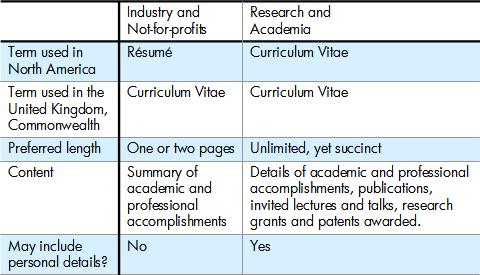
The terms résumé or curriculum vitae (CV) are near-synonyms and often used interchangeably. The sense of these terms, however, may differ in certain geographies.

Difference between Résumé and Curriculum Vitae

Usage in North America

In North America, there is a difference between the terms résumé and curriculum vitae in terms of the target audience, purpose and length.

The term résumé refers to a concise summary of a candidate’s credentials for the purpose of seeking employment in industry or the non-profit sector. A résumé, therefore, primarily summarizes the candidate’s educational background and professional experience. The preferred length of a resume is one or two pages.

A curriculum vitae is a more exhaustive record of a candidate’s qualifications and achievements primarily for seeking positions in academia and research. A curriculum vitae may include publications, fellowships and scholarships, invited lectures and talks, research grants and patents secured, etc. Some curriculum vitae contain personal details as well. Generally, there is no page-limit on a curriculum vitae. For an example, see the curriculum vitae of Donald Knuth, computer science pioneer and Professor Emeritus at Stanford University.

Usage in the United Kingdom and Commonwealth

In the United Kingdom and members of the Commonwealth, the term curriculum vitae is used for seeking employment in industry, the non-profit sector, academia or research. The term résumé is not traditionally used. The format and length of the curriculum vitae depends on the target of the curriculum vitae (industry/not-for-profit or research/academia) as in North America.

Usage in Other Countries

In some countries–India and Australia, for example–the terms résumé and curriculum vitae may be used interchangeably. In India, the term ‘bio-data’ refers to a résumé as well.

Choice between Résumé and Curriculum Vitae

Write your résumé or curriculum vitae to suit the preferred style and format of your target audience (industry or academia) irrespective of what the document is termed.

Do not include the word ‘Résumé’ or phrase ‘Curriculum Vitae’ at the top of your document—use the valuable space to enhance your document either by adding further details of your accomplishments or by increasing white space around various sections of your résumé to make it more visually appealing.

Further Reading

  • The One-page Résumé Rule
  • Fonts and Text Size for Résumés

Wondering what to read next?

  1. Resumé Tips #1: Best Fonts and Text Size for Your Resumé
  2. Resumé Tips #2: The One-page Résumé Rule
  3. Resumé Tips #3: References Not Necessary
  4. Resumé Tips #4: The Hurry-Burry Résumé
  5. Resumé Tips #6: Avoid Clichéd Superlatives and Proclamations

Filed Under: Career Development Tagged With: Resumé

Inspirational Quotations #230

July 20, 2008 By Nagesh Belludi Leave a Comment

To follow without halt, one aim; there is the secret of success. And success? What is it? I do not find it in the applause of the theatre. It lies rather in the satisfaction of accomplishment.
—Anna Pavlova (Russian Dancer)

What the world wants is character. The world is in need of those whose life is one burning love, selfless. That love will make every word tell like a thunderbolt.
—Swami Vivekananda (Indian Hindu Mystic)

They always say that time changes things, but you actually have to change them yourself.
—Andy Warhol (American Painter)

In no direction that we turn do we find ease or comfort. If we are honest and if we have the will to win we find only danger, hard work and iron resolution.
—Wendell Willkie (American Politician)

In the final analysis there is no other solution to man’s progress but the day’s honest work, the day’s honest decisions, the day’s generous utterances and the day’s good deed.
—Clare Boothe Luce (American Playwright)

Life may not be the party we hoped for, but while we’re here we should dance.
—Unknown

The best way to predict the future is to invent it.
—Alan Kay

If you first fortify yourself with the true knowledge of the Universal Self, and then live in the midst of wealth and worldliness, surely they will in no way affect you.
—Ramakrishna Paramahamsa (Indian Hindu Philosopher)

Fortunate is the person who has developed the self-control to steer a straight course toward his objective in life, without being swayed from his purpose by either commendation or condemnation.
—Napoleon Hill (American Author)

Filed Under: Inspirational Quotations

Don’t Let Perfect be the Enemy of Done

July 17, 2008 By Nagesh Belludi 1 Comment

Google’s Marissa Mayer on Perfection

In an interview with the Fast Company magazine, Marissa Mayer, Vice President of search products and user experience at Google, compares two product launch strategies:

Some [programmers] like to code for months or even years, and hope they will have built the perfect product. That’s castle building. Companies work this way, too. Apple is great at it. If you get it right and you’ve built just the perfect thing, you get this worldwide ‘Wow!’ The problem is, if you get it wrong, you get a thud, a thud in which you’ve spent, like, five years and 100 people on something the market doesn’t want.

Others prefer to have something working at the end of the day, something to refine and improve the next day. That’s what we do: our ‘launch early and often’ strategy. The hardest part about indoctrinating people into our culture is when engineers show me a prototype and I’m like, “Great, let’s go!” They’ll say, “Oh, no, it’s not ready.” … They want to castle-build and do all these other features and make it all perfect. I tell them … to launch it early on Google Labs and then iterate, learning what the market wants–and make it great. The beauty of experimenting in this way is that you never get too far from what the market wants.

By releasing new products and features before they are completely refined, as ‘beta’ releases, Google and other technology companies can gain significant advantages over the competition. The products can be marketed earlier and initial users can identify problems with unfinished products and suggest new product features. A case in point: Google’s popular ‘Gmail’ or ‘Google Mail’ application has remained ‘beta’ since April 2004.

The approach of releasing ‘half-baked’ products is limited to certain industries and products. And, for sure, these ‘beta’-products are expected to include all the critical functional features expected of the product. Airlines will not fly a new aircraft that has not yet passed comprehensive tests and regulatory certification.

‘Perfect’ Is Often THE Enemy of ‘Done’

When you aim for perfection, you discover it’s a moving target.
— George Fisher

On our personal and professional initiatives, we tend to wait for the perfect time, the perfect team, or the perfect conditions. The end-result is that we never get started on the initiative. If we do start and then aspire for a perfect design, we may never get done.

Some of us, yours truly included, are chronic perfectionists. We tend to be excessively self-critical and demanding of ourselves. Our struggle for perfection habitually turns into an endless quest for making ‘better’ a ‘little better.’ Any state of perfection ceases to exist when we question the perfection–when we ask how perfect the perfection is.

Make ‘Perfect Enough’ the New Perfect

We need to accept the prospect of compromises to our goals and aspirations. We need to acknowledge that our expectations are often excessive and uncalled for. When we develop a ‘good enough’ or ‘perfect enough’ mindset, we realize that imperfection is, after all, a negotiable outcome. There will always be a chance to improve.

Credits: Marissa Mayer’s photo courtesy of Google

Wondering what to read next?

  1. What Type of Perfectionist Are You?
  2. Don’t Over-Deliver
  3. If You Want to Be Loved, Love
  4. Busyness is a Lack of Priorities
  5. Small Steps, Big Revolutions: The Kaizen Way // Summary of Robert Maurer’s ‘One Small Step Can Change Your Life’

Filed Under: Sharpening Your Skills Tagged With: Attitudes, Getting Things Done, Perfectionism, Virtues

Use The STAR Technique to Ace Your Behavioral Interview

July 15, 2008 By Nagesh Belludi 36 Comments

Introduction

Behavioral interviewing is a popular approach to assess a candidate’s past experiences and judge his/her response to similar situations on a future job. This variety of interviewing is based on the premise that past performance in comparable circumstances is the best predictor of future performance.

Rather than ask hypothetical questions (E.g., “How will you handle…,”) interviewers ask more specific, focused questions (E.g., “Describe a time when you had to…”) to elicit concrete examples of desired behaviors from the past. For example, instead of asking an interviewee, “How will you deal with a team member who is not pulling his weight on a project?” as in a traditional interview, an interviewer using the behavioral technique may ask, “Describe a project where one of your teammates was not pulling his weight. What did you do?” For further details and sample questions, see my earlier article on behavioral interviewing.

Prior to the interview, an interviewer identifies a set of behavioral traits he/she believes is essential for professional success on a particular job assignment. He/she then selects a series of questions:

  • “Describe a time when you had to …. What did you do?”
  • “Give me an example of a time when you had to …”
  • “Tell me about a situation in the past …”

Next, the interviewer may question the interviewee further:

  • “What was the outcome?”
  • “Did you consider …?”
  • “How did the other person react?”

Instead of allowing the interviewee to theorize or generalize about events, the interviewer expects the interviewee to narrate four details for each experience: (1) what the situation was, (2) what the challenges were, (3) how the interviewee dealt with the situation, and (3) what the outcome was.

6 Steps to Answer Behavioral Interview Questions

  1. Listen to the question carefully. Commonly, behavioral interview questions tend be long-winded and may sound vague (blame an overuse of adjectives, adverbs and trendy language.) Here is an example: “Good problem-solving often includes a careful review of the substantial facts and weighing of options before making a decision. Give me an instance when you reached a practical business decision by assessing the facts and weighing the options.”
  2. Make sure you understand the question before you start to answer. You may paraphrase the question and ask the interviewer if you understand it correctly. If necessary, ask the interviewer to repeat the question. Do not, however, ask the interviewer to repeat every question—the interviewer may doubt your ability to listen.
  3. Organize your answer. Allow yourself five to eight seconds to collect your thoughts and structure your response. Interviewers appreciate this break and could use the time to drink some water, review their notes, or rest their hands from note taking.
  4. State your answer. Try to limit your answer to about three minutes. Three minutes is long enough to relate a story completely and short enough to hold the interviewer’s attention.
  5. Do not digress from your plan. Resist the temptation to think of new details as you state the answer. By sticking to your planned details and structure, you can provide a consistent, concise, and well-reasoned answer.
  6. Answer follow-up questions. In response to your three-minute answer, the interviewer may pose additional questions. These questions may require simple ‘yes’ or ‘no’ answers or brief elaboration.

The 'STAR' Technique to Answer Behavioral Interview Questions

Answering a Question: Use the STAR Technique to Narrate an Experience

In behavioral interviewing, every answer should specifically address the skill in question. Your response should relate an experience from a previous job assignment, project, academic study, or community work.

Present a diverse set of experiences. Suppose you are asked six behavioral questions during a thirty-minute interview. Supplementing each question with a distinct experience will help you portray a wide range of skills and interests.

First, examine the question: what is its purpose; what specific skill is the question addressing? Next, choose an applicable experience. In your mind, recollect and reflect on specifics of that experience. You can structure your answer a using the four steps of the ‘STAR’ technique:

  • ‘S’ for Situation: Start your answer by providing the background of your experience. Describe the circumstances of your involvement. Provide enough detail to preface the rest of your narration.
  • ‘T’ for Task: Describe the challenge at hand and what needed to be done. Give the expected outcome and any conditions that needed to be satisfied.
  • ‘A’ for Action: Elaborate your specific action in response to the challenge. Specify analytical work, team effort or project coordination. Use ‘I’ and ‘we’ statements as appropriate.
  • ‘R’ for Results: Explain the results of your efforts: what you accomplished, what you learned, how your managers and team responded, and how your organization recognized you. Wherever possible, quantify your achievements and improvements—e. g., “20% improvement in …” or “reduced manufacturing costs by 1.5 million dollars per year …”

The 'STAR' Technique to Answer Behavioral Interview Questions

An Example: Using the STAR Technique to Narrate an Experience

Consider a question posed by authors Jack and Suzy Welch in a 2008 BusinessWeek article on recruiting for leadership positions: “Have you ever had to define yourself in the midst of criticism, and did you succeed?”

Below is a ‘STAR’ answer to this interview question. The interviewee’s response illustrates their ability to listen to feedback, adapt as a manager, and lead teams well.

  • ‘S’ for Situation: “My first job after business school was to lead a product development team at Acme Corporation. One of my responsibilities involved weekly product planning meetings that chose product features. After the meeting, I would meet with my staff and delegate programming tasks. Since I am an experienced programmer, I would explain the approach to each feature to be programmed. I expected my staff to write the programs in C++, then test and debug them. We seemed to work very well as a team.”
  • ‘T’ for Task: “Three months later, my manager collected feedback from my staff. In my performance review, my manager noted that I could improve my delegation skills. His comment surprised me. I thought I was good at delegating, as I would explain my expectations and all necessary steps to each staff member. I felt my staff was productive and consistently benefitted from my coaching. I thanked my manager for the feedback and promised to reflect on my delegating style and consider a change.”
  • ‘A’ for Action: “Upon reflection, I noticed two issues with my delegation approach. Firstly, in assigning tasks to my staff I only described the steps they needed to take. I had habitually failed to describe the background of product features we wanted to develop and explain how their work would contribute to and improve the overall product. My staff would just do what I had asked of them without understanding the context of their efforts. Secondly, while explaining how to complete each assignment, I was micromanaging. This may have limited my staff’s initiative and reduced opportunities to advance their programming skills. During the next staff meeting, I thanked them for the feedback and acknowledged I would change. from that point forward, Then, each week, I explained each product feature’s unique context, described the task in terms of outcomes and asked my staff how we could approach each task.”
  • ‘R’ for Results: “My staff was very excited by the opportunity to propose ideas, brainstorm, and choose their own preferred method of going about their work. They were no longer working on my idea alone: they shared in its conception and approached it their own way. They were more enthusiastic about their work and realized they were an integral part of something bigger than they were. During the next quarterly meeting, my manager praised me for empowering my team.”

The Significant Accomplishment Question

The single most important question that you will answer in every interview is the significant accomplishment question: “Tell me about the most significant accomplishment in your life. What challenges did you face? What did you do? How did it impact your organization?” An interviewer may pose this question as one of these variations: “Tell me something you are most proud of,” “Share the one thing you want me to know,” or, “Tell me something from your past that you are really excited about.”

If there’s one question that you should prepare for, it’s this significant accomplishment question. Here is a sample answer:

“The accomplishment that I am most proud of was being named ‘Consultant of the Year’ by Acme Medical Systems in 2002. When I worked as a product development consultant at Indigo, a team of Acme Medical Systems designers hired me to develop the plastic prototype of a new Computed Tomography (CT) scanner. Acme wanted to display their new cardiac scanner to their vice president who was visiting the following week. In preparation, I was asked to help develop the prototype of the CT-scanner’s new keyboard.

“The keyboard is a large, intricate device with plenty of keys, knobs, and styluses. One of the primary challenges with prototyping this keyboard was that it was too large to fit into any standard manufacturing machine. In addition, based on the design’s complexity, I originally estimated that developing the prototype would take at least two weeks. We had just eight days, including the weekend. For the next week, I worked from 10:00 AM until midnight every day and over the weekend. On the first day, after studying the design, I proposed a modified, simpler version, which my clients accepted. The next day, I used my advanced CAD skills to digitally split the complex design into smaller components that could be manufactured individually and then assembled. The new modular design, in fact, facilitated the assembly plan.

“Initially, my clients were concerned about the assembly process. I used a finite element model to reassure them and confirm that the assembly would be sufficiently robust. Since my clients were busy working on the rest of the CT-scanner, I offered to work with the suppliers. I visited five suppliers and prepared a manufacturing budget. After my budget was approved, I chose two suppliers and spent three days supervising the manufacturing process. Then, I worked with a third supplier to have the prototype carefully assembled, painted, and delivered the day before the vice president’s visit.

“The end-result was that the prototype was prepared in half the lead-time and 40% under budget, even after paying the suppliers overtime. In addition, my modular design lowered manufacturing costs by 20% when the CT-scanner went into production. In recognition of my hard work and cost savings, Acme honored me among sixteen contenders with the ‘Consultant of the Year’ award.

Behavioral Interview Questions for Practice

Consider the following questions. Practice your answers using the four-step ‘STAR’ technique. For more questions to practice with, see my compilation of job interview questions categorized by personal attributes, career performance, communication skills, team skills, managerial skills, and leadership skills.

  • Question on team work: “Describe a situation when your team members disagreed with your ideas or proposal on a project. What did you do?”
  • Question on analytical problem-solving: “Tell me about a time when you discovered a problem before anybody else on your team. What was the nature of the problem? How did you handle it? Did you ask for help?”
  • Question on assertiveness: “Give me an example of when you had difficulty getting along with a team member. What made this person difficult to work with? How did you handle the situation?”
  • Question on customer orientation and commitment to task: “Tell me about a time when you had to reject a customer’s request. What reasons did you give? How did you communicate?”
  • Question on creativity: “What is your most creative solution to a problem?”
  • Question on working effectively with others: “What was a constructive criticism you received recently? How did you respond to it? Did your relationship with this person change?”

Concluding Thoughts

In answering interview questions, the best way to impress an interviewer is to discuss your credentials and accomplishments in terms of personal success stories. The ‘STAR’ technique is probably the best method to structure answers to interview questions. By following this simple technique, you can narrate direct, meaningful, personalized experiences that best demonstrate your qualifications.

Wondering what to read next?

  1. Job Interviewing #2: Interviewing with a Competitor of your Current Employer
  2. How to Ask for a Raise—and Negotiate in a Way That Commands Respect
  3. The Best Investment of 2025
  4. What’s Behind Your Desire to Job-Hunt and Jump Ship?
  5. Five Questions to Keep Your Job from Driving You Nuts

Filed Under: Career Development, Effective Communication Tagged With: Career Planning, Getting Ahead, Interviewing, Job Search

« Previous Page
Next Page »

Primary Sidebar

Popular Now

Anxiety Assertiveness Attitudes Balance Biases Coaching Conflict Conversations Creativity Critical Thinking Decision-Making Discipline Emotions Entrepreneurs Ethics Etiquette Feedback Getting Along Getting Things Done Goals Great Manager Innovation Leadership Lessons Likeability Mental Models Mindfulness Motivation Parables Performance Management Persuasion Philosophy Problem Solving Procrastination Psychology Relationships Resilience Simple Living Social Skills Stress Suffering Thinking Tools Thought Process Time Management Winning on the Job Wisdom

About: Nagesh Belludi [hire] is a St. Petersburg, Florida-based freethinker, investor, and leadership coach. He specializes in helping executives and companies ensure that the overall quality of their decision-making benefits isn’t compromised by a lack of a big-picture understanding.

Get Updates

Signup for emails

Subscribe via RSS

Contact Nagesh Belludi

RECOMMENDED BOOK:
How Asia Works

How Asia Works: Joe Studwell

Joe Studwell on how Asia’s post-war economic miracles emerged via land reform, government-backed manufacturing, and financial repression.

Explore

  • Announcements
  • Belief and Spirituality
  • Business Stories
  • Career Development
  • Effective Communication
  • Great Personalities
  • Health and Well-being
  • Ideas and Insights
  • Inspirational Quotations
  • Leadership
  • Leadership Reading
  • Leading Teams
  • Living the Good Life
  • Managing Business Functions
  • Managing People
  • MBA in a Nutshell
  • Mental Models
  • News Analysis
  • Personal Finance
  • Podcasts
  • Project Management
  • Proverbs & Maxims
  • Sharpening Your Skills
  • The Great Innovators

Recently,

  • Enterprise Begins in Annoyance: How One Miserable Vacation Sparked a Global Hotel Chain
  • Wishful Thinking Is Free. Movement Pays.
  • Rumination Can Turn the Mind Into a Prison of Repetition
  • Inspirational Quotations #1170
  • Conversational Narcissism: When You Make It About You
  • Reality is Messy—and Denial is Deadly
  • Don’t Exorcise Your Dark Thoughts, Examine Them

Unless otherwise stated in the individual document, the works above are © Nagesh Belludi under a Creative Commons BY-NC-ND license. You may quote, copy and share them freely, as long as you link back to RightAttitudes.com, don't make money with them, and don't modify the content. Enjoy!