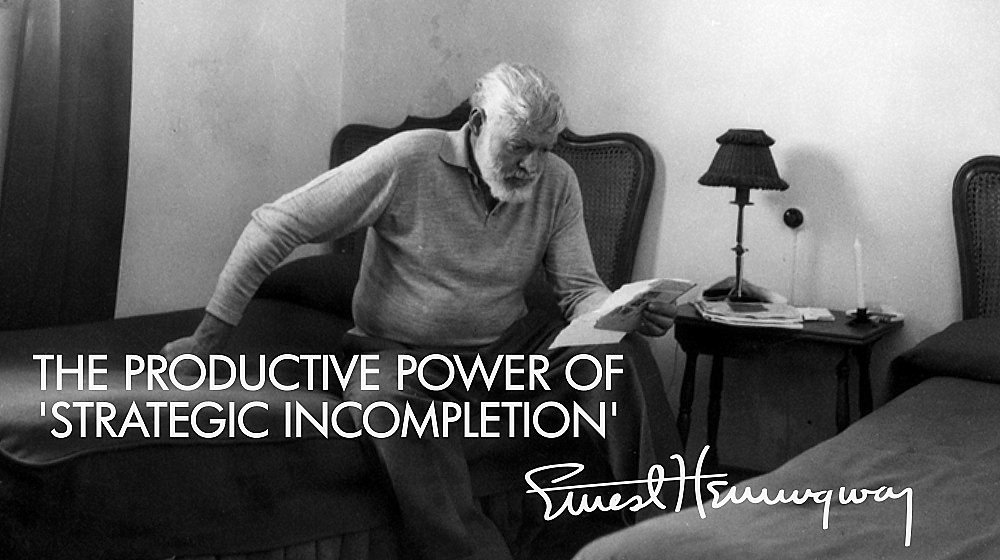
Ernest Hemingway claimed to have a disciplined writing routine. He wrote early each morning and always stopped while he still knew what came next—leaving something in the “well” for the following day. He shared this advice in various contexts, notably in a 1935 Esquire article, framing it as an antidote to creative block.
When the goal is sustained momentum in any creative or cognitive endeavor, one principle stands out: stop while the work is still alive. Hemingway wasn’t just advising writers when he said, “The best way is always to stop when you are going good and when you know what will happen next.” He was articulating a broader truth about motivation: friction.
The method is deceptively simple: pause while momentum remains. Finishing everything may feel productive, but it often kills clarity. Push past peak energy, and you return to dread. Pause midstream, and you resume with direction.
The Hemingway Principle of Continuity
This defies cultural instinct. We’re conditioned to chase closure—to exhaust ourselves chasing completion. But exhaustion isn’t discipline. The better move is knowing when to stop: at the crest of effort, when the next step is obvious—but untaken.
Hemingway distilled this perfectly: “I had learned already never to empty the well of my writing, but always to stop when there was still something there in the deep part of the well, and let it refill at night from the springs that fed it.”
He wasn’t preserving mystery—he was preserving momentum.
Applied broadly, the technique dulls resistance. Reentry becomes ritual—driven by anticipation, not obligation. You don’t resume reluctantly. You resume with hunger.
Idea for Impact: Leave your work unfinished on purpose. Not because you failed, but because the unfinished work remains fertile. Discipline isn’t about what you finish. It’s about the ability to return—again and again.
 In the modern workplace, the line between professional and personal conduct
  Few phrases in the sales playbook are as overused and quietly harmful as “going after the low-hanging fruit.” It promises quick wins, fast cash flow, and a morale boost. In the short term, it delivers. These easy deals validate a pitch, energize a team, and keep the lights on. When immediacy becomes a guiding belief,
  Ever stepped into the shower and suddenly cracked a lingering problem wide open? You turn on the water, and just like that, the perfect idea rushes in. That’s your subconscious at work, making
  Performance proves you belong. But it doesn’t earn influence, open strategic doors, or attract sponsorship. Those privileges follow likeability—not charm, not flattery, but emotional fluency grounded in trust.
.jpg "'The Charisma Myth' by Olivia Fox Cabane (ISBN 1591845947)")
 The
The 

 When work is actually decent, everything else starts to click. A good job challenges you just enough, pays the bills, surrounds you with coworkers who aren’t