• Skip to content
  • Skip to primary sidebar

Right Attitudes

Ideas for Impact

Inspirational Quotations

Inspirational Quotations #580

May 17, 2015 By Nagesh Belludi Leave a Comment

An Italian philosopher said that “time was his estate” an estate indeed which will produce nothing without cultivation, but will always abundantly repay the labors of industry, and generally satisfy the most extensive desires, if no part of it be suffered to lie in waste by negligence, to be overrun with noxious plants, or laid out for show rather than for use.
—Samuel Johnson (British Essayist)

Good leaders make people feel that they’re at the very heart of things, not at the periphery. Everyone feels that he or she makes a difference to the success of the organization. When that happens people feel centered and that gives their work meaning.
—Warren Bennis (American Scholar)

I had rather have a fool to make me merry than experience to make me sad.
—William Shakespeare (British Playwright)

When something does not insist on being noticed, when we aren’t grabbed by the collar or struck on the skull by a presence or an event, we take for granted the very things that most deserve our gratitude.
—Cynthia Ozick

In the hope of reaching the moon men fail to see the flowers that blossom at their feet.
—Albert Schweitzer (French Theologian)

It is not only what we do, but also what we do not do for which we are accountable.
—Moliere (French Playwright)

Faith is a living and unshakable confidence, a belief in the grace of God so assured that a man would die a thousand deaths for its sake.
—Martin Luther (German Protestant Theologian)

If the pain wanders, do not waste your time with doctors.
—Mignon McLaughlin (American Journalist)

Filed Under: Inspirational Quotations

Inspirational Quotations #579

May 10, 2015 By Nagesh Belludi Leave a Comment

Many talk like philosophers yet live like fools.
—Common Proverb

To do the useful thing, to say the courageous thing, to contemplate the beautiful thing: that is enough for one man’s life.
—T. S. Eliot (American-born British Poet)

Embraces are cominglings from the head even to the feet, and not a pompous high priest entering by a secret place.
—William Blake (English Poet)

For knowledge, too, is itself power.
—Francis Bacon (English Philosopher)

Everybody can be great. Because anybody can serve. You don’t have to have a college degree to serve. You don’t have to make your subject and verb agree to serve. You don’t have to know about Plato and Aristotle… (or) Einstein’s Theory of Relativity … (or) the Second Theory of Thermodynamics in physics to serve. You only need a heart full of grace. A soul generated by love.
—Martin Luther King, Jr. (American Civil Rights Leader)

When thinking won’t cure fear, action will.
—W. Clement Stone (American Businessperson)

Positive thinking will let you do everything better than negative thinking will.
—Zig Ziglar (American Author)

When we know how to read our own hearts, we acquire wisdom of the hearts of others.
—Denis Diderot (French Philosopher)

What a man knows should find its expression in what he does; the value of superior knowledge is chiefly in that it leads to a performing manhood.
—Christian Nestell Bovee

Big ideas are little ideas that no-one killed too soon.
—Seth Godin (American Entrepreneur)

An angry man is again angry with himself when he returns to reason.
—Publilius Syrus (Syrian-born Latin Writer)

It is impossible on reasonable grounds to disbelieve miracles.
—Blaise Pascal (French Catholic Mathematician)

Just as courage imperils life; fear protects it.
—Leonardo da Vinci (Italian Polymath)

A great literature is chiefly the product of inquiring minds in revolt against the immovable certainties of the nation.
—H. L. Mencken (American Journalist)

It is ridiculous for any man to criticize the works of another if he has not distinguished himself by his own performances.
—Joseph Addison (English Essayist)

If you want to be important – that’s wonderful. If you want to be great – that’s wonderful. But recognize that he who is greatest among you shall be your servant. That’s your new definition of greatness – it means that everybody can be great because everybody can serve. You don’t have to know about Plato and Aristotle to serve. You don’t have to know the second law of thermodynamics to serve. You only need a heart full of grace, a soul generated by love…
—Martin Luther King, Jr. (American Civil Rights Leader)

Those people who are uncomfortable in themselves are disagreeable to others.
—William Hazlitt (English Essayist)

Filed Under: Inspirational Quotations

Inspirational Quotations #578

May 3, 2015 By Nagesh Belludi Leave a Comment

In contemplation, if a man will begin with certainties, he shall end in doubts; but if he will be content to begin with doubts, he shall end in certainties. They are ill discoverers that think there is no land, when they can see nothing but sea.
—Francis Bacon (English Philosopher)

It is change, continuing change, inevitable change, that is the dominant factor in society today. No sensible decision can be made any longer without taking into account not only the world as it is, but the world as it will be. This, in turn, means that our statesmen, our businessmen, our every man must take on a science fictional way of thinking.
—Isaac Asimov (Russian-born American Children’s Books Writer)

Truth will ultimately prevail where there are plans taken to bring it to light.
—George Washington (American Head of State)

All men have happiness as their object: there are no exceptions. However different the means they employ, they aim at the same end.
—Blaise Pascal (French Catholic Mathematician)

Admonish your friends privately, but praise them openly.
—Publilius Syrus (Syrian-born Latin Writer)

Achievement is not always success while reputed failure often is. It is honest endeavor, persistent effort to do the best possible under any and all circumstances.
—Orison Swett Marden (American New Thought Writer)

The ultimate reason for setting goals is to entice you to become the person it takes to achieve them.
—Jim Rohn (American Entrepreneur)

The tender friendships one gives up, on parting, leave their bite on the heart, but also a curious feeling of a treasure somewhere buried.
—Antoine de Saint-Exupery (French Novelist, Aviator)

Don’t lower your expectations to meet your performance. Raise your level of performance to meet your expectations. Expect the best of yourself, and then do what is necessary to make it a reality.
—Ralph Marston

Many people would be more truthful were it not for their uncontrollable desire to talk.
—E. W. Howe (American Novelist)

Filed Under: Inspirational Quotations

Inspirational Quotations #577

April 26, 2015 By Nagesh Belludi Leave a Comment

Ability is important in our quest for success, but dependability is critical.
—Zig Ziglar (American Author)

Life is like sailing. You can use any wind to go in any direction.
—Robert Brault

To keep the body in good health is a duty, for otherwise we shall not be able to trim the lamp of wisdom, and keep our mind strong and clear. Water surrounds the lotus flower, but does not wet its petals.
—Buddhist Teaching

The more connections you and your lover make, not just between your bodies, but between your minds, your hearts, and your souls, the more you will strengthen the fabric of your relationship, and the more real moments you will experience together.
—Barbara De Angelis (American Lecturer)

Treat your body like a temple, not a woodshed. The mind and body work together. Your body needs to be a good support system for the mind and spirit. If you take good care of it, your body can take you wherever you want to go, with the power and strength and energy and vitality you will need to get there.
—Jim Rohn (American Entrepreneur)

Some people do not become thinkers simply because their memories are too good.
—Friedrich Nietzsche (German Philosopher, Scholar)

We all have possibilities we don’t know about. We can do things we don’t even dream we can do.
—Dale Carnegie (American Author)

Next to ingratitude, the most painful thing to bear is gratitude.
—Henry Ward Beecher (American Protestant Clergyman)

Use your health, even to the point of wearing it out. That is what it is for. Spend all you have before you die; do not outlive yourself.
—George Bernard Shaw (Irish Playwright)

The hardest tumble a man can make is to fall over his own bluff.
—Ambrose Bierce (American Editor)

It is those who have this imperative demand for the best in their natures, and who will accept nothing short of it, that holds the banners of progress, that set the standards, the ideals, for others.
—Orison Swett Marden (American New Thought Writer)

You do not wake up one morning a bad person. It happens by a thousand tiny surrenders of self-respect to self-interest.
—Robert Brault

There is one thing one has to have: either a soul that is cheerful by nature, or a soul made cheerful by work, love, art, and knowledge.
—Friedrich Nietzsche (German Philosopher, Scholar)

Filed Under: Inspirational Quotations

Inspirational Quotations #576

April 19, 2015 By Nagesh Belludi Leave a Comment

Living is being born slowly. It would be a little too easy if we could borrow ready-made souls.
—Antoine de Saint-Exupery (French Novelist, Aviator)

Up to a point a man’s life is shaped by environment, heredity, and the movements and changes in the world around him. Then there comes a time when it lies within his grasp to shape the clay of his life into the sort of thing he wishes to be. Only the weak blame parents, their race, their times, lack of good fortune, or the quirks of fate. Everyone has it within his power to say, ‘This I am today; that I will be tomorrow.’ The wish, however, must be implemented by deeds.
—Louis L’Amour

Creativity means believing you have greatness.
—Wayne Dyer (American Motivational Writer)

A good conscience fears no witness, but a guilty conscience is solicitous even in solitude.—If we do nothing but what is honest, let all the world know it.—But if otherwise, what does it signify to have nobody else know it, so long as I know it myself?—Miserable is he who slights that witness.
—Seneca the Younger (Lucius Annaeus Seneca) (Roman Philosopher)

The realist sees reality as concrete. The optimist sees reality as clay.
—Robert Brault

Everything is possible for him who believes.
—The Holy Bible (Scripture in the Christian Faith)

There is an ongoing battle between conscience and self-interest in which, at some point, we have to take sides.
—Robert Brault

Our happiness depends on the habit of mind we cultivate. So practice happy thinking every day. Cultivate the merry heart, develop the happiness habit, and life will become a continual feast.
—Norman Vincent Peale (American Clergyman, Self-Help Author)

Logic teaches rules for presentation, not thinking.
—Mason Cooley

Be more aware of responsibility than you are of your rights.
—Unknown

Great crises produce great men and great deeds of courage.
—John F. Kennedy (American Head of State)

To love and be loved is the great happiness of existence.
—Sydney Smith (English Anglican Writer)

I’m a slow walker, but I never walk back.
—Abraham Lincoln (American Head of State)

Filed Under: Inspirational Quotations

Inspirational Quotations #575

April 12, 2015 By Nagesh Belludi Leave a Comment

The friend within the man is that part of him which belongs to you and opens to you a door which never, perhaps, is opened to another. Such a friend is true, and all he says is true; and he loves you even if he hates you in other mansions of his heart.
—Antoine de Saint-Exupery (French Novelist, Aviator)

Every day we slaughter our finest impulses. That is why we get a heart-ache when we read those lines written by the hand of a master and recognize them as our own, as the tender shoots which we stifled because we lacked the faith to believe in our own powers, our own criterion of truth and beauty. Every man, when he gets quiet, when he becomes desperately honest with himself, is capable of uttering profound truths. We all derive from the same source. There is no mystery about the origin of things. We are all part of creation, all kings, all poets, all musicians; we have only to open up, to discover what is already there.
—Henry Miller (American Novelist)

A leader, once convinced that a particular course of action is the right one, must be undaunted when the going gets tough.
—Ronald Reagan (American Head of State)

Any emotion, if it is sincere, is involuntary.
—Mark Twain (American Humorist)

No matter how reclusive we tend to be, we picture the after-life as a community of souls. It is one thing to seek privacy in this life; it is another to face eternity alone.
—Robert Brault

It is a mistake to try to look too far ahead. The chain of destiny can only be grasped one link at a time.
—Winston Churchill (British Head of State)

Filed Under: Inspirational Quotations

The Best Inspirational Quotations by Maya Angelou

April 4, 2015 By Nagesh Belludi Leave a Comment

Today marks the birthday of Maya Angelou (1928-2014.) Born Marguerite Ann Johnson, the renowned African-American author adopted an extraordinary range of roles: she was a poet, memoirist, singer, dancer, playwright, director, actor, and even a civil rights activist.

Through all of these lenses, Angelou inspired generations of fans. She enthusiastically shared the great wisdom she acquired from many hardships, including an abusive childhood, the oppressive 1930s Deep South, and various experiences during her early adulthood.

Angelou famously channeled this hard-won wisdom through writing. Her seven autobiographies, three collections of essays and books of poetry chronicle the African American experience. Here are four must-reads from the late American author and poet:

  • 'I Know Why the Caged Bird Sings' by Maya Angelou (ISBN 0345514408) “I Know Why the Caged Bird Sings” (1969,) Angelou’s first autobiography, particularly garnered critical acclaim and international recognition. This work tells her life story of suffering and human endurance up until her teenage years and paints a stirring portrait of a young Angelou. Sent away by her parents to live with grandparents, Angelou faces and overcomes racism and deprivation. She is raped by her mother’s lover, who is later murdered. After his death, Angelou withdraws into herself, taking on a nearly mute state for the next 5 years. Later, with a mentor’s guidance, she develops a passion for books and finds her own voice. Throughout the piece, Angelou steadily gains strength of character, transforms into a dignified young woman, and is even appointed as San Francisco’s first African-American and first woman streetcar conductor. At the conclusion of this moving coming-of-age story, Angelou becomes a 16-year-old mother.
  • “And Still I Rise” (1978,) Angelou’s third volume of poetry, contains her iconic titular poem. “Still I Rise” provides rousing commentary on her ancestors’ struggles and expresses hope for a better future. The poem concludes, “I am the dream and the hope of the slave … I rise … I rise … I rise.” In 1994, Nelson Mandela recited this poem at his inauguration as President of South Africa.
  • “The Heart of a Woman” (1981,) Angelou’s fourth autobiographical installment, recounts the years between 1957 and 1962, during which she was politically active in the civil rights movement and travelled the world. The book reflects on the meaning and enormous responsibilities of motherhood as well as Angelou’s relationship with her teenage son, who, at the book’s end, leaves for college.
  • “On the Pulse of Morning” (1993.) In January 1993, at Bill Clinton’s first inauguration, Angelou once again made history. She became the second poet, the first African-American, and the first woman to recite a poem at a presidential inauguration. Angelou wrote and recited the poem “On the Pulse of Morning” to emphasize unity, social change, and public responsibility.

Inspirational Quotations by Maya Angelou

Each person deserves a day away in which no problems are confronted, no solutions searched for.
—Maya Angelou (American Poet)

The desire to reach the stars is ambitious. The desire to reach hearts is wise and most possible.
—Maya Angelou (American Poet)

We may encounter many defeats but we must not be defeated.
—Maya Angelou (American Poet)

Courage is the most important of all the virtues … One isn’t necessarily born with courage, but one is born with potential. Without courage, we cannot practice any other virtue with consistency. We can’t be kind, true, merciful, generous, or honest.
—Maya Angelou (American Poet)

If we lose love and self respect for each other, this is how we finally die.
—Maya Angelou (American Poet)

No sun outlasts its sunset but will rise again and bring the dawn.
—Maya Angelou (American Poet)

The first time someone shows you who they are, believe them.
—Maya Angelou (American Poet)

Love recognizes no barriers. It jumps hurdles, leaps fences, penetrates walls to arrive at its destination full of hope.
—Maya Angelou (American Poet)

There’s a world of difference between truth and facts. Facts can obscure the truth.
—Maya Angelou (American Poet)

History, despite its wrenching pain, cannot be unlived, but if faced with courage, need not be lived again.
—Maya Angelou (American Poet)

Try to be a rainbow in someone’s cloud.
—Maya Angelou (American Poet)

I’ve learned that people will forget what you said, people will forget what you did, but people will never forget how you made them feel.
—Maya Angelou (American Poet)

A woman who is convinced that she deserves to accept only the best, challenges herself to give the best. Then she is living phenomenally.
—Maya Angelou (American Poet)

Children’s talent to endure stems from their ignorance of alternatives.
—Maya Angelou (American Poet)

I am overwhelmed by the grace and persistence of my people.
—Maya Angelou (American Poet)

Ask For What You Want And Be Prepared To Get It.
—Maya Angelou (American Poet)

It is the belief in a power larger than myself and other than myself which allows me to venture into the unknown and even the unknowable.
—Maya Angelou (American Poet)

I’ve learned that you can tell a lot about a person by the way (s)he handles these three things: a rainy day, lost luggage, and tangled Christmas tree lights.
—Maya Angelou (American Poet)

My great hope is to laugh as much as I cry; to get my work done and try to love somebody and have the courage to accept the love in return.
—Maya Angelou (American Poet)

Love is like a virus. It can happen to anybody at any time.
—Maya Angelou (American Poet)

Live life as if it were created just for you.
—Maya Angelou (American Poet)

Life loves to be taken by the lapel and told: “I’m with you kid. Let’s go.”
—Maya Angelou (American Poet)

Never make someone a priority when all you are to them is an option.
—Maya Angelou (American Poet)

You may not control all the events that happen to you, but you can decide not to be reduced by them.
—Maya Angelou (American Poet)

I’ve learned that you shouldn’t go through life with a catchers mitt on both hands. You need to be able to throw something back.
—Maya Angelou (American Poet)

I love to see a young girl go out and grab the world by the lapels. Life’s a bitch. You’ve got to go out and kick ass.
—Maya Angelou (American Poet)

Bitterness is like cancer. It eats upon the host. But anger is like fire. It burns it all clean.
—Maya Angelou (American Poet)

Stepping onto a brand-new path is difficult, but not more difficult than remaining in a situation, which is not nurturing to the whole woman.
—Maya Angelou (American Poet)

We allow our ignorance to prevail upon us and make us think we can survive alone, alone in patches, alone in groups, alone in races, even alone in genders.
—Maya Angelou (American Poet)

If you don’t like something, change it. If you can’t change it, change your attitude. Don’t complain.
—Maya Angelou (American Poet)

It’s one of the greatest gifts you can give yourself, to forgive. Forgive everybody.
—Maya Angelou (American Poet)

There is a very fine line between loving life and being greedy for it.
—Maya Angelou (American Poet)

We delight in the beauty of the butterfly, but rarely admit the changes it has gone through to achieve that beauty.
—Maya Angelou (American Poet)

You are the sum total of everything you’ve ever seen, heard, eaten, smelled, been told, forgot – it’s all there. Everything influences each of us, and because of that I try to make sure that my experiences are positive.
—Maya Angelou (American Poet)

Jealousy in romance is like salt in food. A little can enhance the savor, but too much can spoil the pleasure and, under certain circumstances, can be life-threatening.
—Maya Angelou (American Poet)

I do not trust people who don’t love themselves and yet tell me, “I love you.” There is an African saying which is: “Be careful when a naked person offers you a shirt.”
—Maya Angelou (American Poet)

If one is lucky, a solitary fantasy can totally transform one million realities.
—Maya Angelou (American Poet)

Nothing can dim the light which shines from within.
—Maya Angelou (American Poet)

My mission in life is not merely to survive, but to thrive; and to do so with some passion, some compassion, some humor, and some style.
—Maya Angelou (American Poet)

There is no greater agony than bearing an untold story inside you.
—Maya Angelou (American Poet)

No matter what happens, or how bad it seems today, life does go on, and it will be better tomorrow.
—Maya Angelou (American Poet)

Nothing will work unless you do.
—Maya Angelou (American Poet)

The most called-upon prerequisite of a friend is an accessible ear.
—Maya Angelou (American Poet)

The love of the family, the love of the person can heal. It heals the scars left by a larger society. A massive, powerful society.
—Maya Angelou (American Poet)

Something made greater by ourselves and in turn that makes us greater.
—Maya Angelou (American Poet)

When an interviewer asked Angelou in 1985 what she’d like to read in her own obituary, Angelou replied, “What I would really like said about me is that I dared to love. By love, I mean that condition in the human spirit so profound it encourages us to develop courage and build bridges, and then to trust those bridges and cross the bridges in attempts to reach other human beings.”

“Caged Bird”—A Poem by Maya Angelou

'Conversations with Maya Angelou' by Jeffrey M. Elliot (ISBN 087805362X) Here is a snippet of Maya Angelou’s poem “Caged Bird” from the collection “Shaker, Why Don’t You Sing?”

The free bird thinks of another breeze
and the trade winds soft through the sighing trees
and the fat worms waiting on a dawn bright lawn
and he names the sky his own

But a caged bird stands on the grave of dreams
his shadow shouts on a nightmare scream
his wings are clipped and his feet are tied
so he opens his throat to sing.

The caged bird sings
with a fearful trill
of things unknown
but longed for still
and his tune is heard
on the distant hill
for the caged bird
sings of freedom.

Filed Under: Great Personalities, Inspirational Quotations, The Great Innovators

Vincent van Gogh on Living Life with Zeal and Engaging Oneself in Work

April 1, 2015 By Nagesh Belludi Leave a Comment

Self-Portrait with Bandaged Ear - Vincent van Gogh

My article earlier this week presented a brief life story of the renowned Dutch painter Vincent van Gogh followed by inspirational quotations chosen from his letters to his brother Theo.

This article will explore his philosophy of work and his sense of devotion, as evidenced by extracts mainly from Vincent’s letters to Theo. I have interspersed fascinating bits of Vincent’s life in hopes that the story of this extraordinary man who achieved so much in the face of adversity may inspire you and, perhaps, elicit further admiration (recommended biography) and even sympathy.

The Letters of Vincent van Gogh

During most of his adult years, Vincent van Gogh wrote copious letters primarily to his brother Theo. Vincent wrote less frequently to his mother, one of his sisters, friends, and collaborators. The Van Gogh Museum in Amsterdam maintains a comprehensive compilation of his letters. I also recommend “Ever Yours: The Essential Letters”, a fascinating anthology of Vincent’s letters to Theo.

'Ever Yours: The Essential Letters' by Vincent van Gogh (ISBN 0300209479) The accessible correspondence between Vincent and Theo is mostly one-way communication. This is because Theo retained the great majority of Vincent’s letters; but Vincent, owing to neglect, retained just a few of Theo’s replies.

Vincent’s letters offer a profound, soul-searching description of the jagged life of a genius who achieved much in the face of adversity. His letters make a splendid record of his life, work, and philosophy. They have provided the primary source and substance of numerous scholarly studies, particularly by art historians and psychiatrists.

Vincent’s letters reveal the inner workings of his mind and heart like few others have done. His letters were extemporaneous ‘thinking aloud’ journals: he took paper everywhere and scribbled his thoughts spontaneously while he was thinking or creating art. For this reason, Vincent’s letters aren’t easy reads—his thoughts often appear unstructured and abstruse.

Vincent van Gogh on Finding Meaningful Work

Portrait of the Postman Joseph Roulin by Vincent van Gogh Vincent embarked upon his artistic career at the somewhat advanced age of 27. According to biographers, he showed no signs that he was precocious during his childhood. All through youth, Vincent struggled to find his place in the world and held various occupations where he proved deficient. Before resolving to devote his life to art, Vincent wrote,

We’ve talked quite a lot about what we feel to be our duty and how we should arrive at something good, and we rightly came to the conclusion that first of all our goal must be to find a certain position and a profession to which we can devote ourselves entirely.

And I think that we also agreed on this point, namely that one must pay special attention to the end, and that a victory achieved after lifelong work and effort is better than one achieved more quickly.

He who lives uprightly and experiences true difficulty and disappointment and is nonetheless undefeated by it is worth more than someone who prospers and knows nothing but relative good fortune. …

… Do let us go on quietly, examining all things and holding fast to that which is good, and trying always to learn more that is useful, and gaining more experience.

If we but try to live uprightly, then we shall be all right, even though we shall inevitably experience true sorrow and genuine disappointments, and also probably make real mistakes and do wrong things, but it’s certainly true that it is better to be fervent in spirit, even if one accordingly makes more mistakes, than narrow-minded and overly cautious. [Letter to Theo, April 1878]

Vincent van Gogh’s Concept of Work and Idea of Art

Core to Vincent’s philosophy was his belief that the concept for a work must precede the execution of the work. At the beginning of his tenure as an artist, Vincent outlined his idea of art,

Art is man added to nature … nature, reality, truth, but with a significance, a conception, a character, which the artist brings out in it, and to which he gives expression … which he disentangles, sets free and interprets. [Letter to Theo, June 1879]

Vincent van Gogh on the Primacy of Work

The tragic circumstances of Vincent’s life allowed him to pursue his calling for just 11 years, the time required by most artists to master their technique fully. During those 11 years, Vincent experimented and practiced art with a steady sense of purpose. He continued to paint right up until his fateful suicide. On deeming one’s work as one’s salvation, Vincent wrote,

How much sadness there is in life! Nevertheless one must not become melancholy. One must seek distraction in other things, and the right thing is to work. [Letter to Theo, September 1883]

Echoing Martin Luther and John Calvin’s emphasis on conscientiousness and hard work (now labeled ‘Protestant work ethic‘,) Vincent believed that work is life’s highest reward and worthy of submission:

I believe more and more that to work for the sake of the work is the principle of all great artists: not to be discouraged even though almost starving, and though one feels one has to say farewell to all material comfort. [Letter to Theo, February 1886]

He firmly believed that art—or more generally, work—like religion, was a way to communion with God.

To try to understand the real significance of what the great artists, the serious masters, tell us in their masterpieces, that leads to God; one man wrote or told it in a book; another, in a picture. [Letter to Theo, July 1880]

Vincent’s letters provide a profile of the shifting quality of his moods. Later, as a mature artist, he regarded his ability to create more sacrosanct than his godliness,

I can very well do without God both in my life and in my painting, but I cannot, ill as I am, do without something which is greater than I, which is my life—the power to create. [Letter to Theo, September 1888]

Starry Night Over the Rhone by Vincent van Gogh

Vincent van Gogh on the Sense of Achievement and Identity that it Brings

Throughout his life, Vincent struggled to find meaning and establish some kind of harmonious relationship with the outer world. He seemed governed entirely by emotions (“the little emotions are the great captains of our lives and we obey them without realizing it,” he once wrote to Theo.) People found him awkward and unreasonable; he even didn’t tend to his physical appearance. He acknowledged,

It is possible that these great geniuses (Rembrandt, Delacroix, Zola, Balzac, Millet) are only madmen, and that one must be mad oneself to have boundless faith in them and a boundless admiration for them. If this is true I should prefer my insanity to the sanity of others. [Letter to Emile Bernard, July 1888]

He caused anger, strife, or embarrassment wherever he went. He struggled in his professional and romantic relationships. However, he was determined to seek his sense of social identity through work. He wrote,

What am I in the eyes of most people? A good-for-nothing, an eccentric and disagreeable man, somebody who has no position in society and never will have. Very well, even if that were true, I should want to show by my work what there is in the heart of such an eccentric man, of such a nobody. … Everyone who works with love and with intelligence finds in the very sincerity of his love for nature and art a kind of armor against the opinions of other people. [Letter to Theo, July 1882]

Vincent van Gogh on “the Secret of Beautiful Work”: Utmost Sincerity

Do you know that it is very, very necessary for honest people to remain in art? … To a great extent the cause of the evil lies in the fact that the intentions of the great landscape painters have been misconstrued. Hardly anyone knows that the secret of beautiful work lies mainly in truth and sincere sentiment. [Letter to Theo, December 1882]

One of the keys to Vincent’s greatness is his incredible sincerity to his work. He exhibited his sense of extreme sincerity in two vocations he held before he decided to devote his life to being an artist. In both these instances, he proved deficient by giving too much of what the circumstances demanded of him.

  • At age 13, Vincent apprenticed with a leading art dealer in Paris where he assisted in the sale of paintings, photographs, and lithographs. This was his first experience with art. Within months, he began discussing unreservedly his opinions about the qualities of artwork with potential customers and frequently talked them out of sales. Within a year, his employer fired Vincent for conducting himself in a manner antithetical to the interests of the art dealership.
  • At age 26, Vincent started work as a lay preacher in a mining community in southern Belgium. Vincent was seized with compassion for the miners who toiled in darkness and exposed themselves to filthy dust. Having fully committed himself to this job and wanting to be like the poor miners, he even smeared his hands and face with soot and dirt. He gave away his belongings, lived on bread and water, and slept on a sack spread out on the floor of his miserable shed. The church’s committee of elders reprimanded Vincent for carelessness in dress and lack of dignity in the conduct of his office. They chastised him for his excessive zeal and dismissed him. His mother complained of his uncompromising stubbornness: “He will never comply with the wishes of the committee, and nothing will change him.”

Portrait of Dr. Gachet by Vincent van Gogh

Vincent van Gogh on Giving Everything One’s Got to One’s Work

After nine years of meticulous experimentation and assiduous practice, Vincent developed his artistic expertise to a level where he could execute art swiftly. For the next two years, he focused on his artwork and produced masterpieces notwithstanding debilitating bouts of mental illness.

On investing in learning technique and mulling over ideas, Vincent said,

I consider making studies like sowing, and making pictures like reaping. [Letter to Theo, September 1882]

Successful people have the ability to concentrate on a single problem for extended periods of time. Vincent wrote,

The sooner one seeks to become competent in a certain position and in a certain profession, and adopts a fairly independent way of thinking and acting, and the more one observes fixed rules, the stronger one’s character becomes, and yet that doesn’t mean that one has to become narrow-minded.

It is wise to do that, for life is but short and time passes quickly. If one is competent in one thing and understands one thing well, one gains at the same time insight into and knowledge of many other things into the bargain.

It’s sometimes good to go about much in the world and to be among people, and at times one is actually obliged and called upon to do so, or it can be one way of ‘throwing oneself into one’s work unreservedly and with all one’s might’, but he who actually goes quietly about his work, alone, preferring to have but very few friends, goes the most safely among people and in the world. One should never trust it when one is without difficulties or some worry or obstacle, and one shouldn’t make things too easy for oneself. …

… Launching out into the deep is what we too must do if we want to catch anything, and if it sometimes happens that we have to work the whole night and catch nothing, then it is good not to give up after all but to let down the nets again at dawn.

And not troubling ourselves too much if we have shortcomings, for he who has none has a shortcoming nonetheless, namely that he has none, and he who thinks he is perfectly wise would do well to start over from the beginning and become a fool. [Letter to Theo, April 1878]

Vincent van Gogh Found Solace and Meaning in Painting

When he lived in the town of Arles in Southern France, he suffered his first attack of mental disturbance and cut off his own ear after a dispute with another artist during Christmas 1888. By May of 1889, he had already suffered two horrifying episodes of psychotic illness. Following a complaint about his conduct by the townspeople of Arles, he was terrified of the possibility of compulsory incarceration. He voluntarily joined the Saint-Paul Asylum in Saint-Remy-de-Provence.

Vincent could not paint during periods of mental illness while at the asylum. On the road to recovery, Vincent sought peace in nature. He found solace and meaning in painting. He drew inspiration from nature and painted some of his well-known works here, including The Starry Night, and Wheat Field series. To Vincent, budding flowers symbolized the cycle of life and butterflies represented hope. Even the metamorphosis of a caterpillar into a butterfly symbolized the ability of humans to transform,

… since nothing confutes the assumption that lines and forms and colours exist on innumerable other planets and suns as well, we are at liberty to feel fairly serene about the possibilities of painting in a better and different existence, an existence altered by a phenomenon that is perhaps no more ingenious and no more surprising than the transformation of a caterpillar into a butterfly or of a grub into a maybug. [Letter to Emile Bernard, July 1888]

Vincent van Gogh on the Frustration of Inactivity and Incoherence

One of the most impressive features of Vincent’s letters is the depth of his self-analysis, even about his debilitating illness and his helplessness with social wellbeing. Even when growing up, he possessed a difficult temper and lacked self-confidence. He wrote,

Do not imagine that I think myself perfect or that I think that many people taking me for a disagreeable character is no fault of mine. I am often terribly melancholy, irritable, hungering and thirsting, as it were, for sympathy; and when I do not get it, I try to act indifferently, speak sharply, and often even pour oil on the fire. I do not like to be in company, and often find it painful and difficult to mingle with people, to speak to them. But do you know what the cause is —if not at all, of a great deal of this? Simply nervousness; I am terribly sensitive, physically as well as morally, the nervousness having developed during those miserable years which drained my health. [Letter to Theo, July 1882]

Vincent’s lifestyle exacerbated his mental condition and compounded his problems. Towards the end of his life, he was deeply upset by the inability to paint and the incoherence in his creative process during periods of illness. After taking to work again during his stay at the Saint-Paul asylum in Saint-Remy-de-Provence, he wrote,

Life passes in this way, time does not return, but I am working furiously for the very reason that I know that opportunities for work do not recur. Especially in my case, where a more violent attack could destroy my ability to paint for good. … I am trying to recover, like someone who has meant to commit suicide, but then makes for the bank because he finds the water too cold.[Letter to Theo, September 1889]

Conceivably, at the brink of death, Vincent was conscious about his mortality.

Theo van Gogh and Johanna van Gogh-Bonger

No discussion of Vincent van Gogh (1853–90) would be complete without mention of the extraordinary devotion of his brother Theo van Gogh (1857–91) and the zeal of Theo’s wife Johanna van Gogh-Bonger (1862–1925.)

Portraits of Vincent van Gogh and Theo van Gogh

Theo van Gogh, the Devoted Brother

Vincent wouldn’t have been an artist had it not been for a squabble he had with his brother Theo who was visiting Vincent after he’d been fired from his job as a lay preacher in 1880. Until then, he held a variety of occupations—art dealer, schoolteacher, book seller, priest—where he proved deficient. Theo declared that the van Gogh family was worried about Vincent’s lack of direction in life, especially after several false starts in various vocations. Vincent once wrote,

Either inside or outside the family, they will always judge me or talk about me from different points of view, and you will always hear the most divergent opinions about me. And I blame no one for it, because relatively few people know why an artist acts as he does. [Letter to Theo, April 1881]

The ensuing dispute between Theo and Vincent marked a serious turning point in Vincent’s life: he resolved to become an artist. He would build on what was once a mere pastime. He would finally find his place in the world.

For the next eleven years, until Vincent’s tragic suicide from a self-inflicted gunshot, Theo supported Vincent not only emotionally, but also provided him a monthly stipend in exchange for his artworks.

The tragedy of Vincent’s life overwhelmed Theo. After losing his adored brother for whom he’d dedicated his life, Theo seemed no more himself. He suffered a stroke that led to paralysis. His health deteriorated rapidly and he died at the age of 33, just six months after Vincent’s death.

Johanna van Gogh-Bonger, the Determined Sister-in-Law

Vincent van Gogh signed only a few of his pieces “Vincent” but did not sign his name in full. He said,

Van Gogh is such an impossible name for many foreigners to pronounce; if it should happen that my pictures found their way to France or England, then the name would certainly be murdered, whereas the whole world can pronounce the name Vincent correctly. … they will surely recognize my work later on, and write about me when I’m dead and gone. I shall take care of that, if I can keep alive for some little time. [Quoted by Anton Kerssemakers, April 1912]

Johanna van Gogh-Bonger, Vincent van Gogh’s sister-in-law and Theo van Gogh’s wife, played a pivotal role in initiating the legacy and renown of Vincent. Johanna inherited all of Vincent’s artwork from Theo. Theo hadn’t been able to save much money because Vincent had been a perpetual drain on Theo’s earnings as an art dealer. Even though Johanna needed money to live on, she did not sell Vincent’s art.

Johanna came from a wealthy family with connections to artists throughout Europe. In the few years after Vincent’s death, Johanna contributed his art pieces to many exhibitions. She compiled 650 of his letters to Theo and published them in three volumes in 1914. She even wrote the first memoir of Vincent. She shared Theo’s conviction that, one day, Vincent’s artistic genius would be widely acknowledged. She lived to see that day.

Wondering what to read next?

  1. Inspirational Mess, Creative Clutter
  2. Mastery Reveals Through Precision: How a Young Michelangelo Won Lorenzo de’ Medici’s Patronage
  3. You Never Know What’ll Spark Your Imagination (and When)
  4. Picasso’s Blue Period: A Serendipitous Invention
  5. Van Gogh Didn’t Just Copy—He Reinvented

Filed Under: Great Personalities, Inspirational Quotations, The Great Innovators Tagged With: Artists, Christianity, Creativity, Philosophy

Inspirational Quotations by Vincent van Gogh + A Précis of the Troubled Life of an Extraordinary Man

March 30, 2015 By Nagesh Belludi 1 Comment

Self-Portrait by Vincent van Gogh

It’s the birthday of Vincent Willem van Gogh (1853–90,) the prominent Dutch painter who is renowned for his characteristic style of undulating lines and bold colors. He produced a great number of masterpiece paintings and sketches in just 11 years dedicated to art. In fact, it was during the last two years of his life that Vincent produced all of his best-known pieces. Though it may surprise us in retrospect, his work was not widely appreciated during his lifetime. Now, of course, he is considered one of the most eminent post-Impressionist painters.

Equally fascinating are the tragic circumstances of Vincent’s short life. His productivity and artistic genius are especially remarkable in the context of his debilitating illness, which caused the self-mutilation of his ear and ultimately his fateful suicide. Even to this day, the trials and tribulations of a man posthumously discovered to be an extraordinary artist elicit haunting curiosity and even sympathy.

Vincent’s letters to his brother Theo and others offer a profound, soul-searching description of the jagged life of a genius who achieved much in the face of adversity. Scholars have even wondered if he was rather a great man who painted great pictures. When understood in a certain light, Vincent’s troubled life, his devotion to art, and his sense of purpose make one of the most inspiring stories in the world.

This article provides a brief story of Vincent’s life followed by inspirational quotations chosen from his letters to Theo. A subsequent article will delve into his philosophy of work and his sense of devotion.

Vincent van Gogh’s Quest for Meaning

Young Vincent van Gogh Vincent was raised in a religious and cultured atmosphere. Growing up, he possessed a difficult temper and lacked self-confidence. All through youth, Vincent struggled to find his place in the world. This was a precursor to his life-long struggle to find meaning and establish some kind of harmonious relationship with the outer world.
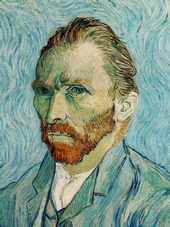
Vincent began his artistic career at the relatively advanced age. Until then, he held a variety of occupations where he had proved deficient. At age 26, Vincent started work as a lay preacher in a mining community in southern Belgium. As was his habit, Vincent quickly developed great empathy for the miners and fully committed himself to this job. He wanted to be like the poor miners—he even smeared his hands and face with soot and dirt. He gave away his belongings, lived on bread and water, and slept on a sack spread out on the floor of his miserable shed. The church’s committee of elders chastised him for his excessive zeal and fired him. His mother complained of his uncompromising stubbornness: “He will never comply with the wishes of the committee, and nothing will change him.”

Soon thereafter, Vincent’s younger brother Theo visited to discuss Vincent’s future. Theo declared that the van Gogh family was worried about Vincent’s lack of direction in life, especially after several false starts in various vocations. The ensuing dispute marked a serious turning point in Vincent’s life: he resolved to become an artist. He would build on what was once a mere pastime.

Starry Night by Vincent van Gogh

The Art of a Self-Taught Genius

Vincent van Gogh - Self-Taught Genius For the next nine years, with Theo’s financial and emotional support, Vincent traveled around Europe teaching himself to draw and paint. He struggled financially and even starved sometimes after spending the entire stipend that Theo sent him on art supplies rather than on the necessities of living. After a great deal of meticulous experimentation and assiduous practice, Vincent developed his artistic expertise to a level where he could execute art swiftly.

Vincent was an artist for just 11 years before his death. In those 11 years, he completed more than 2,150 pieces, including 860 oil paintings and more than 1,300 watercolors, drawings, and sketches. Vincent was exceptionally productive towards the end of his life, churning out work with incredible speed—he sometimes executed up to three pieces a day. His most notable paintings are Starry Night, Portrait of Dr. Gachet, Portrait of Joseph Roulin, Bedroom in Arles series, Sunflowers series, Church at Auvers, and several self-portraits including the iconic Self-Portrait with Bandaged Ear.

Following years of depression, frequent bouts of mental illness, struggles with personal relationships, and tumultuous romantic pursuits, Vincent shot himself at age 37, just when his artistic genius was starting to be acknowledged. In an unfinished final letter found on his person when he shot himself, he declared, “Well, the truth is, we can only make our pictures speak.” And speak they did: even today, art lovers marvel at Vincent’s attention to color, his ability to convey emotions, and his unique sense of observation. Although he was poor and practically unknown most of his life, Vincent’s work greatly influenced 20th century art.

The Letters of Vincent van Gogh

'Ever Yours: The Essential Letters' by Vincent van Gogh (ISBN 0300209479) Despite suffering from mental illness, Vincent possessed an extraordinary unity of mind and spirit. This is evident in the 700 letters he wrote over a period of 20 years, primarily to his beloved brother Theo. These letters are a marvelous record of his life, art, and philosophy. They are the primary source and substance for scholarly studies on Vincent’s life and work, particularly by art historians and psychiatrists.

“Ever Yours: The Essential Letters”, an absorbing anthology of correspondence between Vincent and Theo, sheds light on the shifting quality of his moods, his turbulent life, and philosophical evolution as an artist. Few other men and women have written such letters that reveal the inner workings of their minds and hearts.

I also recommend Steven Naifeh and Gregory Smith’s brilliant biography, “Van Gogh: The Life and Anthology”, and Michael Howard’s “Van Gogh: His Life & Works in 500 Images”.

Inspirational Quotations by Vincent van Gogh

If one is master of one thing and understands one thing well, one has at the same time, insight into and understanding of many things.
—Vincent van Gogh (Dutch Painter)

The fishermen know that the sea is dangerous and the storm terrible, but they have never found these dangers sufficient reason for remaining ashore.
—Vincent van Gogh (Dutch Painter)

People are often unable to do anything, imprisoned as they are in I don’t know what kind of terrible, terrible, oh such terrible cage.
—Vincent van Gogh (Dutch Painter)

It is better to be high-spirited, even though one makes more mistakes, than to be narrow-minded and all too prudent. It is good to love many things, for therein lies the true strength, and whosoever loves much performs much, and can accomplish much, and what is done in love, is well done.
—Vincent van Gogh (Dutch Painter)

Love is something eternal; the aspect may change, but not the essence.
—Vincent van Gogh (Dutch Painter)

I dream of painting and then I paint my dream.
—Vincent van Gogh (Dutch Painter)

One must work and dare if one really wants to live.
—Vincent van Gogh (Dutch Painter)

The more I think about it, the more I realize there is nothing more artistic than to love others.
—Vincent van Gogh (Dutch Painter)

For my part I know nothing with any certainty, but the sight of the stars makes me dream.
—Vincent van Gogh (Dutch Painter)

A weaver who has to direct and to interweave a great many little threads has no time to philosophize about it, but rather he is so absorbed in his work that he doesn’t think but acts, and he feels how things must go more than he can explain it.
—Vincent van Gogh (Dutch Painter)

What would life be if we had no courage to attempt anything?
—Vincent van Gogh (Dutch Painter)

The more I think it over, the more I feel that there is nothing more truly artistic than to love people.
—Vincent van Gogh (Dutch Painter)

What has changed is that my life then was less difficult and my future seemingly less gloomy, but as far as my inner self, my way of looking at things and of thinking is concerned, that has not changed. But if there has indeed been a change, then it is that I think, believe and love more seriously now what I thought, believed and loved even then.
—Vincent van Gogh (Dutch Painter)

Even the knowledge of my own fallibility cannot keep me from making mistakes. Only when I fall do I get up again.
—Vincent van Gogh (Dutch Painter)

When we are working at a difficult task and strive after a good thing, we are fighting a righteous battle, the direct reward of which is that we are kept from much evil. As we advance in life it becomes more and more difficult, but in fighting the difficulties the inmost strength of the heart is developed.
—Vincent van Gogh (Dutch Painter)

In spite of everything I shall rise again: I will take up my pencil, which I have forsaken in my great discouragement, and I will go on with my drawing.
—Vincent van Gogh (Dutch Painter)

If you hear a voice within you saying, “You are not a painter,” then by all means paint… and that voice will be silenced.
—Vincent van Gogh (Dutch Painter)

I tell you, if one wants to be active, one must not be afraid of going wrong, one must not be afraid of making mistakes now and then. Many people think that they will become good just by doing no harm—but that’s a lie, and you yourself used to call it that. That way lies stagnation, mediocrity.
—Vincent van Gogh (Dutch Painter)

If you truly love Nature, you will find beauty everywhere.
—Vincent van Gogh (Dutch Painter)

Someone has a great fire in his soul and nobody ever comes to warm themselves at it, and passers-by see nothing but a little smoke at the top of the chimney and then go on their way.
—Vincent van Gogh (Dutch Painter)

Conscience is a man’s compass.
—Vincent van Gogh (Dutch Painter)

Poetry surrounds us everywhere, but putting it on paper is, alas, not so easy as looking at it.
—Vincent van Gogh (Dutch Painter)

No matter how vacant and vain, how dead life may appear to be, the man of faith, of energy, of warmth, who knows something, will not be put off so easily.
—Vincent van Gogh (Dutch Painter)

But what is your final goal, you may ask. That goal will become clearer, will emerge slowly but surely, much as the rough draught turns into a sketch, and the sketch into a painting through the serious work done on it, through the elaboration of the original vague idea and through the consolidation of the first fleeting and passing thought.
—Vincent van Gogh (Dutch Painter)

Love always brings difficulties, that is true, but the good side of it is that it gives energy.
—Vincent van Gogh (Dutch Painter)

I must continue to follow the path I take now. If I do nothing, if I study nothing, if I cease searching, then, woe is me, I am lost. That is how I look at it—keep going, keep going come what may.
—Vincent van Gogh (Dutch Painter)

Some good must come by clinging to the right. Conscience is a man’s compass, and though the needle sometimes deviates, though one often perceives irregularities in directing one’s course by it, still one must try to follow its direction.
—Vincent van Gogh (Dutch Painter)

Let’s not forget that the little emotions are the great captains of our lives and we obey them without realizing it.
—Vincent van Gogh (Dutch Painter)

It is a pity that, as one gradually gains experience, one loses one’s youth.
—Vincent van Gogh (Dutch Painter)

But I always think that the best way to know God is to love many things.
—Vincent van Gogh (Dutch Painter)

What is true is that I have at times earned my own crust of bread, and at other times a friend has given it to me out of the goodness of his heart. I have lived whatever way I could, for better or for worse, taking things just as they came
—Vincent van Gogh (Dutch Painter)

One may have a blazing hearth in one’s soul and yet no one ever came to sit by it. Passers-by see only a wisp of smoke from the chimney and continue on their way.
—Vincent van Gogh (Dutch Painter)

If one were to say but few words, though ones with meaning, one would do better than to say many that were only empty sounds, and just as easy to utter as they were of little use.
—Vincent van Gogh (Dutch Painter)

The thing has already taken form in my mind before I start it. The first attempts are absolutely unbearable. I say this because I want you to know that if you see something worthwhile in what I am doing, it is not by accident but because of real direction and purpose.
—Vincent van Gogh (Dutch Painter)

Let’s not forget that the little emotions are the great captains of our lives and we obey them without realizing it.
—Vincent van Gogh (Dutch Painter)

It is better to be high-spirited, even though one makes more mistakes, than to be narrow-minded and all too prudent. It is good to love many things, for therein lies the true strength, and whosoever loves much performs much, and can accomplish much, and what is done in love, is well done.
—Vincent van Gogh (Dutch Painter)

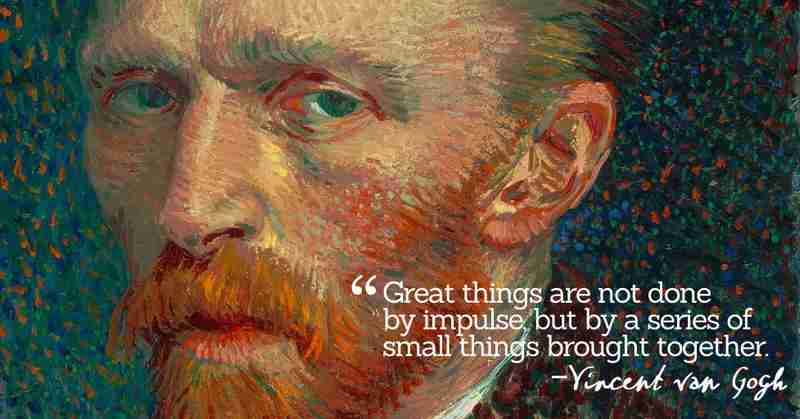
Great things are not done by impulse, but by a series of small things brought together.
—Vincent van Gogh (Dutch Painter)

It is with the reading of books the same as with looking at pictures; one must, without doubt, without hesitations, with assurance, admire what is beautiful.
—Vincent van Gogh (Dutch Painter)

Life is not long for anybody, and the problem is only to make something of it.
—Vincent van Gogh (Dutch Painter)

Wondering what to read next?

  1. Inspirational Mess, Creative Clutter
  2. Mastery Reveals Through Precision: How a Young Michelangelo Won Lorenzo de’ Medici’s Patronage
  3. You Never Know What’ll Spark Your Imagination (and When)
  4. Picasso’s Blue Period: A Serendipitous Invention
  5. Van Gogh Didn’t Just Copy—He Reinvented

Filed Under: Great Personalities, Inspirational Quotations, The Great Innovators Tagged With: Artists, Creativity

Inspirational Quotations #572

March 22, 2015 By Nagesh Belludi Leave a Comment

We must give more in order to get more, It is the generous giving of ourselves that produce the generous harvest.
—Orison Swett Marden (American New Thought Writer)

Success serves men as a pedestal; it makes them look larger, if reflection does not measure them.
—Joseph Joubert (French Essayist)

Great talents, such as honor, virtue, learning, and parts, are above the generality of the world, who neither possess them themselves, nor judge of them rightly in others; but all people are judges of the lesser talents, such as civility, affability, and an obliging, agreeable address and manner, because they feel the good effects of them, as making society easy and pleasing.
—Earl of Chesterfield

Never forget the three powerful resources you always have available to you: love, prayer, and forgiveness.
—H. Jackson Brown, Jr. (American Author)

Truth is the secret of eloquence and of virtue, the basis of moral authority; it is the highest summit of art and of life.
—Henri Frederic Amiel (Swiss Philosopher)

As you seek new opportunity, keep in mind that the sun does not usually reappear on the horizon where last seen.
—Robert Brault

A mind always employed is always happy. This is the true secret, the grand recipe, for felicity.
—Thomas Jefferson (American Head of State)

You cannot consistently perform in a manner which is inconsistent with the way you see yourself.
—Zig Ziglar (American Author)

A great many worries can be diminished by realizing the unimportance of the matter which is causing anxiety.
—Bertrand A. Russell (British Philosopher)

The creative person is willing to live with ambiguity. He doesn’t need problems solved immediately and can afford to wait for the right ideas.
—Abe Tannenbaum

Anger dwells only in the bosom of fools.
—Albert Einstein (German-born Theoretical Physicist)

The art of using moderate abilities to advantage often brings greater results than actual brilliance.
—Francois de La Rochefoucauld

Filed Under: Inspirational Quotations

« Previous Page
Next Page »

Primary Sidebar

Popular Now

Anxiety Assertiveness Attitudes Balance Biases Coaching Conflict Conversations Creativity Critical Thinking Decision-Making Discipline Emotions Entrepreneurs Etiquette Feedback Getting Along Getting Things Done Goals Great Manager Innovation Leadership Leadership Lessons Likeability Mental Models Mentoring Mindfulness Motivation Networking Parables Performance Management Persuasion Philosophy Problem Solving Procrastination Relationships Simple Living Social Skills Stress Suffering Thinking Tools Thought Process Time Management Winning on the Job Wisdom

About: Nagesh Belludi [hire] is a St. Petersburg, Florida-based freethinker, investor, and leadership coach. He specializes in helping executives and companies ensure that the overall quality of their decision-making benefits isn’t compromised by a lack of a big-picture understanding.

Get Updates

Signup for emails

Subscribe via RSS

Contact Nagesh Belludi

RECOMMENDED BOOK:
Tap Dancing to Work

Tap Dancing to Work: Warren Buffett

Insights into Warren Buffett's investment strategies and his philosophies on management, philanthropy, public policy, and even parenting. Articles by Carol Loomis, Bill Gates, and others.

Explore

  • Announcements
  • Belief and Spirituality
  • Business Stories
  • Career Development
  • Effective Communication
  • Great Personalities
  • Health and Well-being
  • Ideas and Insights
  • Inspirational Quotations
  • Leadership
  • Leadership Reading
  • Leading Teams
  • Living the Good Life
  • Managing Business Functions
  • Managing People
  • MBA in a Nutshell
  • Mental Models
  • News Analysis
  • Personal Finance
  • Podcasts
  • Project Management
  • Proverbs & Maxims
  • Sharpening Your Skills
  • The Great Innovators

Recently,

  • Founders Struggle to Lead Growing Companies
  • Inspirational Quotations #1133
  • Good Taste in Humor
  • Eat with Purpose, on Purpose
  • It’s Never About You
  • Inspirational Quotations #1132
  • What You’re Saying When You Say ‘Yes’

Unless otherwise stated in the individual document, the works above are © Nagesh Belludi under a Creative Commons BY-NC-ND license. You may quote, copy and share them freely, as long as you link back to RightAttitudes.com, don't make money with them, and don't modify the content. Enjoy!