• Skip to content
  • Skip to primary sidebar

Right Attitudes

Ideas for Impact

Career Development

Job-Hunting Tips #1: Your Online Presence can be an Asset or a Liability

January 31, 2007 By Nagesh Belludi Leave a Comment

MySpace is Everybody’s Space

A friend I spoke to last night mentioned an interesting experience with a college candidate he had considered for a full-time position in his organization. After determining that the candidate possessed first-class credentials, my friend searched for the candidate’s name on Google. He discovered that the candidate’s MySpace pages had contents that were in poor taste and lacked professional maturity. My friend said he immediately rejected the candidate from further consideration.
Many employers search the internet, the blogosphere and social networking websites such as MySpace and Facebook for more information on job candidates. Information they gather from the internet on a potential recruit can be very helpful. Quite often, an employer can learn about a candidate’s extra-curricular activities, academic papers, recognitions, scholarships, etc. —information that may not be stated in his/her résumé. In other instances, as with my friend’s experience described above, an employer can discover content that may establish a negative impression of the candidate. Internet search, therefore, can easily provide pointers to a candidate’s talents and to how he/she may portray himself/herself as a member of an organization.

Save Yourself from Embarrassment from your Online Content

Here are three few simple precautions you can take to save yourself from embarrassment during a job search and during employment.

  • Clean-up your webpages. Search engines and other archival agents frequently archive content on the internet. Online content is also distributed through web-feeds, aggregators and other circulation channels. It is difficult or usually impossible to retract information you post online. However, you can minimize the chances of prospective employers discovering more information about you by getting rid of any content that may reflect negatively on you. Many professionals are usually busy or are not tech-savvy enough to do a thorough internet search. Further, do not disclose online any personal information (birthday, marital status, political affiliations, etc.) that you will not include in your résumé or mention in a job interview.
  • Watch what you write. You do not have any control over the information you post in public domain. Other netizens may distort or misinterpret your thoughts when they quote you or link to your content. As a rule, refrain from writing mean or crude postings, portraying organizations and individuals in negative light, bad-mouthing, plagiarizing content and posting extreme opinions on sensitive topics. Maintain a professional etiquette when posting comments on others’ blogs, in newsgroups and other interactive services. If necessary, use a pseudonym on newsgroups and online forums.
  • Post insightful content that appeals to prospective employers. Discuss your personal and professional experiences and present perspectives on topics related to your career interests. Include links to your portfolio, references to papers or articles you may have published, charity events you may have participated in and other content that will supplement your résumé. Organize the details logically. If you are lucky enough, an employer may develop an interest in hiring you after surveying your site. Use a mature, professional approach to enhance your prospects for landing a job you desire.

Conclusion

Employers can eliminate candidates from consideration based on information available in the public domain. In your job search, you can leverage the networking advantage of the internet by being conscious of the professional image you project online. Generate a positive first impression that can complement an employer’s perceptions from appraising your résumé.
Wondering what to read next?

  1. An Underappreciated Way to Improve Team Dynamic
  2. Reverse Mentoring: How a Younger Advisor Can Propel You Forward
  3. Make Friends Now with the People You’ll Need Later
  4. Wide Minds, Bright Ideas: Book Summary of ‘Range: Why Generalists Triumph’ by David Epstein
  5. Likeability Is What’ll Get You Ahead

Filed Under: Career Development Tagged With: Networking, Skills for Success

Resumé Tips #1: Best Fonts and Text Size for Your Resumé

October 31, 2006 By Nagesh Belludi Leave a Comment

Blog reader Michelle from the University of Kentucky, Lexington asked me

“I am preparing my résumé for an upcoming job fair, and I’d appreciate your suggestions on the choice of fonts.”

Serif and Sans-serif Fonts

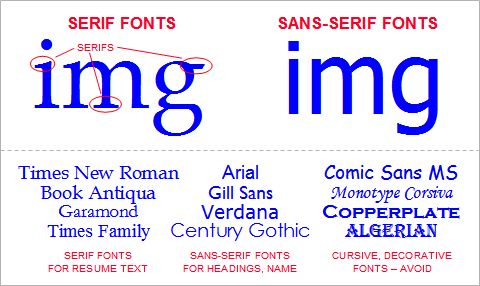
Font families are classified according to their appearance: serif fonts, sans-serif fonts, mono-space fonts, cursive fonts, fantasy fonts, etc.

Characters in serif fonts have little projections or ‘tails’ (serif = tail in French) at the end of strokes and line widths that thin out on curves. The serifs guide a reader’s eyes to flow across lines of text. Conventionally, serif fonts are used for smaller text such as blocks of texts in newspapers. Serif fonts are harder to read from a distance.

Characters in sans-serif fonts have more consistent line widths and do not have tails (sans = without in French). Sans-serif fonts appear clear and balanced in shape and in form. Conventionally, sans-serif fonts are used for larger text such as headlines or text in posters. Sans-serif fonts are the most popular choice for on-screen (TV, computer, etc.) text because of their clarity in display.

Choice of Fonts and Text Size for Résumés

Fonts for a Résumé

Résumé reviewers expect résumés to be professional–readable and inviting. Serif fonts are the de-facto standard for résumé text. Times New Roman (the default font in Microsoft Word), Book Antiqua or Palatino (my personal favorite,) Garamond and Times are the most popular serif fonts for résumés. I would suggest using serif fonts for the entire résumé. You may use sans-serif fonts for section headings and/or your name.

Cursive or decorative fonts easily distract the eye and make the résumé look unprofessional. Explore fancier fonts only if you desire a career in fine arts or graphic design.

Font size: 10-, 11- or 12-point only

Choice of Fonts and Text Size for RésumésFont size is measured in points. A point represents 1/72 of an inch; text in 72 points prints to text of one-inch height. Use a 10-, 11- or a 12-point font for content. Begin with an 11-point font and increase to a 12-point font to fill up the page or decrease to a 10-point font if you cannot fit all the details on one page. (All primary details, academic backgrounds and professional accomplishments should fit into one page.)

Section headings can be one or two points larger than content. Subheadings, such as name of the university or employer or your job title, should be set in standard font size. Do not increase the font size for your name; your name will look disproportionate.

Consistency in Formatting

As with every other detail on the résumé, viz., content, structure, paragraph spacing, etc., use consistent font formatting. In Microsoft Word, the ‘Format Painter’ tool is handy to copy formatting to various sections of text or paragraphs.

Making your Résumé Standout

On my recruiting trips to colleges, one of the most common questions students ask me is how one could make his/her résumé stand out. You can make your résumé standout primarily based on the content in the résumé: your accomplishments, academic strengths, extra-curricular involvement, leadership activities, etc.

However, résumé reviewers form their first impressions, mostly subconsciously, on how well the content is structured and how well the text is presented. On average, reviewers spend as little as fifteen seconds before they decide to read your résumé further for detailed consideration. Hence, the value of preparing a résumé with an orderly, consistent, professional look-and-feel cannot be overstated.

Wondering what to read next?

  1. Resumé Tips #2: The One-page Résumé Rule
  2. Resumé Tips #3: References Not Necessary
  3. Resumé Tips #4: The Hurry-Burry Résumé
  4. Resumé Tips #5: Résumé or Curriculum Vitae?
  5. Resumé Tips #6: Avoid Clichéd Superlatives and Proclamations

Filed Under: Career Development, Sharpening Your Skills Tagged With: Resumé

« Previous Page

Primary Sidebar

Popular Now

Anxiety Assertiveness Attitudes Balance Biases Coaching Conflict Conversations Creativity Critical Thinking Decision-Making Discipline Emotions Entrepreneurs Ethics Etiquette Feedback Getting Along Getting Things Done Goals Great Manager Innovation Leadership Lessons Likeability Mental Models Mindfulness Motivation Parables Performance Management Personal Growth Persuasion Philosophy Problem Solving Procrastination Psychology Relationships Resilience Simple Living Social Skills Stress Thinking Tools Thought Process Time Management Winning on the Job Wisdom

About: Nagesh Belludi [hire] is a St. Petersburg, Florida-based freethinker, investor, and leadership coach. He specializes in helping executives and companies ensure that the overall quality of their decision-making benefits isn’t compromised by a lack of a big-picture understanding.

Get Updates

Signup for emails

Subscribe via RSS

Contact Nagesh Belludi

RECOMMENDED BOOK:
How Asia Works

How Asia Works: Joe Studwell

Joe Studwell on how Asia’s post-war economic miracles emerged via land reform, government-backed manufacturing, and financial repression.

Explore

  • Announcements
  • Belief and Spirituality
  • Business Stories
  • Career Development
  • Effective Communication
  • Great Personalities
  • Health and Well-being
  • Ideas and Insights
  • Inspirational Quotations
  • Leadership
  • Leadership Reading
  • Leading Teams
  • Living the Good Life
  • Managing Business Functions
  • Managing People
  • MBA in a Nutshell
  • Mental Models
  • News Analysis
  • Personal Finance
  • Podcasts
  • Project Management
  • Proverbs & Maxims
  • Sharpening Your Skills
  • The Great Innovators

Recently,

  • The Commercialization of Yoga: Downward Dog, Upward Profit
  • Write Your Constitution, Then Cut What Doesn’t Fit
  • Inspirational Quotations #1175
  • How to Interview for Grit
  • Everything’s a Remix: Originality is Overrated
  • In Japan, Shame is Not a Private Torment but a Civic Virtue
  • Inspirational Quotations #1174

Unless otherwise stated in the individual document, the works above are © Nagesh Belludi under a Creative Commons BY-NC-ND license. You may quote, copy and share them freely, as long as you link back to RightAttitudes.com, don't make money with them, and don't modify the content. Enjoy!