• Skip to content
  • Skip to primary sidebar

Right Attitudes

Ideas for Impact

Nagesh Belludi

Inspirational Quotations #141

November 5, 2006 By Nagesh Belludi Leave a Comment

The elephant passing through the market-place is always beset by curs, but he cares not. He goes straight on his own way. So it is always, when a great soul appears there will be numbers to bark after him.
—Tulsidas (Indian Hindu Composer)

You become a star not because of your title; you become a star because you are adding star value to the company.
—N. R. Narayana Murthy (Indian Businessperson)

The trouble with being in the rat race is that even if you win, you’re still a rat.
—Lily Tomlin

Reminding one another of the dream that each of us aspires to may be enough for us to set each other free.
—Antoine de Saint-Exupery (French Novelist, Aviator)

Our character is a reflection of the friends we keep.
—Unknown

Follow effective action with quiet reflection.
From the quiet reflection will come even more effective action.
—Peter Drucker (Austrian-born Management Consultant)

There is only one success – to be able to spend your life in your own way, and not to give others absurd maddening claims upon it.
—Christopher Morley (American Journalist)

One of the main barriers to turning knowledge into action is the tendency to treat talking about something as equivalent to doing something about it.
—Jeffrey Pfeffer


Filed Under: Inspirational Quotations

Resumé Tips #1: Best Fonts and Text Size for Your Resumé

October 31, 2006 By Nagesh Belludi Leave a Comment

Blog reader Michelle from the University of Kentucky, Lexington asked me

“I am preparing my résumé for an upcoming job fair, and I’d appreciate your suggestions on the choice of fonts.”

Serif and Sans-serif Fonts

Font families are classified according to their appearance: serif fonts, sans-serif fonts, mono-space fonts, cursive fonts, fantasy fonts, etc.

Characters in serif fonts have little projections or ‘tails’ (serif = tail in French) at the end of strokes and line widths that thin out on curves. The serifs guide a reader’s eyes to flow across lines of text. Conventionally, serif fonts are used for smaller text such as blocks of texts in newspapers. Serif fonts are harder to read from a distance.

Characters in sans-serif fonts have more consistent line widths and do not have tails (sans = without in French). Sans-serif fonts appear clear and balanced in shape and in form. Conventionally, sans-serif fonts are used for larger text such as headlines or text in posters. Sans-serif fonts are the most popular choice for on-screen (TV, computer, etc.) text because of their clarity in display.

Choice of Fonts and Text Size for Résumés

Fonts for a Résumé

Résumé reviewers expect résumés to be professional–readable and inviting. Serif fonts are the de-facto standard for résumé text. Times New Roman (the default font in Microsoft Word), Book Antiqua or Palatino (my personal favorite,) Garamond and Times are the most popular serif fonts for résumés. I would suggest using serif fonts for the entire résumé. You may use sans-serif fonts for section headings and/or your name.

Cursive or decorative fonts easily distract the eye and make the résumé look unprofessional. Explore fancier fonts only if you desire a career in fine arts or graphic design.

Font size: 10-, 11- or 12-point only

Choice of Fonts and Text Size for RésumésFont size is measured in points. A point represents 1/72 of an inch; text in 72 points prints to text of one-inch height. Use a 10-, 11- or a 12-point font for content. Begin with an 11-point font and increase to a 12-point font to fill up the page or decrease to a 10-point font if you cannot fit all the details on one page. (All primary details, academic backgrounds and professional accomplishments should fit into one page.)

Section headings can be one or two points larger than content. Subheadings, such as name of the university or employer or your job title, should be set in standard font size. Do not increase the font size for your name; your name will look disproportionate.

Consistency in Formatting

As with every other detail on the résumé, viz., content, structure, paragraph spacing, etc., use consistent font formatting. In Microsoft Word, the ‘Format Painter’ tool is handy to copy formatting to various sections of text or paragraphs.

Making your Résumé Standout

On my recruiting trips to colleges, one of the most common questions students ask me is how one could make his/her résumé stand out. You can make your résumé standout primarily based on the content in the résumé: your accomplishments, academic strengths, extra-curricular involvement, leadership activities, etc.

However, résumé reviewers form their first impressions, mostly subconsciously, on how well the content is structured and how well the text is presented. On average, reviewers spend as little as fifteen seconds before they decide to read your résumé further for detailed consideration. Hence, the value of preparing a résumé with an orderly, consistent, professional look-and-feel cannot be overstated.

Wondering what to read next?

  1. Resumé Tips #2: The One-page Résumé Rule
  2. Resumé Tips #3: References Not Necessary
  3. Resumé Tips #4: The Hurry-Burry Résumé
  4. Resumé Tips #5: Résumé or Curriculum Vitae?
  5. Resumé Tips #6: Avoid Clichéd Superlatives and Proclamations

Filed Under: Career Development, Sharpening Your Skills Tagged With: Resumé

Inspirational Quotations #140

October 30, 2006 By Nagesh Belludi Leave a Comment

Your chances of success in any undertaking can always be measured by your belief in yourself.
—Robert Collier (American Self-Help Author)

A merely fallen enemy may rise again, but the reconciled one is truly vanquished.
—Johan Christoph Schiller

He who knows Self as the enjoyer of|The honey from the flowers of the senses,|Ever present within, ruler of time,|Goes beyond fear. For this Self is Supreme!
—The Upanishads

Perpetual inspiration is as necessary to the life of good- ness, holiness and happiness as perpetual respiration is necessary to animal life.
—William Law

The first and most important step toward success is the feeling that we can succeed.
—Nelson Boswell

Knowledge has to be improved, challenged, and increased constantly, or it vanishes.
—Peter Drucker (Austrian-born Management Consultant)

We learn…
10%… of what we read
20%… of what we hear
30%… of what we see
50%… of what we see and hear
70%… of what we discuss with others
80%… of what we experience personally
95%… of what we teach others
—William Glasser (American Psychiatrist)

We are what our thoughts have made us; so take care about what you think. Words are secondary. Thoughts live; they travel far.
—Swami Vivekananda (Indian Hindu Mystic)

Filed Under: Inspirational Quotations

How to Prepare for Meetings

October 26, 2006 By Nagesh Belludi Leave a Comment

Preparing to Attend MeetingsMeetings are important organizational tools. Whether as one-on-one conversations or as larger all-employee information sharing sessions, meetings are integral components of getting work done. Despite some obvious benefits, most meetings are not very productive and are longer than necessary. One of the primary reasons for the lower productivity of meetings is that attendees come unprepared.

Assume you have consented to attend a meeting because your participation is critical to the objective of the meeting. What questions will you ask to prepare for the meeting?

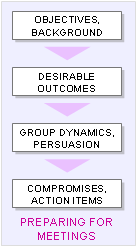
  • Have I read the meeting agenda? What is the objective of the meeting? What is my role? How will I contribute to the meeting?
  • What segment of the meeting is relevant to me? Can I join late or leave early if I am not required throughout the length of the meeting?
  • Is this a follow-up to a previous meeting? What action items had I agreed on then? What results will I present? What questions will arise?
  • What relevant pre-reading material should I seek?
  • What research do I need to do? Whom on my team should I talk to regarding items on the agenda?
  • What is the desirable outcome? What is the undesirable outcome? Is there a compromise?
  • What positions am I prepared to take on key issues being discussed in this meeting? What facts and charts will I present to support my position?
  • Who are the other attendees? What positions are they likely to take on key issues? Why? What are the likely group dynamics: who will support me, who will oppose my positions? What counter arguments will I present?
  • What other attendees should I talk to prior to the meeting to garner support to my position? Can I invite additional attendees to the meeting to help support my position? How will I persuade other people to see my point of view?
  • What action items am I willing to take? Do I have the necessary resources? Will I participate in follow-up meetings, if scheduled?

Meetings are all about sharing thoughts in a collective setting. They are only as good as the ideas that attendees bring to the discussions. By asking the above questions, you will contribute to focused, productive meetings. You owe it to yourself, the meeting leaders and to your fellow-attendees.

Wondering what to read next?

  1. How to Be a Great Conversationalist: Ask for Stories
  2. Don’t Underestimate Others’ Willingness to Help
  3. How to … Gracefully Exit a Conversation at a Party
  4. Many Creative People Think They Can Invent Best Working Solo
  5. The Curse of Teamwork: Groupthink

Filed Under: Managing People, Sharpening Your Skills Tagged With: Meetings

Inspirational Quotations #139

October 22, 2006 By Nagesh Belludi Leave a Comment

Concentration can be cultivated. One can learn to exercise will-power, discipline one’s body and train one’s mind.
—Anil Ambani (Indian Businessperson)

Love your job, but never fall in love with your company because you never know when the company stops loving you.
—N. R. Narayana Murthy (Indian Businessperson)

Most of what we call management consists of making it difficult for people to get their work done.
—Peter Drucker (Austrian-born Management Consultant)

There are many truths of which the full meaning cannot be realized until personal experience has brought it home.
—John Stuart Mill (English Philosopher, Economist)

We become like those with whom we associate: a mirror reflects a man’s face, but what he is really like is shown by the kind of friends he chooses.
—The Holy Bible (Scripture in the Christian Faith)

The chief duty I long to accomplish great and noble tasks, but it is my chief duty to accomplish humble tasks as though they were great and noble. The world is moved along, not only by the mighty shoves of its heroes, but also by the aggregate of the tiny pushes of each honest worker.
—Helen Keller (American Author)

Do your work with your whole heart, and you will succeed—there’s so little competition.
—Elbert Hubbard (American Writer)

Not to be cheered by praise, not to be grieved by blame, but to know thoroughly one’s own virtues or powers are the characteristics of an excellent man.
—Sakya Pandita

Filed Under: Inspirational Quotations

Virus on iPods: Apple blames Microsoft Windows

October 20, 2006 By Nagesh Belludi Leave a Comment

On Wednesday, Apple’s iPod support website acknowledged that a small number of video iPods were infected with a Windows virus. In addition to describing the scale of infection and providing instructions to remove the virus, the website blamed Microsoft Windows for the glitch.

“As you might imagine, we are upset at Windows for not being more hardy against such viruses, and even more upset with ourselves for not catching it.”

Apple’s “114,000 viruses? Not on a Mac” advertisements have lately targeted Windows users to ‘Get a Mac’. Presumably, someone at Apple [AAPL] believed that blaming Microsoft Windows for viruses on the iPod could extend its ‘Get a Mac’ campaign. The outcome is a cheap shot at the competition.

The iPods were apparently infected with the virus at one of Apple’s contract manufacturers. There is no reason for Apple to be “upset” at Microsoft for not being more hardy against such viruses.” Microsoft [MSFT] has invested significant resources (money and talent) fighting hackers and improving its software development process. As Jonathan Poon of the Microsoft virus-scanning group pointed out on his blog, Apple should blame its own manufacturing system.

“It’s not a matter of which platform that the virus originated. The fact that it’s found on the portable player means that there’s an issue with how the quality checks, specifically the content check was done.”

Apple should also blame hackers, who were creative enough to get malicious code embedded on an Apple product while it was connected to a Windows machine on Apple’s manufacturing line.

The take-away lessons: (1) possess a healthy respect for the competition, and, (2) blaming the competition without cause constitutes poor taste.

Wondering what to read next?

  1. When Growth Stalls: A Case Study of the iPhone
  2. Three Leadership Lessons from Ron Johnson’s Debacle at J.C. Penney
  3. No Amount of Shared Triumph Makes a Relationship Immune to Collapse
  4. Microsoft’s Resurgence Story // Book Summary of CEO Satya Nadella’s ‘Hit Refresh’
  5. Evolution, Not Revolution

Filed Under: Business Stories, Managing Business Functions, News Analysis Tagged With: Apple, Microsoft

Overcoming the Temptation to Please

October 18, 2006 By Nagesh Belludi Leave a Comment

You can close more business in two months by becoming interested in other people than you can in two years by trying to get people interested in you.
– Dale Carnegie

We desire that people around us like us; we yearn for their respect and affection. We depend on the choices these people make: be it in a job interview with a corporate recruiter, a performance review with a boss or a project delegation meeting with a team member. Clearly, the more likeable we are, the more people are ‘on our side,’ and therefore, the more likely they will make decisions in our favor.

Doing what others want to gain their approval regardless of the merit of their wants is, therefore, a temptation. Companies are tempted to pursue short-term profit-enhancing strategies to satisfy stock market expectations. Politicians are tempted to devise welfare schemes to help garner votes in an upcoming election. A professional is tempted to please the boss by agreeing to everything the boss asks.

We need to be tough-minded—we need to base our decisions and actions on facts, not personal inclinations. It takes courage and discipline to resist the lure of pleasing others. Making an objective decision that is unfavorable for a requester may disappoint him/her; however, a candid explanation of the rationale behind the choice often appeases the requestor. Being tough-minded does not mean being inflexible or insensitive. Being tough-minded involves doing what is just and right after careful consideration of procedures and people.

I encourage you to reflect on your actions and decisions by asking yourselves if you make these choices to please other people or if you make these choices based on the virtue of facts. Improving your likability should be a wish and not a goal.

Wondering what to read next?

  1. The Likeability Factor: Whose “Do Not Pair” List Includes You?
  2. Likeability Is What’ll Get You Ahead
  3. A Trick to Help you Praise At Least Three People Every Day
  4. Avoid Control Talk
  5. It’s Never About You

Filed Under: Managing People, Sharpening Your Skills Tagged With: Likeability, Personality, Relationships

Inspirational Quotations #138

October 15, 2006 By Nagesh Belludi Leave a Comment

In doing your work in the great world, it is a safe plan to follow a rule I once heard on the football field: Don’t flinch, don’t fall; hit the line hard”.”
—Theodore Roosevelt (American Head of State)

Where you end up isn’t the most important thing. It’s the road you take to get there. The road you take is what you’ll look back on and call your life.
—Tim Wiley

When it comes to the future, there are three kinds of people: those who let it happen, those who make it happen, and those who wonder what happened.
—John M. Richardson, Jr.

A fool always finds a greater fool to admire him.
—Nicolas Boileau-Despreaux

Luck is a loser’s excuse for a winner’s success.
—Unknown

If you listen, you will hear. If you look, you will see. If you touch, you will feel. If you try, you will be.
—Becky Stanford

Luck is a loser’s excuse for a winner’s effort and commitment. Failure doesn’t happen unless you allow it.
—Anonymous

Half the world is composed of people who have something to say and can’t, and the other half who have nothing to say and keep on saying it.
—Robert Frost (American Poet)

My grandfather once told me that there are two kinds of people: those who do the work and those who take the credit. He told me to try to be in the first group; there was less competition there.
—Indira Gandhi (Indian Head of State)

Life is not a problem to be solved, but a reality to be experienced.
—Soren Kierkegaard (Danish Philosopher, Theologian)

Filed Under: Inspirational Quotations

Inspirational Quotations #137

October 8, 2006 By Nagesh Belludi Leave a Comment

If you want others to be happy, practice compassion. If you want to be happy, practice compassion.
—The 14th Dalai Lama (Tibetan Buddhist Religious Leader)

Get a good idea and stay with it. Dog it, and work at it until it’s done right.
—Walt Disney (American Entrepreneur)

Another flaw in the human character is that everybody wants to build and nobody wants to do maintenance.
—Kurt Vonnegut (American Novelist)

People love others not for who they are, but for how they make them feel.
—Irwin Federman

The opposite of love is not hate, it’s indifference. The opposite of art is not ugliness, it’s indifference. The opposite of faith is not heresy, it’s indifference. And the opposite of life is not death, it’s indifference.
—Elie Wiesel (Romanian-born American Writer)

^Challenge^ The challenge is not to win, but to conquer the fear. It is not the other people you have to beat, it is your self.
—Herman Melville (American Novelist)

Wrinkles should merely indicate where smiles have been.
—Mark Twain (American Humorist)

There are times when a man should be content with what he has, but never with what he is.
—William George Jordan (American Essayist)

Filed Under: Inspirational Quotations

Respect for Employees: Cases from RadioShack and Northwest Airlines

October 6, 2006 By Nagesh Belludi

Lisa Haneberg wrote about RadioShack [RSE] laying off 400 workers and informing them of the decision via email. Lisa’s Management Craft blog article records her thoughts on this choice.

Human resources… People are not just resources like computer systems and Post It notes. Our employees, all of them, even the underperforming ones who ought to be let go, are our partners. They are our business family. Even when it is the right thing to do to let someone go, we need to remember that they are important partners. How we leave a relationship is just as important as how we enter into it.

‘101 Ways to Save Money’

Northwest Airlines terminal at Detroit Metropolitan AirportThis reminds me of another instance of careless mistakes at Northwest Airlines. The company, currently operating under Chapter 11 bankruptcy protection, is considering additional layoffs and pay cuts for employees.

A few weeks ago, a booklet distributed to likely-to-be-laid-off ground workers is reported to have advised them on saving money: “don’t be shy about pulling something you like out of the trash” and “take a date for a walk along the beach or in the woods” along with more sensible tips like “brown bag your lunch” and “refinance your mortgage.” See the full list of ‘101 Ways to Save Money’ here.

Irrespective of the organizational and financial state of the company, including tips such as the above in employee communication is careless, insensitive and insulting to the dignity of the workers, especially when they are candidates for potential layoffs. An appropriate supervisory review of this publication prior to release could have easily avoided the bad publicity and ill will that this incident generated.

As alluded to every year in Fortune magazine’s ranking of the ‘best companies to work for’ in America, employees’ attitudes towards their organizations have a profound effect on the performance of companies. Further, better performance leads to higher morale among the employees; this results in a virtuous cycle of company performance and employee morale. The primary means of achieving high employee morale is by co-creating a corporate culture that instills a sense of ownership through empowerment, trust and fair treatment, by instilling pride for personal and organizational achievements and by providing adequate opportunities for personal and career growth.

Filed Under: Managing People, News Analysis

« Previous Page
Next Page »

Primary Sidebar

Popular Now

Anxiety Assertiveness Attitudes Balance Biases Coaching Conflict Conversations Creativity Critical Thinking Decision-Making Discipline Emotions Entrepreneurs Ethics Etiquette Feedback Getting Along Getting Things Done Goals Great Manager Innovation Leadership Leadership Lessons Likeability Mental Models Mindfulness Motivation Parables Performance Management Persuasion Philosophy Problem Solving Procrastination Psychology Relationships Simple Living Social Skills Stress Suffering Thinking Tools Thought Process Time Management Winning on the Job Wisdom

About: Nagesh Belludi [hire] is a St. Petersburg, Florida-based freethinker, investor, and leadership coach. He specializes in helping executives and companies ensure that the overall quality of their decision-making benefits isn’t compromised by a lack of a big-picture understanding.

Get Updates

Signup for emails

Subscribe via RSS

Contact Nagesh Belludi

RECOMMENDED BOOK:
A Guide to the Good Life

A Guide to the Good Life: William Irvine

Philosophy professor William Irvine's practical handbook includes actionable advice for self-improvement by applying the ancient stoic wisdom to contemporary life.

Explore

  • Announcements
  • Belief and Spirituality
  • Business Stories
  • Career Development
  • Effective Communication
  • Great Personalities
  • Health and Well-being
  • Ideas and Insights
  • Inspirational Quotations
  • Leadership
  • Leadership Reading
  • Leading Teams
  • Living the Good Life
  • Managing Business Functions
  • Managing People
  • MBA in a Nutshell
  • Mental Models
  • News Analysis
  • Personal Finance
  • Podcasts
  • Project Management
  • Proverbs & Maxims
  • Sharpening Your Skills
  • The Great Innovators

Recently,

  • The Fallacy of Outsourced Sin: The Cow Paradox in India
  • Inspirational Quotations #1151
  • Don’t Ruin Your Brilliant Idea by Talking About It
  • Gandhi’s Wheel, Apple’s Spin: The Paradox of Apple’s ‘Think Different’ Campaign
  • Book Summary: Hadley Freeman’s ‘Life Moves Pretty Fast’—How ’80s Movies Wrote America’s Story
  • Inspirational Quotations #1150
  • Corporate Boardrooms: The Governance Problem Everyone Knows and Nobody Fixes

Unless otherwise stated in the individual document, the works above are © Nagesh Belludi under a Creative Commons BY-NC-ND license. You may quote, copy and share them freely, as long as you link back to RightAttitudes.com, don't make money with them, and don't modify the content. Enjoy!