• Skip to content
  • Skip to primary sidebar

Right Attitudes

Ideas for Impact

Nagesh Belludi

Resumé Tips #5: Résumé or Curriculum Vitae?

July 22, 2008 By Nagesh Belludi Leave a Comment

The terms résumé or curriculum vitae (CV) are near-synonyms and often used interchangeably. The sense of these terms, however, may differ in certain geographies.
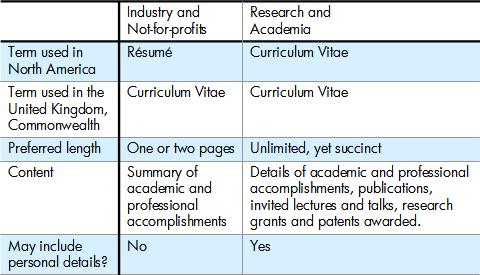
Difference between Résumé and Curriculum Vitae

Usage in North America

In North America, there is a difference between the terms résumé and curriculum vitae in terms of the target audience, purpose and length.

The term résumé refers to a concise summary of a candidate’s credentials for the purpose of seeking employment in industry or the non-profit sector. A résumé, therefore, primarily summarizes the candidate’s educational background and professional experience. The preferred length of a resume is one or two pages.

A curriculum vitae is a more exhaustive record of a candidate’s qualifications and achievements primarily for seeking positions in academia and research. A curriculum vitae may include publications, fellowships and scholarships, invited lectures and talks, research grants and patents secured, etc. Some curriculum vitae contain personal details as well. Generally, there is no page-limit on a curriculum vitae. For an example, see the curriculum vitae of Donald Knuth, computer science pioneer and Professor Emeritus at Stanford University.

Usage in the United Kingdom and Commonwealth

In the United Kingdom and members of the Commonwealth, the term curriculum vitae is used for seeking employment in industry, the non-profit sector, academia or research. The term résumé is not traditionally used. The format and length of the curriculum vitae depends on the target of the curriculum vitae (industry/not-for-profit or research/academia) as in North America.

Usage in Other Countries

In some countries–India and Australia, for example–the terms résumé and curriculum vitae may be used interchangeably. In India, the term ‘bio-data’ refers to a résumé as well.

Choice between Résumé and Curriculum Vitae

Write your résumé or curriculum vitae to suit the preferred style and format of your target audience (industry or academia) irrespective of what the document is termed.

Do not include the word ‘Résumé’ or phrase ‘Curriculum Vitae’ at the top of your document—use the valuable space to enhance your document either by adding further details of your accomplishments or by increasing white space around various sections of your résumé to make it more visually appealing.

Further Reading

  • The One-page Résumé Rule
  • Fonts and Text Size for Résumés

Wondering what to read next?

  1. Resumé Tips #1: Best Fonts and Text Size for Your Resumé
  2. Resumé Tips #2: The One-page Résumé Rule
  3. Resumé Tips #3: References Not Necessary
  4. Resumé Tips #4: The Hurry-Burry Résumé
  5. Resumé Tips #6: Avoid Clichéd Superlatives and Proclamations

Filed Under: Career Development Tagged With: Resumé

Inspirational Quotations #230

July 20, 2008 By Nagesh Belludi Leave a Comment

To follow without halt, one aim; there is the secret of success. And success? What is it? I do not find it in the applause of the theatre. It lies rather in the satisfaction of accomplishment.
—Anna Pavlova (Russian Dancer)

What the world wants is character. The world is in need of those whose life is one burning love, selfless. That love will make every word tell like a thunderbolt.
—Swami Vivekananda (Indian Hindu Mystic)

They always say that time changes things, but you actually have to change them yourself.
—Andy Warhol (American Painter)

In no direction that we turn do we find ease or comfort. If we are honest and if we have the will to win we find only danger, hard work and iron resolution.
—Wendell Willkie (American Politician)

In the final analysis there is no other solution to man’s progress but the day’s honest work, the day’s honest decisions, the day’s generous utterances and the day’s good deed.
—Clare Boothe Luce (American Playwright)

Life may not be the party we hoped for, but while we’re here we should dance.
—Unknown

The best way to predict the future is to invent it.
—Alan Kay

If you first fortify yourself with the true knowledge of the Universal Self, and then live in the midst of wealth and worldliness, surely they will in no way affect you.
—Ramakrishna Paramahamsa (Indian Hindu Philosopher)

Fortunate is the person who has developed the self-control to steer a straight course toward his objective in life, without being swayed from his purpose by either commendation or condemnation.
—Napoleon Hill (American Author)

Filed Under: Inspirational Quotations

Don’t Let Perfect be the Enemy of Done

July 17, 2008 By Nagesh Belludi 1 Comment

Google’s Marissa Mayer on Perfection

In an interview with the Fast Company magazine, Marissa Mayer, Vice President of search products and user experience at Google, compares two product launch strategies:

Some [programmers] like to code for months or even years, and hope they will have built the perfect product. That’s castle building. Companies work this way, too. Apple is great at it. If you get it right and you’ve built just the perfect thing, you get this worldwide ‘Wow!’ The problem is, if you get it wrong, you get a thud, a thud in which you’ve spent, like, five years and 100 people on something the market doesn’t want.

Others prefer to have something working at the end of the day, something to refine and improve the next day. That’s what we do: our ‘launch early and often’ strategy. The hardest part about indoctrinating people into our culture is when engineers show me a prototype and I’m like, “Great, let’s go!” They’ll say, “Oh, no, it’s not ready.” … They want to castle-build and do all these other features and make it all perfect. I tell them … to launch it early on Google Labs and then iterate, learning what the market wants–and make it great. The beauty of experimenting in this way is that you never get too far from what the market wants.

By releasing new products and features before they are completely refined, as ‘beta’ releases, Google and other technology companies can gain significant advantages over the competition. The products can be marketed earlier and initial users can identify problems with unfinished products and suggest new product features. A case in point: Google’s popular ‘Gmail’ or ‘Google Mail’ application has remained ‘beta’ since April 2004.

The approach of releasing ‘half-baked’ products is limited to certain industries and products. And, for sure, these ‘beta’-products are expected to include all the critical functional features expected of the product. Airlines will not fly a new aircraft that has not yet passed comprehensive tests and regulatory certification.

‘Perfect’ Is Often THE Enemy of ‘Done’

When you aim for perfection, you discover it’s a moving target.
— George Fisher

On our personal and professional initiatives, we tend to wait for the perfect time, the perfect team, or the perfect conditions. The end-result is that we never get started on the initiative. If we do start and then aspire for a perfect design, we may never get done.

Some of us, yours truly included, are chronic perfectionists. We tend to be excessively self-critical and demanding of ourselves. Our struggle for perfection habitually turns into an endless quest for making ‘better’ a ‘little better.’ Any state of perfection ceases to exist when we question the perfection–when we ask how perfect the perfection is.

Make ‘Perfect Enough’ the New Perfect

We need to accept the prospect of compromises to our goals and aspirations. We need to acknowledge that our expectations are often excessive and uncalled for. When we develop a ‘good enough’ or ‘perfect enough’ mindset, we realize that imperfection is, after all, a negotiable outcome. There will always be a chance to improve.

Credits: Marissa Mayer’s photo courtesy of Google

Wondering what to read next?

  1. What Type of Perfectionist Are You?
  2. How to Banish Your Inner Perfectionist
  3. You Can’t Know Everything
  4. Busyness is a Lack of Priorities
  5. Small Steps, Big Revolutions: The Kaizen Way // Summary of Robert Maurer’s ‘One Small Step Can Change Your Life’

Filed Under: Sharpening Your Skills Tagged With: Attitudes, Getting Things Done, Perfectionism, Virtues

Use The STAR Technique to Ace Your Behavioral Interview

July 15, 2008 By Nagesh Belludi 35 Comments

Introduction

Behavioral interviewing is a popular approach to assess a candidate’s past experiences and judge his/her response to similar situations on a future job. This variety of interviewing is based on the premise that past performance in comparable circumstances is the best predictor of future performance.

Rather than ask hypothetical questions (E.g., “How will you handle…,”) interviewers ask more specific, focused questions (E.g., “Describe a time when you had to…”) to elicit concrete examples of desired behaviors from the past. For example, instead of asking an interviewee, “How will you deal with a team member who is not pulling his weight on a project?” as in a traditional interview, an interviewer using the behavioral technique may ask, “Describe a project where one of your teammates was not pulling his weight. What did you do?” For further details and sample questions, see my earlier article on behavioral interviewing.

Prior to the interview, an interviewer identifies a set of behavioral traits he/she believes is essential for professional success on a particular job assignment. He/she then selects a series of questions:

  • “Describe a time when you had to …. What did you do?”
  • “Give me an example of a time when you had to …”
  • “Tell me about a situation in the past …”

Next, the interviewer may question the interviewee further:

  • “What was the outcome?”
  • “Did you consider …?”
  • “How did the other person react?”

Instead of allowing the interviewee to theorize or generalize about events, the interviewer expects the interviewee to narrate four details for each experience: (1) what the situation was, (2) what the challenges were, (3) how the interviewee dealt with the situation, and (3) what the outcome was.

6 Steps to Answer Behavioral Interview Questions

  1. Listen to the question carefully. Commonly, behavioral interview questions tend be long-winded and may sound vague (blame an overuse of adjectives, adverbs and trendy language.) Here is an example: “Good problem-solving often includes a careful review of the substantial facts and weighing of options before making a decision. Give me an instance when you reached a practical business decision by assessing the facts and weighing the options.”
  2. Make sure you understand the question before you start to answer. You may paraphrase the question and ask the interviewer if you understand it correctly. If necessary, ask the interviewer to repeat the question. Do not, however, ask the interviewer to repeat every question—the interviewer may doubt your ability to listen.
  3. Organize your answer. Allow yourself five to eight seconds to collect your thoughts and structure your response. Interviewers appreciate this break and could use the time to drink some water, review their notes, or rest their hands from note taking.
  4. State your answer. Try to limit your answer to about three minutes. Three minutes is long enough to relate a story completely and short enough to hold the interviewer’s attention.
  5. Do not digress from your plan. Resist the temptation to think of new details as you state the answer. By sticking to your planned details and structure, you can provide a consistent, concise, and well-reasoned answer.
  6. Answer follow-up questions. In response to your three-minute answer, the interviewer may pose additional questions. These questions may require simple ‘yes’ or ‘no’ answers or brief elaboration.

The 'STAR' Technique to Answer Behavioral Interview Questions

Answering a Question: Use the STAR Technique to Narrate an Experience

In behavioral interviewing, every answer should specifically address the skill in question. Your response should relate an experience from a previous job assignment, project, academic study, or community work.

Present a diverse set of experiences. Suppose you are asked six behavioral questions during a thirty-minute interview. Supplementing each question with a distinct experience will help you portray a wide range of skills and interests.

First, examine the question: what is its purpose; what specific skill is the question addressing? Next, choose an applicable experience. In your mind, recollect and reflect on specifics of that experience. You can structure your answer a using the four steps of the ‘STAR’ technique:

  • ‘S’ for Situation: Start your answer by providing the background of your experience. Describe the circumstances of your involvement. Provide enough detail to preface the rest of your narration.
  • ‘T’ for Task: Describe the challenge at hand and what needed to be done. Give the expected outcome and any conditions that needed to be satisfied.
  • ‘A’ for Action: Elaborate your specific action in response to the challenge. Specify analytical work, team effort or project coordination. Use ‘I’ and ‘we’ statements as appropriate.
  • ‘R’ for Results: Explain the results of your efforts: what you accomplished, what you learned, how your managers and team responded, and how your organization recognized you. Wherever possible, quantify your achievements and improvements—e. g., “20% improvement in …” or “reduced manufacturing costs by 1.5 million dollars per year …”

The 'STAR' Technique to Answer Behavioral Interview Questions

An Example: Using the STAR Technique to Narrate an Experience

Consider a question posed by authors Jack and Suzy Welch in a 2008 BusinessWeek article on recruiting for leadership positions: “Have you ever had to define yourself in the midst of criticism, and did you succeed?”

Below is a ‘STAR’ answer to this interview question. The interviewee’s response illustrates their ability to listen to feedback, adapt as a manager, and lead teams well.

  • ‘S’ for Situation: “My first job after business school was to lead a product development team at Acme Corporation. One of my responsibilities involved weekly product planning meetings that chose product features. After the meeting, I would meet with my staff and delegate programming tasks. Since I am an experienced programmer, I would explain the approach to each feature to be programmed. I expected my staff to write the programs in C++, then test and debug them. We seemed to work very well as a team.”
  • ‘T’ for Task: “Three months later, my manager collected feedback from my staff. In my performance review, my manager noted that I could improve my delegation skills. His comment surprised me. I thought I was good at delegating, as I would explain my expectations and all necessary steps to each staff member. I felt my staff was productive and consistently benefitted from my coaching. I thanked my manager for the feedback and promised to reflect on my delegating style and consider a change.”
  • ‘A’ for Action: “Upon reflection, I noticed two issues with my delegation approach. Firstly, in assigning tasks to my staff I only described the steps they needed to take. I had habitually failed to describe the background of product features we wanted to develop and explain how their work would contribute to and improve the overall product. My staff would just do what I had asked of them without understanding the context of their efforts. Secondly, while explaining how to complete each assignment, I was micromanaging. This may have limited my staff’s initiative and reduced opportunities to advance their programming skills. During the next staff meeting, I thanked them for the feedback and acknowledged I would change. from that point forward, Then, each week, I explained each product feature’s unique context, described the task in terms of outcomes and asked my staff how we could approach each task.”
  • ‘R’ for Results: “My staff was very excited by the opportunity to propose ideas, brainstorm, and choose their own preferred method of going about their work. They were no longer working on my idea alone: they shared in its conception and approached it their own way. They were more enthusiastic about their work and realized they were an integral part of something bigger than they were. During the next quarterly meeting, my manager praised me for empowering my team.”

The Significant Accomplishment Question

The single most important question that you will answer in every interview is the significant accomplishment question: “Tell me about the most significant accomplishment in your life. What challenges did you face? What did you do? How did it impact your organization?” An interviewer may pose this question as one of these variations: “Tell me something you are most proud of,” “Share the one thing you want me to know,” or, “Tell me something from your past that you are really excited about.”

If there’s one question that you should prepare for, it’s this significant accomplishment question. Here is a sample answer:

“The accomplishment that I am most proud of was being named ‘Consultant of the Year’ by Acme Medical Systems in 2002. When I worked as a product development consultant at Indigo, a team of Acme Medical Systems designers hired me to develop the plastic prototype of a new Computed Tomography (CT) scanner. Acme wanted to display their new cardiac scanner to their vice president who was visiting the following week. In preparation, I was asked to help develop the prototype of the CT-scanner’s new keyboard.

“The keyboard is a large, intricate device with plenty of keys, knobs, and styluses. One of the primary challenges with prototyping this keyboard was that it was too large to fit into any standard manufacturing machine. In addition, based on the design’s complexity, I originally estimated that developing the prototype would take at least two weeks. We had just eight days, including the weekend. For the next week, I worked from 10:00 AM until midnight every day and over the weekend. On the first day, after studying the design, I proposed a modified, simpler version, which my clients accepted. The next day, I used my advanced CAD skills to digitally split the complex design into smaller components that could be manufactured individually and then assembled. The new modular design, in fact, facilitated the assembly plan.

“Initially, my clients were concerned about the assembly process. I used a finite element model to reassure them and confirm that the assembly would be sufficiently robust. Since my clients were busy working on the rest of the CT-scanner, I offered to work with the suppliers. I visited five suppliers and prepared a manufacturing budget. After my budget was approved, I chose two suppliers and spent three days supervising the manufacturing process. Then, I worked with a third supplier to have the prototype carefully assembled, painted, and delivered the day before the vice president’s visit.

“The end-result was that the prototype was prepared in half the lead-time and 40% under budget, even after paying the suppliers overtime. In addition, my modular design lowered manufacturing costs by 20% when the CT-scanner went into production. In recognition of my hard work and cost savings, Acme honored me among sixteen contenders with the ‘Consultant of the Year’ award.

Behavioral Interview Questions for Practice

Consider the following questions. Practice your answers using the four-step ‘STAR’ technique. For more questions to practice with, see my compilation of job interview questions categorized by personal attributes, career performance, communication skills, team skills, managerial skills, and leadership skills.

  • Question on team work: “Describe a situation when your team members disagreed with your ideas or proposal on a project. What did you do?”
  • Question on analytical problem-solving: “Tell me about a time when you discovered a problem before anybody else on your team. What was the nature of the problem? How did you handle it? Did you ask for help?”
  • Question on assertiveness: “Give me an example of when you had difficulty getting along with a team member. What made this person difficult to work with? How did you handle the situation?”
  • Question on customer orientation and commitment to task: “Tell me about a time when you had to reject a customer’s request. What reasons did you give? How did you communicate?”
  • Question on creativity: “What is your most creative solution to a problem?”
  • Question on working effectively with others: “What was a constructive criticism you received recently? How did you respond to it? Did your relationship with this person change?”

Concluding Thoughts

In answering interview questions, the best way to impress an interviewer is to discuss your credentials and accomplishments in terms of personal success stories. The ‘STAR’ technique is probably the best method to structure answers to interview questions. By following this simple technique, you can narrate direct, meaningful, personalized experiences that best demonstrate your qualifications.

Wondering what to read next?

  1. Job Interviewing #2: Interviewing with a Competitor of your Current Employer
  2. Wouldn’t You Take a Pay Cut to Get a Better Job Title?
  3. The Best Investment of 2025
  4. What’s Behind Your Desire to Job-Hunt and Jump Ship?
  5. Before Jumping Ship, Consider This

Filed Under: Career Development, Effective Communication Tagged With: Career Planning, Getting Ahead, Interviewing, Job Search

Inspirational Quotations #229

July 13, 2008 By Nagesh Belludi 1 Comment

He who loves the world as his body may be entrusted with the empire.
—Laozi (Chinese Philosopher)

If I were to begin life again,|I should want it as it was.|I would only open my eyes a little more.
—Jules Renard (French Novelist)

God will hold us responsible for all the wonderful things that we have refused to enjoy.
—Anonymous

No one can make you feel inferior without your consent.
—Eleanor Roosevelt (American First Lady)

Undertake something that is difficult; it will do you good. Unless you try to do something beyond what you have already mastered, you will never grow.
—Ronald E. Osborn

Man, know thyself.
—Socrates (Anceient Greek Philosopher)

We have always held to the hope, the belief, the conviction that there is a better life, a better world, beyond the horizon.
—Franklin D. Roosevelt (American Head of State)

We greatly overestimate what we can accomplish in one year. But we greatly underestimate what we can accomplish in five years.
—Peter Drucker (Austrian-born Management Consultant)

Nothing is more endangered in the modern world than the powerful combination of hard work toward meaningful goals joined with an exuberant embrace of the present moment.
—Tom Morris

The reason why all men honor love is because it looks up, and not down; aspires and not despairs.
—Ralph Waldo Emerson (American Philosopher)

Filed Under: Inspirational Quotations

Inspirational Quotations #228

July 5, 2008 By Nagesh Belludi Leave a Comment

Don’t be a cynic and disconsolate preacher. Don’t bewail and moan. Omit the negative propositions. Challenge us with incessant affirmatives. Don’t waste yourself in rejection, or bark against the bad, but chant the beauty of the good.
—Ralph Waldo Emerson (American Philosopher)

When ideas fail, words come in very handy.
—Johann Wolfgang von Goethe (German Poet)

Nothing is so contagious as enthusiasm.—It is the real allegory of the tale of Orpheus; it moves stones, and charms brutes.—It is the genius of sincerity, and truth accomplishes no victories without it.
—Samuel Taylor Coleridge (English Poet)

Perfection does not come from belief or faith. Talk does not count for anything. Parrots can do that. Perfection comes through selfless work.
—Swami Vivekananda (Indian Hindu Mystic)

Ah, good taste! What a dreadful thing! Taste is the enemy of creativeness.
—Pablo Picasso (Spanish Painter)

Don’t be a cynic and disconsolate preacher. Don’t bewail and bemoan. Omit the negative propositions. Nerve us with incessant affirmatives. Don’t waste yourself in rejection, nor bark against the bad, but chant the beauty of the good. When that is spoken which has a right to be spoken, the chatter and the criticism will stop. Set down nothing that will help somebody.
—Ralph Waldo Emerson (American Philosopher)

I had no vision of the scope of what I would start. But I had confidence that as long as we did our work well and were good to our customers, there would be no limit to us.
—Sam Walton (American Entrepreneur)

I love you, not only for what you are, but for what I am when I am with you.
—Unknown

For SUCCESS, like HAPPINESS, cannot be pursued,
it is the unintended side effect of one’s personal
dedication to a course greater than oneself.
—Viktor Frankl (Austrian Physician)

Seek self-discipline with all your soul. Devote yourself to worship and save your soul. Be grateful that God gave you the gift of self-discipline, for you had no power over it. He inspired it within you with the command, “Be!”
—Jalal ad-Din Muhammad Rumi (Persian Muslim Mystic)

Nothing is so contagious as enthusiasm.—It is the real allegory of the tale of Orpheus; it moves stones, and charms brutes.—It is the genius of sincerity, and truth accomplishes no victories without it.
—Edward Bulwer-Lytton, 1st Baron Lytton (English Poet)

Again and again I therefore admonish my students in Europe and America: Don’t aim at success—the more you aim at it and make it a target, the more you are going to miss it. For success, like happiness, cannot be pursued; it must ensue, and it only does so as the unintended side effect of one’s personal dedication to a cause greater than oneself or as the by-product of one’s surrender to a person other than oneself. Happiness must happen, and the same holds for success: you have to let it happen by not caring about it. I want you to listen to what your conscience commands you to do and go on to carry it out to the best of your knowledge. Then you will live to see that in the long-run—in the long-run, I say!—success will follow you precisely because you had forgotten to think about it.
—Viktor Frankl (Austrian Physician)

Are you excited because things are going well, or are things going well because you’re excited?
—Anonymous

Filed Under: Inspirational Quotations

How to Make Eye Contact [Body Language]

July 3, 2008 By Nagesh Belludi

Humanity is imparted on us by actions and language and by looks and glances. We start to comprehend humanity soon after birth in the eyes of our parents, our siblings, and other loved ones. The glances of their eyes have profound meanings—even the subtlest of glimpses could convey emotions of love and hostility, cheerfulness and anxiety, approval and disapproval. The glances elevate us from our insignificance and instinctively make us feel more significant. In “La vie commune. Essai d’anthropologie generale,” Bulgarian-French philosopher and essayist Tzvetan Todorov declares,

The child seeks its mother’s eyes not only so that she will come to feed and comfort him but because the very fact that she looks at him gives him an indispensable complement: it confirms his own existence … As if they recognized the importance of this moment – though such is not the case – parent and child can look at each other’s eyes for a long time. Such an action is totally exceptional in the case of adults, when looking at each other’s eyes for more than ten seconds can only signify one of two things: both partners are either going to fight or make love.

Eyes are the Mirror of the Soul

“The eyes are the mirror of the soul.”
– A Yiddish Proverb

Our eyes play a major role in our interpersonal communication. The eyes express our moods and reactions more overtly than does other body language. Largely, observant people can attempt to understand our attitudes through the nature of our eye contact, our facial expressions, and body language.

When we meet other people, we usually observe their eyes first. When we speak, we tend to look other’s eyes. In return, we expect our audience to look at our eyes and pay their undivided attention. Hence, making and keeping good eye contact with others is an important habit.

President John F. Kennedy’s Technique for Eye Contact

The Reader’s Digest guide ‘How to Write and Speak Better’ notes a technique used by President John F Kennedy.

When people look and listen they tend to focus on one eye rather than both. Kennedy, however, would look from eye to eye when he listened, softening the expression in his own eyes at the same time, and so giving the impression that he cared greatly about the speaker’s feelings.

Trick: Make a Mental Note of Their Eye Color

The ‘ Success Begins Today‘ blog cites a technique from Nicholas Boothman’s book, “How to Connect in Business in 90 Seconds”

Eye contact and smile … it’s a simple courtesy and leads to a relaxed conversation. If you tend to be a shy person, this may be somewhat difficult for you. You may tend to look down or away when greeting someone. This can break the conversation right away.

When you meet or greet someone for the first time, just make a mental note of their eye color. This simple technique is amazingly effective. If you are looking for their eye color you’ll automatically make eye contact for a second or two.

Keeping Eye Contact in Conversations

When people maintain eye contact during a conversation, others usually interpret the eye contact as a sign of interest, confidence, honesty, compassion, and sympathy depending on the nature of the conversation. Failure to maintain eye contact may be interpreted as signs of suppression of emotions or truth, distraction, disagreement, confusion, reticence or lack of interest. Further, when people react to blame or accusation or are provoked into defensiveness or aggressiveness, their eye contact increase considerably—often, their pupils dilate.

Individual Differences

Many people, due to innate shyness or cultural background, tend to evade or curtail eye contact. They do not realize that, even if they are sincere and confident, their lack of eye contact could inadvertently communicate insincerity and lack of self-assurance.

Cultural Differences

The amount of eye contact varies dramatically in different cultures. In Asian cultures, for instance, where formal social structures (age, experience, social status, etc.) exist, eye contact with somebody superior can be offending. In some parts of India, men and women do not keep eye contact with their in-laws, out of respect. In most cultures, a longer eye contact while interacting with the other gender may be read as a sign of intimacy and expression of interest.

Gender Differences in Eye Contact

  • Between men, prolonged eye contact may signal aggression or intent to dominate–especially so during acquaintance or if the men are not completely familiar with each other’s expectations. Although more contact is tolerable as a relationship grows, eye contact needs to be broken often.
  • Women tend to maintain better eye contact in conversations with other women–more so with friends and family than with strangers. Generally, women interpret eye contact as a sign of trust and compassion.
  • Prolonged eye contact, an intent-look in particular, between men and women may quickly be interpreted as a sign of intimate interest. In the absence of romantic interest, concentrated eye contact must be avoided.

Avoid Staring and Gazing into Somebody’s Eyes

Staring or gazing at other individuals is typically awkward, sometimes intimidating. Never overdo an eye contact. Break eye contact often.

Idea for Impact: Learn to Keep Eye Contact

People who keep good eye contact are usually seen as personable, self-assured and confident. In the context of cultural backgrounds of the people around you, consider what messages your eye contact and body language may be unconsciously communicating about you. A firm handshake and a smile at the onset of a meeting, and eye contact throughout your conversations can establish a good impression of you.

Wondering what to read next?

  1. Want to be more likeable? Improve your customer service? Adopt Sam Walton’s “Ten-Foot Rule”
  2. How to Increase Your Likeability: The 10/5 Rule
  3. Avoid Control Talk
  4. The Trouble with Accusing Someone of Virtue Signaling
  5. A Trick to Help you Praise At Least Three People Every Day

Filed Under: Effective Communication, Sharpening Your Skills Tagged With: Body Language, Etiquette, Likeability, Personality

Inspirational Quotations #227

June 29, 2008 By Nagesh Belludi Leave a Comment

Meditation has been defined as the cessation of active eternal thought.
—Helena Blavatsky (Ukrainian-born American Theosophist)

Even fate cannot touch him whose heart is filled with compassion, whose words always reflect the truth and whose body is always meant to help others.
—Subhashita Manjari

When you become detached mentally from yourself and concentrate on helping other people with their difficulties, you will be able to cope with your own more effectively. Somehow, the act of self-giving is a personal power-releasing factor.
—Norman Vincent Peale (American Clergyman, Self-Help Author)

A little inaccuracy sometimes saves tons of explanation.
—Saki (Hector Hugh Munro) (British Short Story Writer)

A particular breed of dog may cost a lot of money, but only love will make its tail wag.
—Unknown

He has honor if he holds himself to an ideal of conduct though it is inconceivable, unprofitable, or dangerous to do so.
—Walter Lippmann (American Journalist)

It’s not a question of who’s going to throw the first stone; it’s a question of who’s going to start building with it.
—Sloan Wilson (American Novelist)

What we leave behind is not engraved in stone monuments but woven into the lives of others.
—Pericles

The best way to have a good idea is to have lots of ideas.
—Linus Pauling (American Chemist)

Filed Under: Inspirational Quotations

‘Stealth’ Layoffs and Employee Morale

June 28, 2008 By Nagesh Belludi Leave a Comment

‘For Wall Street Workers, Ax Falls Quietly’

Last month, the New York Times reported about ‘stealth’ layoffs in the financial services industry. The story refers to a trend of Wall Street firms downsizing their workforces by laying people off without formal announcements. It appears that, at these firms, managements rarely discuss layoffs in meetings or formal communications to preclude negative publicity. As a result, employees cannot easily identify what divisions are targeted for layoffs or whether they’ll stay or go.

Here are excerpts from the “For Wall Street Workers, Ax Falls Quietly” story.

  • Some bosses hardly say a word after people are fired. At Citigroup, Goldman Sachs and Morgan Stanley, for example, the first clue that someone is gone can be e-mail messages that are returned to senders from a former colleague’s inactivated corporate address.
  • Some Lehman Brothers investment bankers found out their jobs were in peril when they saw cardboard boxes and dumpster bins in the hallways in March.
  • And when Bank of America dismissed some bankers recently, it told them that their annual bonuses had been almost wiped out and that their personal belongings would arrive in the mail.
  • “Nobody knows who is coming in; nobody knows who is going out,” said JoAnne Kennedy, who was laid off by JPMorgan Chase this year. “They want to keep it all as quiet as possible.” In January, when Ms. Kennedy was temporarily out of the office at JPMorgan because of surgery, her boss called to say her job had been eliminated. She did not return to her office and ended up asking the bank to send her the photos of her son that she kept on her desk. [Note: Reorganized]

Impending Layoffs Initiate Distraction and Poor Employee Morale

Portait of Ben Bernanke, Chairman of the US Federal Reserve, with the caption 'Big Ben, We're Totally Screwed' After about five years of terrific across-the-industry performance and sky-high compensations, the financial services sector is presently reeling in a downturn—triggered by the sub-prime crisis, credit crunch and stunted returns in capital markets. Under present circumstances, Wall Street firms can justify downsizing their workforce. Still, the trend of ‘stealth’ layoffs amounts to unfair treatment of employees. Ironically, it is likely that these very companies publicly pride themselves on the talent of their workforce and boast “our people are our most important assets” in annual reports.

The practice of ‘stealth’ layoffs establishes an environment of mistrust and apprehension. Employees cannot focus on their work, speculate on ‘who is next,’ and prepare themselves for a potential dismissal. Employees may even hesitate to take vacations for fear of returning to a dismissal. The end result is poor morale and possible defections of talented people to competing firms.

[Image above: A portrait of Ben Bernanke, Chairman of the US Federal Reserve, with the caption ‘Big Ben, We’re Totally Screwed’ in reference to the sub-prime crisis. I photographed this portrait across from the New York Stock Exchange (NYSE) in November ’07. The artist had placed this portrait on auction at eBay.]

Layoffs are Never Easy

Often, business decisions entail some pain. Layoffs are never easy—for executives of a large organization facing the need to downsize by thousands or for a manager trying to dismiss one of his/her employees. Habitually, managers dread the prospect of facing employees being dismissed. Formal top-to-bottom communication and candid conversations with affected employees are obligations of the management. Employees being dismissed rightfully deserve to hear a respectful and honest assessment of the reasons for layoffs. They merit an offer for support through the transition and in pursuing employment elsewhere. This is the essence of true corporate character.

Wondering what to read next?

  1. What Every Manager Should Know Why Generation Y Quits
  2. Don’t Surround Yourself with People Like Yourself
  3. Create a Diversity and Inclusion Policy
  4. The Speed Trap: How Extreme Pressure Stifles Creativity
  5. Teams That Thrive make it Safe to Speak & Safe to Fail

Filed Under: Managing People, News Analysis Tagged With: Human Resources

Inspirational Quotations #226

June 22, 2008 By Nagesh Belludi Leave a Comment

Enthusiasm is: A quiet spiritual strength: An inner glow: Faith in action: Greatest asset in the world: Beats money power influence: Tramples over prejudice.
—Henry Chester

Face your deficiencies and acknowledge them; but do not let them master you. Let them teach you patience, sweetness, insight… When we do the best we can, we never know what miracle is wrought in our life, or in the life of another.
—Helen Keller (American Author)

The creative knows the great beginnings. The Receptive completes the finished things.
—I. Ching

If you absolutely can’t tolerate critics, then don’t do anything new or interesting.
—Jeff Bezos (American Businessman)

As we express our gratitude, we must never forget that the highest appreciation is not to utter words, but to live by them.
—John F. Kennedy (American Head of State)

God is merciful to those whom He sees struggling heart and soul for realization. But remain idle, without any struggle, and you will see that His grace will never come.
—Swami Vivekananda (Indian Hindu Mystic)

Some things cannot be spoken or discovered until we have been stuck, incapacitated, or blown off course for awhile. Plain sailing is pleasant, but you are not going to explore many unknown realms that way.
—David Whyte

Let not the fierce sun dry one tear of pain before thyself hast wiped it from the sufferer’s eye.
—Helena Blavatsky (Ukrainian-born American Theosophist)

If you think twice before you speak once, you will speak better for it.
—Anonymous

Let us carefully observe those good qualities wherein our enemies excel us; and endeavor to excel them, by avoiding what is faulty, and imitating what is excellent in them.
—Plutarch (Ancient Greek Historian)

Yesterday is a cancelled check; tomorrow is a promissory note; today is the only cash you have—so spend it wisely.
—Unknown

Enthusiasm is the greatest asset in the world.
It beats money, power and influence.
—Henry Chester

Filed Under: Inspirational Quotations

« Previous Page
Next Page »

Primary Sidebar

Popular Now

Anxiety Assertiveness Attitudes Balance Biases Coaching Conflict Conversations Creativity Critical Thinking Decision-Making Discipline Emotions Entrepreneurs Ethics Etiquette Feedback Getting Along Getting Things Done Goals Great Manager Innovation Leadership Leadership Lessons Likeability Mental Models Mindfulness Motivation Parables Performance Management Persuasion Philosophy Problem Solving Procrastination Psychology Relationships Simple Living Social Skills Stress Suffering Thinking Tools Thought Process Time Management Winning on the Job Wisdom

About: Nagesh Belludi [hire] is a St. Petersburg, Florida-based freethinker, investor, and leadership coach. He specializes in helping executives and companies ensure that the overall quality of their decision-making benefits isn’t compromised by a lack of a big-picture understanding.

Get Updates

Signup for emails

Subscribe via RSS

Contact Nagesh Belludi

RECOMMENDED BOOK:
The Wright Brothers

The Wright Brothers: David McCullough

Historian David McCullough's enjoyable, fast-paced tale of how the Wrights broke through against great odds to invent inventing powered flight.

Explore

  • Announcements
  • Belief and Spirituality
  • Business Stories
  • Career Development
  • Effective Communication
  • Great Personalities
  • Health and Well-being
  • Ideas and Insights
  • Inspirational Quotations
  • Leadership
  • Leadership Reading
  • Leading Teams
  • Living the Good Life
  • Managing Business Functions
  • Managing People
  • MBA in a Nutshell
  • Mental Models
  • News Analysis
  • Personal Finance
  • Podcasts
  • Project Management
  • Proverbs & Maxims
  • Sharpening Your Skills
  • The Great Innovators

Recently,

  • The Fallacy of Outsourced Sin: The Cow Paradox in India
  • Inspirational Quotations #1151
  • Don’t Ruin Your Brilliant Idea by Talking About It
  • Gandhi’s Wheel, Apple’s Spin: The Paradox of Apple’s ‘Think Different’ Campaign
  • Book Summary: Hadley Freeman’s ‘Life Moves Pretty Fast’—How ’80s Movies Wrote America’s Story
  • Inspirational Quotations #1150
  • Corporate Boardrooms: The Governance Problem Everyone Knows and Nobody Fixes

Unless otherwise stated in the individual document, the works above are © Nagesh Belludi under a Creative Commons BY-NC-ND license. You may quote, copy and share them freely, as long as you link back to RightAttitudes.com, don't make money with them, and don't modify the content. Enjoy!