• Skip to content
  • Skip to primary sidebar

Right Attitudes

Ideas for Impact

Nagesh Belludi

Inspirational Quotations #326

May 30, 2010 By Nagesh Belludi Leave a Comment

Isn’t it the mind that translates the outer condition into happiness and suffering?
—Matthieu Ricard (French Buddhist Monk)

The hardest time to tell: when to stop.
—Malcolm Forbes (American Publisher)

We don’t believe in rheumatism and true love until after the first attack.
—Marie von Ebner-Eschenbach (Austrian Novelist)

It is better to drink of deep griefs than to taste shallow pleasures.
—William Hazlitt (English Essayist)

Anything simple always interests me.
—David Hockney

There is but one way to be born but a hundred ways to die.
—Chinese Proverb

I do not know anyone who has got to the top without hard work. That is the recipe. It will not always get you to the top, but should get you pretty near.
—Margaret Thatcher (British Head of State)

The one charm of the past is that it is the past.
—Oscar Wilde (Irish Poet)

Virtue is praised, but hated. People run from it, for it is ice-cold and in this world you have to keep your feet warm.
—Denis Diderot (French Philosopher)

Nothing is more despicable than respect based on fear.
—Albert Camus (Algerian-born French Philosopher)

Filed Under: Inspirational Quotations

Inspirational Quotations #325

May 23, 2010 By Nagesh Belludi Leave a Comment

It’s what you learn after you know it all that counts.
—John Wooden (American Sportsperson)

Integrity has no need of rules.
—Albert Camus (Algerian-born French Philosopher)

A hug is the perfect gift–one size fits all, and nobody minds if you exchange it.
—Ivern Ball (American Writer, Aphorist)

As the rays come from the sun, and yet are not the sun, even so our love and pity, though they are not God, but merely a poor, weak image and reflection of Him, yet from him alone they come.
—Charles Kingsley (English Clergyman)

The human mind treats a new idea the way the body treats a strange protein; it rejects it.
—Peter Medawar

Happiness makes up in height what it lacks in length.
—Robert Frost (American Poet)

Adversity has ever been considered the state in which a man most easily becomes acquainted with himself, then, especially, being free from flatterers.
—Samuel Johnson (British Essayist)

Opportunity is missed by most people because it is dressed in overalls and looks like work.
—Thomas Edison (American Inventor)

Happiness is not having what you want, but wanting what you have.
—Hyman Judah Schachtel (American Jewish Religious Leader)

It’s what you learn after you know it all that counts.
—Unknown

You can safely assume you’ve created God in your own image when it turns out that God hates all the same people you do.
—Anne Lamott

Nature creates ability; luck provides it with opportunity.
—Francois de La Rochefoucauld

When a man dwells on the objects of sense, he creates an attraction for them; attraction develops into desire, and desire breeds anger.
—The Bhagavad Gita (Hindu Scripture)

Filed Under: Inspirational Quotations

Inspirational Quotations #324

May 15, 2010 By Nagesh Belludi Leave a Comment

A coach is someone who can give correction without causing resentment.
—John Wooden (American Sportsperson)

Happiness walks on busy feet.
—Anonymous

Throughout the centuries there were men who took first steps down new roads armed with nothing but their own vision.
—Ayn Rand (Russian-born American Novelist)

Everything comes to us that belongs to us if we create the capacity to receive it.
—Rabindranath Tagore (Indian Hindu Polymath)

Wisdom doesn’t come with age. Wisdom comes with wisdom.
—Neil Simon

To confess your fallibility and then do nothing about it is not humble; it is boasting of your modesty.
—Eliezer Yudkowsky (American Scientist)

Live according to Nature, runs the maxim of the West; but according to what nature, the nature of the body or the nature which exceeds the body ? This first we ought to determine.
—Sri Aurobindo (Indian Yogi, Nationalist)

Hard is it to be in the world, free, yet living the life of ordinary men; but because it is hard, therefore it must be attempted and accomplished.
—Sri Aurobindo (Indian Yogi, Nationalist)

Celebrate the happiness that friends are always giving; make every day a holiday and celebrate just living.
—Amanda Bradley

It is better to live with wild beasts wandering in the mountains, than with fools even in the comfortable and heavenly halls of the Lord of Gods.
—Neetishatakam

Filed Under: Inspirational Quotations

Inspirational Quotations #323

May 10, 2010 By Nagesh Belludi Leave a Comment

Climb mountains to see lowlands.
—Chinese Proverb

It isn’t what you do, but how you do it.
—John Wooden (American Sportsperson)

We are at our very best, and we are happiest, when we are fully engaged in work we enjoy on the journey toward the goal we’ve established for ourselves. It gives meaning to our time off and comfort to our sleep. It makes everything else in life so wonderful, so worthwhile.
—Earl Nightingale (American Motivational Speaker)

How we spend our days is, of course, how we spend our lives.
—Annie Dillard

It’s not so important who starts the game but who finishes it.
—John Wooden (American Sportsperson)

The meeting of preparation with opportunity generates the offspring we call luck.
—Tony Robbins (American Actor Author)

It is impossible to live pleasurably without living prudently, and honorably, and justly; or to live prudently, and honorably, and justly, without living pleasurably.
—Epicurus (Ancient Greek Philosopher)

The very best way to learn self-control is by practicing self-control.
—Sterling W. Sill (American Mormon Religious Leader)

What’s the use of happiness? It can’t buy you money.
—Henny Youngman

Happiness is like peeing your pants: Everyone can see it, but only you can feel it’s warmth.
—Unknown

Only a life lived for others is a life worth while.
—Albert Einstein (German-born Theoretical Physicist)

I see God walking in every human form. When I meet different people, I say to myself, “God in the form of the saint, God in the form of the sinner, God in the form of the righteous, God in the form of the unrighteous.”
—Ramakrishna Paramahamsa (Indian Hindu Philosopher)

Filed Under: Inspirational Quotations

Telecommuting: Out of sight, Out of mind

May 7, 2010 By Nagesh Belludi Leave a Comment

Perils of telecommuting: Disconnectedness and diminished face time

For over four decades, employers have offered telecommuting and other flexible work arrangements to boost employee morale, promote work-life balance, and retain skilled workers. In spite of the ubiquity of electronic communication and accessibility to travel, a growing body of research has shown that it is significantly harder to build and maintain social relationships electronically than it is in person.

  • In the 1960s, Hewlett-Packard (HP) pioneered flexible work arrangements as part of its legendary “HP Way” culture. However, in year 2006, HP surprised employees and the HR industry by deciding to cutback telecommuting in one of its divisions to encourage employee interactivity, promote teamwork, and enable skilled workers to train the less-experienced employees.
  • A few years ago, an internal IBM study revealed that when teams went more than three days without a meeting, their happiness and productivity suffered. This promoted the “Making IBM Feel Small” initiative to promote face-to-face contact among its employees.

It’s important of show up and be “there”

Telecommuting - The importance of being 'there' Getting management to recognize you for your achievements and consider you for promotions and leadership positions has never been more challenging, especially at large companies. As I have mentioned in my previous articles, career success is no more about “who you know,” but rather about “who knows you” and what they know about you. Earning this recognition begins by showing up, “being there” and acting the part of a dedicated, enthusiastic employee.
Look, companies rarely promote employees who are not around to solve challenges and slug it out during tough times. For those of you who wish to graduate from individual contributor roles and get promoted to team-leader or management positions, telecommuting comes with a cost—reduced face time with your peers, management, and customers, and diminished opportunities to foster your management’s trust in your abilities. Therefore, telecommuting can be an impediment to climbing the corporate ladder.

Wondering what to read next?

  1. Five Questions to Spark Your Career Move
  2. Five Ways … You Could Score Points with Your Boss
  3. Don’t be Rude to Receptionists and Support Staff
  4. How You Can Make the Most of the Great Resignation
  5. Five Questions to Keep Your Job from Driving You Nuts

Filed Under: Career Development, Sharpening Your Skills Tagged With: Likeability, Managing the Boss, Work-Life, Workplace

Three Great Commencement Speeches by Steve Jobs, Bill Gates, and J.K. Rowling

May 4, 2010 By Nagesh Belludi 9 Comments

The commencement season is upon us. On these momentous occasions, students celebrate their academic achievements and prepare to transit from one pivotal life experience to another.

In graduation speeches, students hear reflections of personal stories and timeless advice from accomplished individuals. While commencement speeches are brimming with plenty of patently obvious advice such as “pursue whatever you do with passion,” speeches such as the ones featured below are truly motivating.

I have coached many students graduating this year and I have recognized that, despite a gloomy job market and other challenges ahead, this year’s graduating classes seem to be more optimistic than previous classes with which I have interacted. My very best to them.

Steve Jobs: “Don’t waste your time living someone else’s life”

Steve Jobs cofounded Apple Computer Inc. at age 21 in 1976, got fired in 1985, and returned in 1997 to lead one of the most remarkable corporate turnarounds in business history. The product and marketing visions he has since executed have elevated him to the status of a business and media superstar. Steve Jobs had a cancerous pancreatic tumor removed in 2004 and underwent a liver transplant in 2009.

In his 2005 commencement address (transcript, video) at Stanford University, Steve Jobs urged graduates to pursue their dreams and fulfill the opportunities in life’s setbacks:

  • Sometimes life hits you in the head with a brick. Don’t lose faith. I’m convinced that the only thing that kept me going was that I loved what I did. You’ve got to find what you love. … Your work is going to fill a large part of your life, and the only way to be truly satisfied is to do what you believe is great work. And the only way to do great work is to love what you do. If you haven’t found it yet, keep looking. Don’t settle. As with all matters of the heart, you’ll know when you find it.
  • Your time is limited, so don’t waste it living someone else’s life. Don’t be trapped by dogma – which is living with the results of other people’s thinking. Don’t let the noise of other’s opinions drown out your own inner voice. And most important, have the courage to follow your heart and intuition. They somehow already know what you truly want to become. Everything else is secondary.

Bill Gates: “Address the world’s deepest inequities”

Bill Gates, the co-founder of Microsoft and Corbis, is currently the world’s most influential philanthropist. His Bill and Melinda Gates Foundation has donated billions of dollars to world health causes, particularly toward the eradication of infectious diseases.

In his 2007 commencement address (transcript, video) at Harvard University, Bill Gates urged graduates to discover and help solve the health and social inequalities that the world faces:

  • I left Harvard with no real awareness of the awful inequities in the world—the appalling disparities of health, and wealth, and opportunity that condemn millions of people to lives of despair. … Humanity’s greatest advances are not in its discoveries—but in how those discoveries are applied to reduce inequity. Whether through democracy, strong public education, quality health care, or broad economic opportunity—reducing inequity is the highest human achievement.
  • If you believe that every life has equal value, it’s revolting to learn that some lives are seen as worth saving and others are not. … I hope you will come back here to Harvard 30 years from now and reflect on what you have done with your talent and your energy. I hope you will judge yourselves not on your professional accomplishments alone, but also on how well you have addressed the world’s deepest inequities … on how well you treated people a world away who have nothing in common with you but their humanity.

J.K. Rowling: “The benefits of failure”

J.K. Rowling, the celebrated author of the Harry Potter series of fantasy novels, is a classic “rags to riches” life success story. At the age of 28, as a depressed, unemployed single mother who lived on welfare, J.K. Rowling started writing the first Harry Potter book at a café. Within five years, thanks to the success of Harry Potter, she rose from obscurity to literary prominence and became a billionaire.

In her 2008 commencement address (transcript, video) at Harvard University, J.K. Rowling urges graduates to persist through failures and despondency:

  • Failure meant a stripping away of the inessential. I stopped pretending to myself that I was anything other than what I was, and began to direct all my energy into finishing the only work that mattered to me. … Rock bottom became the solid foundation on which I rebuilt my life.
  • Failure gave me an inner security that I had never attained by passing examinations. Failure taught me things about myself that I could have learned no other way. I discovered that I had a strong will, and more discipline than I had suspected; I also found out that I had friends whose value was truly above the price of rubies.
  • The knowledge that you have emerged wiser and stronger from setbacks means that you are, ever after, secure in your ability to survive. You will never truly know yourself, or the strength of your relationships, until both have been tested by adversity.

Wondering what to read next?

  1. Let the Buddha Help You Appreciate the Role of Questions in Inquiry
  2. Lessons from Tito’s Leadership of Yugoslavia
  3. Lessons in Leadership and Decline: CEO Debra Crew and the Rot at Diageo
  4. Become a Smart, Restrained Communicator Like Benjamin Franklin
  5. Transformational Leadership Lessons from Lee Kuan Yew, Singapore’s Founding Father

Filed Under: Great Personalities, Ideas and Insights Tagged With: Bill Gates, Steve Jobs, Wisdom

Inspirational Quotations #322

May 2, 2010 By Nagesh Belludi Leave a Comment

Creativity is allowing yourself to make mistakes. Art is knowing which ones to keep.
—Scott Adams (American Cartoonist)

Success is peace of mind, a direct result of self-satisfaction in knowing that you did your best to become the best that you are capable of becoming, and not just in a physical way: seek ye first the kingdom and His righteousness and all these things will be yours as well.
—John Wooden (American Sportsperson)

An elephant can be tethered by a thread–if he believes he is captive. If we believe we are chained by habit or anxiety, we are in bondage.
—John H. Crowe

To aim at the best and to remain essentially ourselves is one and the same thing.
—Janet Erskine Stuart (English Catholic Nun)

A vulgar mind is proud in prosperity and humble in adversity. A noble mind is humble in prosperity and proud in adversity.
—Friedrich Ruckert

To be content with little is hard; to be content with much is impossible.
—Marie von Ebner-Eschenbach (Austrian Novelist)

Sometimes the best gain is to lose.
—George Herbert (Welsh Anglican Poet)

The habit of being happy enables one to be freed, or largely freed, from the domination of outward conditions.
—Robert Louis Stevenson (Scottish Novelist)

The powerful exact what they can; the weak grant what they must.
—Thucydides

A few observations and much reasoning lead to error; many observations and a little reasoning to truth.
—Alexis Carrel (American Surgeon)

Relationships are like Rome. Difficult to start out, incredible during the prosperity of the ‘Golden Age’, and unbearable during the fall. Then, a new kingdom will come along and the whole process will repeat itself until you come across a kingdom like Egypt…that thrives, and continues to flourish. This kingdom will become your best friend, your soulmate, and your love.
—Helen Keller (American Author)

Filed Under: Inspirational Quotations

The Halo and Horns Effects [Rating Errors]

April 30, 2010 By Nagesh Belludi 1 Comment

Preamble: We are often unaware of the many biases and prejudices that influence our social judgments. Psychologists call these “bias blind spots.” We can overcome many of these subliminal biases by teaching ourselves to be aware of them. This is the second in a series of articles on the common rating errors. See my earlier article on the recency bias.

Unconscious Judgments of an Investment Broker

A 2007 study highlights two of the most common unconscious social judgment biases. Prof. Emily Pronin of Princeton University showed study participants one of two pictures of the same man whom she introduced as an investment broker. One picture showed a suited man with a highly regarded Cornell degree and the other showed the man in casual clothing with a degree from a nondescript college. The professor asked her participants how much of a theoretical $1,000 they would invest in each. The participants rated the suited man as more competent: on average, he got $535 on without having his background checked. In contrast, the causal dresser received just $352. Not only were the participants more likely to have the second broker’s credentials verified —but also they did not consider him as trustworthy.

The Halo Effect

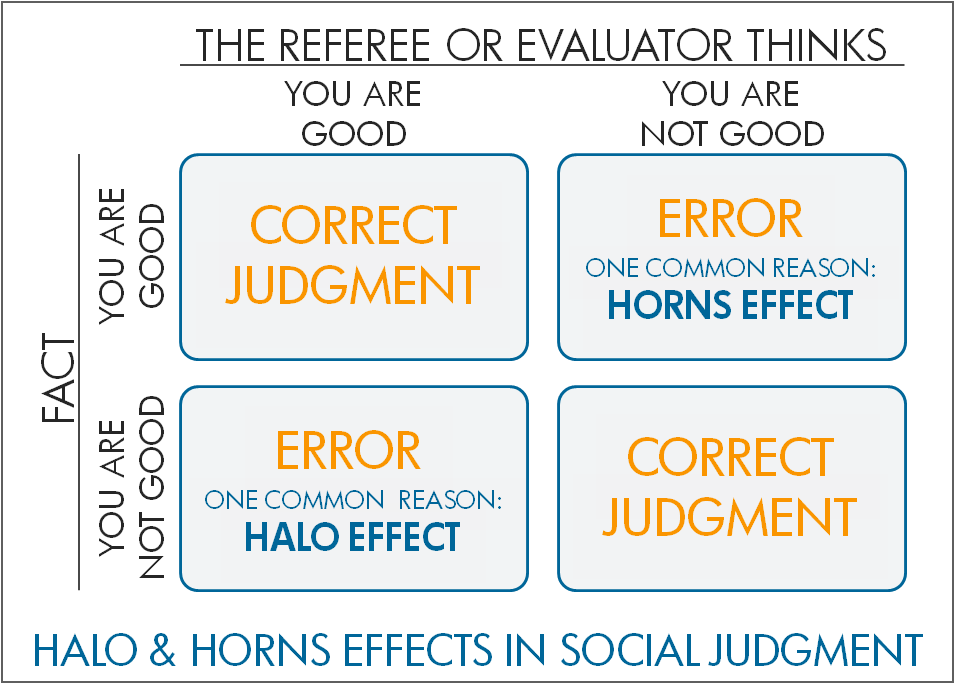
The “halo effect” captures what happens when a person who is judged positively based on one aspect is automatically judged positively on several others without much evidence. For instance, as a result of the halo effect,

  • attractive people are often judged as competent and sociable. Film stars and other celebrities are assumed pleasant and sharp-witted,
  • inexperienced interviewers tend to pay less attention to a candidate’s negative traits after discerning one or two positive traits in the first few minutes of a job interview,
  • charismatic professionals tend to get noticed and move up the corporate ladder faster, irrespective of their technical and leadership skills,
  • articulate speakers are likely to influence their audiences more even if their messages are poor in form and content.

Politicians, film and TV stars, sportspersons, celebrities and brand managers have learned to construct a halo effect and capitalize on their reputations. Apple’s iPod spawned positive impressions of other Apple products—the company took advantage of this halo effect and delivered excellent products in the iPhone and iPad. In another example, renowned fashion designers can set high prices for perfectly ordinary clothes.

Halo and Horns Effects in Social Judgment

The Horns Effect

The “horns” or “devil effect” is the concept by which a person who is judged negatively on one aspect is automatically judged negatively on several other aspects without much evidence. Clearly, this is the opposite of the halo effect.

For years, American car manufacturers have battled the mistaken public perception that cars made by Japanese companies are of significantly better quality. This misperception remains even when American car manufacturers use identical components from the same suppliers and assemble their cars using identical manufacturing processes. Even today, Japanese-brand cars resell for much higher prices than American-brand cars.

Call for Action

  • Reflect on your decision-making process to steer clear of biases. As human beings, we incessantly form opinions of people, objects, and events, both consciously and subconsciously. However, our judgment is rarely free of biases and our measures are not always comprehensive enough. Before reaching any important decision, be sure to collect all the relevant facts and reflect on whether your thought processes are free of the common biases.
  • Understand that perception is reality and be conscious of the image you are projecting. People judge the proverbial book by its cover. Your friends and family, workplace and society at large have a certain perception of who you are and what you can do, irrespective of the reality. As much as you would prefer to be evaluated based on who you actually are and what you can actually do, understand that your identity and prospects are based on others’ image of you. Do everything you can to connect people’s perception to the reality. Look and play your role. Begin by reading the seminal article on the topic of personal branding, “The Brand Called You,” written by renowned management author, Tom Peters.

Wondering what to read next?

  1. Book Summary of Nassim Taleb’s ‘Fooled by Randomness’
  2. The “Ashtray in the Sky” Mental Model: Idiot-Proofing by Design
  3. Gambler’s Fallacy is the Failure to Realize How Randomness Rules Our World
  4. The Historian’s Fallacy: People of the Past Had No Knowledge of the Future
  5. How Stress Impairs Your Problem-Solving Capabilities: Case Study of TransAsia Flight 235

Filed Under: Leading Teams, Sharpening Your Skills Tagged With: Biases, Mental Models

[Rating Errors] Beware of the Recency Bias

April 27, 2010 By Nagesh Belludi Leave a Comment

Preamble: This is a first of a series of articles on common mistakes in judgment. Even if the focus of these articles is on performance assessment of employees, the discussions hold in all forms of social judgment.

Recency Bias in Performance Assessment

Suppose that you have executed a project effectively and exceeded all expectations during the first ten months of a year. If your manager has overlooked all these achievements and rated you poorly based on a major roadblock your project encountered in November, then you are subject to a Recency Bias. Your manager is in effect evaluating excessively positively or negative, depending on what is most recent.

Many managers tend to rate an employee’s job performance based on a “what has he done lately” mindset. They do not weigh the employee’s performance from earlier in the year (or quarter, if their organizations use a quarterly review system) and tend to rely more on the employee’s performance in the period immediately preceding the performance evaluation deadline. Consequently, achievements and events that happened lately tend to bear more influence on the employee’s performance rating than achievements and events from earlier in the evaluation period.

The cognitive bias (positive or negative) where judgment is founded only on readily recallable recent experiences is termed the ‘Recency Bias’ or ‘Recency Effect.’ This is analogous to people tending to recall items that are at the end of a list rather than items that are in the start of the list. (See Wikipedia’s entry on serial position effect.)

Some employees may exploit the recency bias by being more resourceful and trying to stay in the boss’s good graces in the period leading to performance reviews. I know of a manager who every year organizes community service events at his boss’s favorite non-profit during November and stay in the boss’s good graces ahead of his annual performance review in December. I have also identified wily employees who underperform earlier in a year and shape-up in the months before a performance evaluation is due.

To Avoid Recency Bias, Maintain a Performance Log

If you are a manager, maintain an informal log or diary where you can record each employee’s accomplishments, contributions, praises, and comments from peers and management. When a performance evaluation is due, review all the significant and relevant examples of employee performance you have recorded and write an objective performance summary report. This ensures that you keep yourself informed of your employee’s work and demonstrates that you care about his/her current work and achievements.

As an employee, you can maintain your own log or diary of your achievements. Review this information with your employee once every week. Whether your organization requires a self-assessment or not, refer to this log at the end of the evaluation period, summarize your achievements and submit a concise report to your manager.

Wondering what to read next?

  1. Why Incentives Backfire and How to Make Them Work: Summary of Uri Gneezy’s Mixed Signals
  2. When Work Becomes a Metric, Metrics Risk Becoming the Work: A Case Study of the Stakhanovite Movement
  3. The High Cost of Too Much Job Rotation: A Case Study in Ford’s Failure in Teamwork and Vision
  4. Virtue Deferred: Marcial Maciel, The Catholic Church, and How Institutions Learn to Look Away
  5. Don’t Over-Measure and Under-Prioritize

Filed Under: Leading Teams, Sharpening Your Skills Tagged With: Biases, Performance Management

Inspirational Quotations #321

April 25, 2010 By Nagesh Belludi Leave a Comment

What is now proven was once only imagined.
—William Blake (English Poet)

Small opportunities are often the beginning of great enterprises.
—Demosthenes

There are things of deadly earnest that can only be mentioned under the cover of a joke.
—John James Procter

True happiness comes from the joy of deeds well done, the zest of creating things new.
—Antoine de Saint-Exupery (French Novelist, Aviator)

And when mistakes occur, let them become instructive, not destructive.
—Neal A. Maxwell (American Mormon Religious Leader)

Money is not the point. It is an indication that I have succeeded in the grand adventure of understanding reality.
—George Soros (American Investor)

There is a courageous wisdom; there is also a false, reptile prudence, the result not of caution but of fear.
—Edmund Burke (Irish Political leader)

My creed is this: Happiness is the only good. The place to be happy is here. The time to be happy is now. The way to be happy is to make others so.
—Robert G. Ingersoll (American Atheist Politician)

To know what we know what we know, and that we do not know what we do not know, that is true knowledge.
—Confucius (Chinese Philosopher)

Happiness is a thing to be practiced, like the violin.
—John Lubbock

Filed Under: Inspirational Quotations

« Previous Page
Next Page »

Primary Sidebar

Popular Now

Anxiety Assertiveness Attitudes Balance Biases Coaching Conflict Conversations Creativity Critical Thinking Decision-Making Discipline Emotions Entrepreneurs Etiquette Feedback Getting Along Getting Things Done Goals Great Manager Innovation Leadership Leadership Lessons Likeability Mental Models Mindfulness Motivation Networking Parables Performance Management Persuasion Philosophy Problem Solving Procrastination Psychology Relationships Simple Living Social Skills Stress Suffering Thinking Tools Thought Process Time Management Winning on the Job Wisdom

About: Nagesh Belludi [hire] is a St. Petersburg, Florida-based freethinker, investor, and leadership coach. He specializes in helping executives and companies ensure that the overall quality of their decision-making benefits isn’t compromised by a lack of a big-picture understanding.

Get Updates

Signup for emails

Subscribe via RSS

Contact Nagesh Belludi

RECOMMENDED BOOK:
The Effective Executive

The Effective Executive: Peter Drucker

Management guru Peter Drucker's insightful perspective and suggestions for making executives more effective managers of both themselves and others.

Explore

  • Announcements
  • Belief and Spirituality
  • Business Stories
  • Career Development
  • Effective Communication
  • Great Personalities
  • Health and Well-being
  • Ideas and Insights
  • Inspirational Quotations
  • Leadership
  • Leadership Reading
  • Leading Teams
  • Living the Good Life
  • Managing Business Functions
  • Managing People
  • MBA in a Nutshell
  • Mental Models
  • News Analysis
  • Personal Finance
  • Podcasts
  • Project Management
  • Proverbs & Maxims
  • Sharpening Your Skills
  • The Great Innovators

Recently,

  • Gandhi’s Wheel, Apple’s Spin: The Paradox of Apple’s ‘Think Different’ Campaign
  • Book Summary: Hadley Freeman’s ‘Life Moves Pretty Fast’—How ’80s Movies Wrote America’s Story
  • Inspirational Quotations #1150
  • Corporate Boardrooms: The Governance Problem Everyone Knows and Nobody Fixes
  • Every Agreement Has a Loophole: What Puma’s Pele Gambit Teaches About Lateral Thinking
  • Five Simple Changes That Can Save You the Most Time
  • Inspirational Quotations #1149

Unless otherwise stated in the individual document, the works above are © Nagesh Belludi under a Creative Commons BY-NC-ND license. You may quote, copy and share them freely, as long as you link back to RightAttitudes.com, don't make money with them, and don't modify the content. Enjoy!