• Skip to content
  • Skip to primary sidebar

Right Attitudes

Ideas for Impact

Nagesh Belludi

Don’t Assume Conversations with Human Resources Will Remain Confidential

February 19, 2016 By Nagesh Belludi 2 Comments

Human Resources (HR) can be a great resource to help you secure a promotion, be a better manager, and even deal with an employee grievance/claim.

However, if you’re having a serious problem with a manager or a colleague, don’t pour your heart out to your HR person and ask that no action be taken. You cannot count on the confidentiality of your discussions. While your HR person intends to help you, he also has an obligation as well to helping your manager and your colleague deal with you.

Similarly, do not discuss any career-transition plans (switching to another job within your company, resigning, job hunting, or retiring) with HR. HR is obligated to keep your manager informed about any prospective issue concerning staffing or anything that might affect organizational goals.

Human Resources and Confidentiality

HR has no lawful obligation to maintain confidentiality in anything you discuss. You may expect your HR person to remain confidential to the greatest possible extent. However, remember that the HR person’s primary loyalties and responsibilities concern the organization’s business needs. He is duty-bound to investigate employee complaints and involve other levels of management, especially in case of possible discrimination or harassment concerns.

Expect your HR person to pass on any information that’s in the organization’s best interest, even after promising confidentiality. HR should never mislead employees about the level of confidentiality they can expect. Such HR people aren’t behaving ethically and, over time, tend to lose employees’ and managers’ trust.

Go to HR for guidance on solving people problems or for help with organizational policies and procedures. See a reliable friend or a trusted peer to confide problems and challenges. Do not share anything with HR that you wouldn’t share with your manager.

Idea for Impact: HR is obligated to act on serious issues they learn about, whether or not you want them to. Therefore, never assume that conversations with HR will remain wholly confidential. Be discriminating in what you disclose to HR.

Wondering what to read next?

  1. Job-Hunting While Still Employed
  2. Not Everyone’s Chill About Tattoos and Body Art
  3. Performance Appraisal Systems “Don’t Meet Expectations”
  4. The Never-Ending Office vs. Remote Work Debate
  5. How You Can Make the Most of the Great Resignation

Filed Under: Career Development Tagged With: Ethics, Human Resources

What’s Behind Your Desire to Job-Hunt and Jump Ship?

February 16, 2016 By Nagesh Belludi Leave a Comment

The primary motivations for seeking a new job are a more enjoyable job, better compensation, and opportunities for career progression. Talent management firm Caliper’s analysis of exit interviews from 180 companies confirmed that the principal reason employees quit their jobs is a lack of personal fulfillment and the feeling of not being well matched to their jobs. 40% of exit interviews complained about poor advancement potential, insufficient recognition, and not being challenged on the job. Just 26% mentioned wages and 11% mentioned workplace conflict.

Examine Your Motivations Before Job-Hunting

Many people who jump ship in frustration run into the same problems that were an obstacle with their previous employers. So, if you’re considering a change and seeking a new job because you’re not moving forward at your current job, first get honest feedback about how you’re perceived by your managers: what do they think your strengths are, where you need to develop, and what’s holding you back? Without such feedback on your career challenges, you may run into the same problems at your new employer.

You’ll find it easier to tackle career progression frustrations at your current employer in a familiar environment rather than at a new company where you’ll be under pressure to learn the ropes, form new relationships, produce results quickly, and work with superiors who may be less forgiving. Indeed, many people who change jobs fail or flame out at their new employers and don’t meet their job-change objectives after two years. Their premature departures and undue job-hopping reflects negatively on their career progress.

When You Must Seek a New Job

By all means, explore the job market in pursuit of career advancement if,

  • you’ve been passed over many times and haven’t been told how you need to develop to move ahead, or
  • you’ve been locked into your current job because of a long-tenured manager and can’t find another position within the same employer.

Be discreet about whom you tell that you’re looking for another job. When you find a new job, inform your boss immediately, give as much notice as required, and offer to help transition your duties to a replacement. Don’t use your new job offer to try to negotiate a counteroffer from your employer.

Wondering what to read next?

  1. Job Hunting: Don’t Chase Perfection
  2. Five Questions to Keep Your Job from Driving You Nuts
  3. Job-Hunting While Still Employed
  4. Before Jumping Ship, Consider This
  5. Don’t Use Personality Assessments to Sort the Talented from the Less Talented

Filed Under: Career Development Tagged With: Career Planning, Job Search, Job Transitions

Inspirational Quotations #619

February 14, 2016 By Nagesh Belludi Leave a Comment

People do not deserve to have good writings; they are so pleased with the bad.
—Ralph Waldo Emerson (American Philosopher)

When you pray for anyone you tend to modify your personal attitude toward him.
—Norman Vincent Peale (American Clergyman, Self-Help Author)

Despise not death, but welcome it, for nature wills it like all else.
—Marcus Aurelius Antoninus Augustus

Men are happy to be laughed at for their humor, but not for their folly.
—Jonathan Swift (Irish Satirist)

Decisiveness is a characteristic of high-performing men and women. Almost any decision is better than no decision at all.
—Brian Tracy (American Author)

Success consists of getting up just one more time than you fall.
—Oliver Goldsmith (Irish Author)

Habits are soon assumed; but when we endeavor to strip them off, it is being flayed alive.
—William Cowper (English Anglican Poet)

Lost, yesterday, somewhere between sunrise and sunset, two golden hours, each set with sixty diamond minutes. No reward is offered, for they are gone forever.
—Horace Mann (American Educator)

Riches do not delight us so much with their possession, as torment us with their loss.
—Dick Gregory

I saw that we’re all doing the best we can. This is how a lifetime of humility begins.
—Byron Katie (American Speaker)

The more you are motivated by love, the more fearless and free your actions will be.
—Katherine Mansfield (New Zealand-born British Author)

Do you know what a man is? Are not birth, beauty, good shape, discourse, manhood, learning, gentleness, virtue, youth, liberality, and such like, the spice and salt that season a man?
—William Shakespeare (British Playwright)

Filed Under: Inspirational Quotations

Surprising Secrets of America’s Wealthy // Book Summary of ‘The Millionaire Next Door’

February 12, 2016 By Nagesh Belludi Leave a Comment

'The Millionaire Next Door' by Thomas Stanley, William Danko (ISBN 1567315682) The Millionaire Next Door summarizes anthropological research from the ’90s on the attributes of unassuming wealthy Americans. The authors, marketing professors Thomas Stanley and William Danko, offer unique insights into millionaires’ lifestyles and their buying habits. They explain that, in contrast to today’s earn-and-consume culture, the many ordinary folks who accumulate wealth live modestly and prize frugality.

When first published in 1996, The Millionaire Next Door generated widespread enthusiasm for its core message: that anybody could become rich by living below their means, efficiently allocating funds in ways that build wealth, and ignoring conspicuous consumption. Consequently, the book sold millions of copies and stayed on the New York Times bestseller list for three years.

A bulk of The Millionaire Next Door focuses on rejecting the stereotypical view of the wealthy; the authors write, “Most people have it all wrong about wealth in America. Wealth is not the same as income. If you make a good income each year and spend it all, you are not getting wealthier. You are just living high. Wealth is what you accumulate, not what you spend.”

The authors discuss the fancy trappings of wealth and the high cost of maintaining social status. They explain that wealthy individuals prioritize financial independence over a high social status. Further, they did not receive sizable financial support from parents, and raise their own children to be economically self-sufficient adults.

The Millionaire Next Door is a definitive example of books that present simple concepts by reiterating them ad nauseam with an overabundance of statistics, tables, charts, and anecdotes to attain a respectable book length. For instance, a tedious 31-page chapter discusses how the wealthy purchase cars and includes statistics for average price-per-pound of popular cars.

Recommendation: Skim. The Millionaire Next Door defends the timeless values of thrift, disciplined spending, and prudent accumulation of wealth. However, the book overemphasizes penny-pinching and the merits of hoarding money. The book feels dated (it was first published in 1996) and engages the reader in crude generalizations and oversimplifications.

Wondering what to read next?

  1. The Extra Salary You Can Negotiate Ain’t Gonna Make You Happy
  2. Never Enough
  3. Here’s the #1 Lesson from Secret Millionaires
  4. The Problem with Modern Consumer Culture
  5. How Ads Turn Us into Dreamers

Filed Under: Living the Good Life, Personal Finance Tagged With: Materialism, Money, Personal Finance, Simple Living

Lessons from Dwight Eisenhower: Authentic Leaders Demonstrate Accountability

February 9, 2016 By Nagesh Belludi Leave a Comment

In a previous article about how you can control just your efforts and not the outcomes of those efforts, I detailed Dwight Eisenhower’s weather-induced dilemma on the eve of the Allied invasion of Normandy in June 1944.

The Success of the Normandy Invasion Was Not Entirely in Eisenhower’s Control

Despite a year of intense planning and preparation under Eisenhower’s leadership, the Allied invasion’s success ultimately depended on the weather across the English Channel. Their landings hinged on suitable weather—something entirely beyond their control.

Eisenhower tentatively planned to send his troops across the English Channel on 5-June. On 4-June, however, the troops predicted cloudy skies, rain, and heavy seas that threatened the invasion. Although the following day’s weather was not necessarily ideal, it was comparatively more suitable than the 5-June, so Eisenhower postponed the invasion by a day. If he did not invade on 6-June, the tides would not favor an invasion for another two weeks, which would possibly give the Germans enough time to get wind of the Allies’ plan.

Early in the morning of 5-June, Eisenhower gathered his advisers’ and military officers’ opinions on whether to launch the attack despite the less-than-suitable weather. He sat quietly in deep contemplation. One of his advisers later recalled, “I never realized before, the loneliness and isolation of a commander at a time when such a momentous decision has to be taken, with full knowledge that failure or success rests on his judgment alone.”

After five minutes, Eisenhower gazed at his advisers and said, “Well, we’ll go!”

With those words, Eisenhower launched the D-Day invasion of Europe on 6-June. After issuing those marching orders, events passed from Eisenhower’s control. He then realized that the invasion’s success was no longer in his hands. Its outcome depended on 160,000 allied troops, thousands of commanders, and hundreds of lieutenants. Eisenhower had done everything in his power to coordinate their efforts and create conditions conducive to the mission’s success. After issuing his orders, all he could do was let those conditions come to fruition on their own terms. After all his efforts, he could not control the outcomes—he let go of the outcomes.

An Authentic Leader in Action: Eisenhower’s Character, Responsibility, & Accountability

That evening, on his way to visit American and British paratroopers (pictured above) who were headed into battle that night, Eisenhower told his driver, “I hope to God I’m right.”

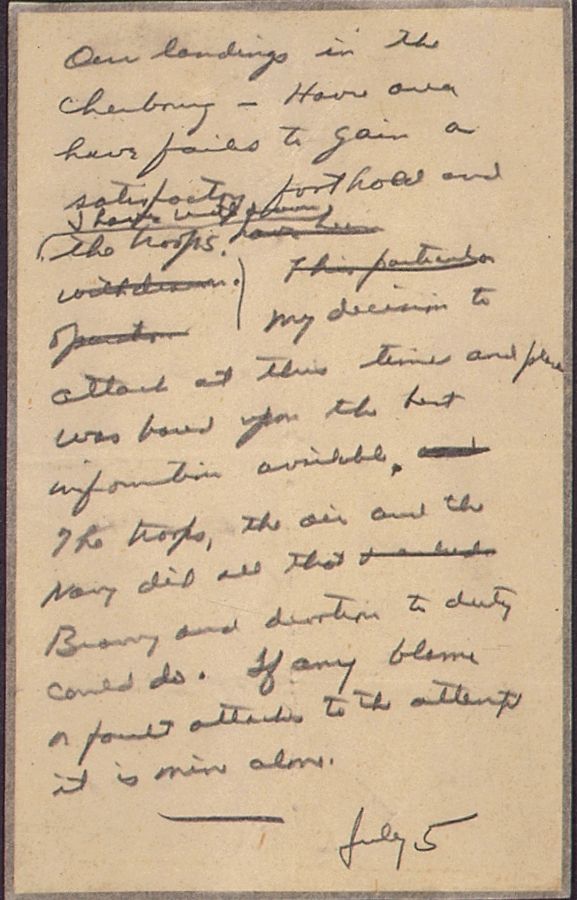
Just before he went to bed at night, Eisenhower scribbled a note and tucked it into his wallet. He thought he would use this letter if the invasion went wrong. (Eisenhower mistakenly dated the note July 5 instead of June 5.)

Our landings in the Cherbourg-Havre area have failed to gain a satisfactory foothold and I have withdrawn the troops. My decision to attack at this time and place was based upon the best information available. The troops, the air and the Navy did all that bravery and devotion to duty could do. If any blame or fault attaches to the attempt it is mine alone.

Dwight Eisenhower's note to use if the Normandy Invasion went wrong, 5-June-1945

Observe that Eisenhower crossed out “This particular operation” and wrote “My decision to attack.” This demonstrates Eisenhower’s assertive and responsible leadership in action. He wrote, “any blame or fault … is mine alone” and underscored the phrase “mine alone.” He did not use passive language or try to camouflage failure with phrases like, “as fate would have had it,” “unaccommodating weather,” “forecast not met,” “mistakes were made,” or “we tried really hard, but ….”

Eisenhower was an authentic leader in action—a leader who was ready and willing to accept unshrinking responsibility for his actions and their results.

Eisenhower won his wager with the weather. The invasion of Normandy was successful and proved to be a turning point in World War II. Eisenhower never used the note he had prepared on the eve of the attack. It is now on display at Dwight D. Eisenhower Library and Museum in Abilene, Kansas.

Authentic Leaders Demonstrate Accountability

As exemplified by Dwight Eisenhower’s leadership as the Supreme Allied Commander during World War II, authentic leaders recognize the accountability that comes with their roles. They accept absolute responsibility for the expected outcomes—both good and bad—no matter what the situation is. They don’t blame unfavorable circumstances, the external environment, employees, superiors, customers, or anybody else.

Wondering what to read next?

  1. Moral Self-Licensing: Do Good Deeds Make People Act Bad?
  2. The Poolguard Effect: A Little Power, A Big Ego!
  3. Virtue Deferred: Marcial Maciel, The Catholic Church, and How Institutions Learn to Look Away
  4. One of the Tests of Leadership is the Ability to Sniff out a Fire Quickly
  5. Power Corrupts, and Power Attracts the Corruptible

Filed Under: Leadership, Sharpening Your Skills Tagged With: Attitudes, Authenticity, Character

Inspirational Quotations #618

February 7, 2016 By Nagesh Belludi Leave a Comment

I have used these weeks to revalue values. Do you understand this expression?. When you come right down to it, the alchemist is the most praiseworthy of men: I mean the one who changes something negligible or contemptible into something of value, even gold. He alone enriches, the others merely exchange. My task is quite singular this time: I have asked myself what mankind has always hated, feared, and despised the most.
—Friedrich Nietzsche (German Philosopher, Scholar)

To know that which before us lies in daily life, is the prime wisdom; what is more is fume, or emptiness, or fond impertinence, and renders us, in things that most concern, unpracticed and unprepared.
—John Milton (English Poet)

Some desire is necessary to keep life in motion; he whose real wants are supplied, must admit those of fancy.
—Samuel Johnson (British Essayist)

At the center of our agency is our freedom to form a healthy attitude toward whatever circumstances we are placed in.
—Neal A. Maxwell (American Mormon Religious Leader)

If I were given the opportunity to present a gift to the next generation, it would be the ability for each individual to learn to laugh at himself.
—Charles M. Schulz (American Cartoonist)

Not being able to govern events, I govern myself, and apply myself to them, if they will not apply themselves to me.
—Michel de Montaigne (French Philosopher)

Answered prayers cover the field of providential history as flowers cover western prairies.
—Theodore L. Cuyler (American Presbyterian Clergyman)

I put all my genius into my life; I put only my talent into my works.
—Oscar Wilde (Irish Poet)

We are all exceptional cases. Each man insists on being innocent, even if it means accusing the whole human race, and heaven.
—Albert Camus (Algerian-born French Philosopher)

Filed Under: Inspirational Quotations

Serendipity and Entrepreneurship in the Invention of Corn Flakes

February 5, 2016 By Nagesh Belludi Leave a Comment

In previous articles about Johnson’s Baby Powder and Picasso’s Blue Period, I discussed serendipity as a rich phenomenon that is central to entrepreneurial and artistic processes. In this article, I will discuss another case study of ideas born by chance and reinforced by casual observation and customer input.

One of America’s Favorite Cereals was Invented by Fortuitous Accident

Will Keith Kellogg invented corn flakes in 1894 at a sanitarium in Battle Creek, Michigan. Will worked there as an assistant to his brother Dr. John Harvey Kellogg and helped research patients’ diets.

One day, while making bread dough at the sanitarium, Will accidentally left boiled wheat sitting out overnight unattended. When he returned to roll the wheat into dough, he discovered that it had dried out and was flaky. Interested to see what would happen, Will passed the flaky dough through the bread rollers and baked them to create a crunchy snack. He seasoned the flakes with salt and fed them with milk to the sanitarium’s patients. The wheat flakes were an immediate hit. Indeed, after some patients left the sanitarium, they ordered Kellogg’s flakes by post.

Will Kellogg’s Entrepreneurial Ingenuity

Will Kellogg then tinkered his recipe for wheat flakes and ultimately settled on using corn in place of wheat as the flakes’ main ingredient.

In 1906, Will Kellogg launched “The Battle Creek Toasted Corn Flakes Company.” In addition to inventing corn flakes, Kellogg had a genius for business and marketing. He was a pioneer in testing markets, sampling products, using multi-color print advertisements, and developing innovative marketing campaigns.

Kellogg was keen on using slogans to promote his company’s products. In 1907, he introduced a marketing campaign that declared, “Wednesday is Wink Day in New York.” Every woman who winked at her grocer on a Wednesday received a free packet of corn flakes. Corn flakes sales skyrocketed.

Will Kellogg was also a prominent philanthropist and, in 1934, started the W. K. Kellogg Foundation.

The company Will Kellogg founded eventually became Kellogg Company, a prominent cereal and convenience foods multinational.

Wondering what to read next?

  1. How Johnson’s Baby Powder Got Started: Serendipity and Entrepreneurship
  2. The Myth of the First-Mover Advantage
  3. Always Be Ready to Discover What You’re Not Looking For
  4. Van Gogh Didn’t Just Copy—He Reinvented
  5. Chance and the Currency of Preparedness: A Case Study on an Indonesian Handbag Entrepreneur, Sunny Kamengmau

Filed Under: Business Stories, Sharpening Your Skills, The Great Innovators Tagged With: Creativity, Entrepreneurs, Luck

Ten Rules of Management Success from Sam Walton

February 2, 2016 By Nagesh Belludi 1 Comment

Sam Walton (1918–1992,) the iconic founder of Walmart and Sam’s Club, was arguably the most successful entrepreneur of his generation. He was passionate about retailing, loved his work, and built and ran Walmart with boundless energy.

'Sam Walton: Made In America' by Sam Walton (ISBN 0553562835) “Made in America” is Walton’s very educational, insightful, and stimulating autobiography. It’s teeming with Walton’s relentless search for better ideas, learning from competitors, managing costs and prices to gain competitive advantage, asking incessant questions of day-to-day operations, listening to employees at all levels of Walmart, and inventing creative ways to foster an idea-driven culture. “Made in America” is also filled with anecdotes from Walton’s associates and family members—in fact, some of their opinions are less than flattering.

Former CEO of General Electric Jack Welch once said, “Walton understood people the way Thomas Edison understood innovation and Henry Ford, production. He brought out the very best in his employees, gave his very best to his customers, and taught something of value to everyone he touched.”

Here are ten insightful management ideas from “Made in America” with the relevant anecdotes from Walton or his associates.

  1. When hiring employees, look for passion and desire to grow. Having the right skills and qualifications is no doubt essential in a potential employee, but a better predictor of long-term success and career advancement is his/her passion for learning new things, commitment to a task, and a drive to get things done. A former Walmart executive recalls, “Sam would take people with hardly any retail experience, give them six months with us, and if he thought they showed any real potential to merchandise a store and manage people, he’d give them a chance. He’d make them an assistant manager. They were the ones who would go around and open all the new stores and they would be next in line to manage their own store. In my opinion, most of them weren’t anywhere near ready to run stores, but Sam proved me wrong there. He finally convinced me. If you take someone who lacks the experience and the know-how but has the real desire and the willingness to work his tail off to get the job done, he’ll make up for what he lacks.”
  2. Delegate and follow up. Delegation is indispensable; yet it remains one of the most underutilized and underdeveloped managerial skills. One element of effective delegation is consistent follow-up. Far too often, managers will delegate a task and then fail to follow up to see how things are going. Such failure to follow-up is tantamount to abdication of accountability for results, which still lies with the manager. Former Walmart CEO David Glass recalls, “As famous as Sam is for being a great motivator … he is equally good at checking on the people he has motivated. You might call his style: management by looking over your shoulder.”
  1. Persist and rally people to the cause. Passionate managers demonstrate the energy and drive needed to rally their teams around a shared vision. They engage their employees with the same messages over and over, escalate their sense of urgency, and get their vision implemented quickly. Former Walmart CEO David Glass recalls, “When Sam feels a certain way, he is relentless. He will just wear you out. He will bring up an idea, we’ll all discuss it and then decide maybe that it’s not something we should be doing right now—or ever. Fine. Case closed. But as long as he is convinced that it is the right thing, it just keeps coming up—week after week after week—until finally everybody capitulates and says, well, it’s easier to do it than to keep fighting this fight. I guess it could be called management by wearing you down.”
  2. Mentor, critique, and inspire employees. Mentoring employees is an effective way to improve employee performance and build trust and loyalty. Effective mentoring is not merely telling employees what to do. It is helping them broaden and deepen their thinking by clarifying their goals and asking the right questions. Effective mentoring is also about supporting employees as they learn and practice new skills and habits. Walton writes, “I’ve been asked if I was a hands-on manager or an arm’s-length type. I think really I’m more of a manager by walking and flying around, and in the process I stick my fingers into everything I can to see how it’s coming along. I’ve let our executives make their decisions—and their mistakes—but I’ve critiqued and advised them.”
  3. Invest in frontline employees for better customer relationships. Much of customers’ opinions about a business come from the myriad interactions they have with customer-interfacing frontline employees, who are the face of any business. If a business doesn’t get these customer experiences right, nothing else matters. Walton writes, “The way management treats the associates is exactly how the associates will then treat the customers. And if the associates treat the customers well, the customers will return again and again, and that is where the real profit in this business lies, not in trying to drag strangers into your stores for one-time purchases based on splashy sales or expensive advertising. Satisfied, loyal, repeat customers … are loyal to us because our associates treat them better than salespeople in other stores do. So, in the whole Wal-Mart scheme of things, the most important contact ever made is between the associate in the store and the customer.”
  4. Treat employees like business partners and empower them by sharing information. Effective managers foster open communication by treating employees as co-owners of the business and sharing operational data regularly. Managers empower employees by helping them understand how their contribution makes a difference, discussing opportunities and challenges, and encouraging them to contribute to solutions. Walton writes, “Our very unusual willingness to share most of the numbers of our business with all the associates … It’s the only way they can possibly do their jobs to the best of their abilities—to know what’s going on in their business. … Sharing information and responsibility is a key to any partnership. It makes people feel responsible and involved …. In our individual stores, we show them their store’s profits, their store’s purchases, their store’s sales, and their store’s markdowns.
  5. Never be satisfied. There’s always room for improvement. Effective managers never rest on their laurels and are persistently dissatisfied with the status quo. They possess a pervasive obsession for discovering problems and improving products, services, and people. Home Depot founder Bernard Marcus recalls, “If you ask Sam how’s business, he’s never satisfied. He says, ‘Bernie, things are really lousy. Our lines are too long at the cash registers. Our people aren’t being helpful enough. I don’t know what we’re gonna do to get them motivated.’ Then you ask some of these CEOs from other retail organizations who you know are on the verge of going out of business, and they brag and tell you how great everything is. Really putting on airs. Not Sam. He is down to earth and knows who he is.”
  1. Appreciate employees and give honest feedback. A key determinant of employee engagement is whether employees feel their managers genuinely care. Do the managers provide regular, direct feedback, both appreciative and corrective? Do they coach employees in their learning and career growth? Walton writes, “Keeping so many people motivated to do the best job possible involves … appreciation. All of us like praise. So what we try to practice in our company is to look for things to praise. … We want to let our folks know when they are doing something outstanding, and let them know they are important to us. You can’t praise something that’s not done well. You can’t be insincere. You have to follow up on things that aren’t done well. There is no substitute for being honest with someone and letting them know they didn’t do a good job. All of us profit from being corrected—if we’re corrected in a positive way.”
  2. Listening to employee’s complaints and concerns could be a positive force for change. Effective managers provide their employees the opportunity to not only contribute their ideas, but also air concerns and complaints. By fostering an environment of open communication, managers who handle employee opinions effectively not only boost employee motivation, performance, and morale, but also benefit from learning directly about problems with teams, organizations, and businesses. Walton writes, “Executives who hold themselves aloof from their associates, who won’t listen to their associates when they have a problem, can never be true partners with them. … Folks who stand on their feet all day stocking shelves or pushing carts of merchandise out of the back room get exhausted and frustrated too, and occasionally they dwell on problems that they just can’t let go of until they’ve shared it with somebody who they feel is in a position to find a solution. … We have really tried to maintain an open-door policy at Wal-Mart. … If the associate happens to be right, it’s important to overrule their manager, or whoever they’re having the problem … . The associates would know pretty soon that it was just something we paid lip service to, but didn’t really believe.”
  3. Learn from the competition. Effective managers understand that keeping tabs on competitors, copying their innovations as much as possible, and reaching out to customers the way competitors do is a great strategy for growing business. Sam Walton’s brother Bud recalls, “There may not be anything (Walton) enjoys more than going into a competitor’s store trying to learn something from it.” A former K-Mart board member recalls, “(Walton) had adopted almost all of the original Kmart ideas. I always had great admiration for the way he implemented—and later enlarged those ideas. Much later on, when I was retired still a K-Mart board member, I tried to advise (K-Mart) management of just what a serious threat I thought he was. But it wasn’t until recently that they took him seriously.”

Wondering what to read next?

  1. General Electric’s Jack Welch Identifies Four Types of Managers
  2. How to Manage Overqualified Employees
  3. Why Hiring Self-Leaders is the Best Strategy
  4. Seven Real Reasons Employees Disengage and Leave
  5. Fire Fast—It’s Heartless to Hang on to Bad Employees

Filed Under: Leadership, Leading Teams, Managing People, Sharpening Your Skills Tagged With: Employee Development, Entrepreneurs, Great Manager, Hiring & Firing, Mental Models, Mentoring

Inspirational Quotations #617

January 31, 2016 By Nagesh Belludi Leave a Comment

Timely service, like timely gifts, is doubled in value.
—George MacDonald (Scottish Christian Author)

Just as much as we see in others we have in ourselves.
—William Hazlitt (English Essayist)

The world does not have to change … The only thing that has to change is our attitude.
—Gerald Jampolsky

Mankind differs from the animals only by a little and most people throw that away.
—Confucius (Chinese Philosopher)

Lying, a telling of beautiful untrue things, this is the proper aim of art.
—Oscar Wilde (Irish Poet)

We do not see nature with our eyes, but with our understanding and our hearts.
—William Hazlitt (English Essayist)

Fear clogs; Faith liberates.
—Elbert Hubbard (American Writer)

Distinction is the consequence, never the object, of a great mind.
—Washington Allston (American Poet)

Many concerns now make part or the whole of their dividends from by-products that formerly went to waste. How do we, as individuals, utilize our principal by-product? Our principal by-product is, of course, our leisure time. Many years of observation forces the conclusion that a man’s success or failure in life is determined as much by how he acts during his leisure as by how he acts during his work hours. Tell me how a young man spends his evenings and I will tell you how he is likely to spend the latter part of his life.
—B. C. Forbes (Scottish-born American Journalist)

The best hearts are ever the bravest.
—Laurence Sterne (Irish Anglican Novelist)

The secret to success is constancy to purpose.
—Benjamin Franklin (American Political leader)

We know but a few men, a great many coats and breeches.
—Henry David Thoreau (American Philosopher)

We choose to go to the moon in this decade and do the other things, not because they are easy, but because they are hard, because that goal will serve to organize and measure the best of our energies and skills, because that challenge is one that we are willing to accept, one we are unwilling to postpone, and one which we intend to win, and the others, too.
—John F. Kennedy (American Head of State)

Filed Under: Inspirational Quotations

Success Conceals Wickedness

January 29, 2016 By Nagesh Belludi Leave a Comment

Biographies of Steve Jobs (by Walter Isaacson,) Jeff Bezos (by Brad Stone,) and Elon Musk (by Ashlee Vance)

Two common themes in the biographies of Steve Jobs (by Walter Isaacson,) Jeff Bezos (by Brad Stone,) and Elon Musk (by Ashley Vance) are these entrepreneurs’ extreme personalities and the costs of their extraordinary successes.

The world mostly regards Musk, Jobs, and Bezos as passionate, inspiring, visionary, and charismatic leaders who’ve transformed their industries. Yet their biographies paint a vivid picture of how ill-mannered these innovators are (or were, in the case of Jobs). They exercise ruthless control over every aspect of their companies’ products but have little tolerance for underperformers. They are extremely demanding of employees and unnecessarily demeaning to people who help them succeed.

  • Steve Jobs was renowned for his cranky, rude, spiteful, and controlling outlook. Biographer Isaacson recalls, “Nasty was not necessary. It hindered him more than it helped him.” Jobs famously drove his Mercedes around without a license and frequently parked in handicapped spots. For years, he denied paternity of his first daughter Lisa and forced her and her mother to live on welfare. He often threw tantrums when he didn’t get his way and publicly humiliated employees.
  • In a 2010 commencement address at Princeton, Jeff Bezos recalled his grandfather counseling, “Jeff, one day you’ll understand that it’s harder to be kind than clever.” Still, according to Brad Stone’s biography, Bezos often imparts insulting rebukes and criticisms to employees: “I’m sorry, did I take my stupid pills today?” “Are you lazy or just incompetent?” “Why are you wasting my life?” and “Do I need to go down and get the certificate that says I’m CEO of the company to get you to stop challenging me on this?”
  • According to Ashlee Vance’s biography, when an executive assistant asked for a raise, Elon Musk asked her to take a two-week vacation while he contemplated her request. When the assistant returned from vacation, Musk fired her.

“Success covers a multitude of blunders”

The great Irish playwright Oscar Wilde once remarked, “No object is so beautiful that, under certain conditions, it will not look ugly.”

The other great Irish playwright George Bernard Shaw wrote, “Success covers a multitude of blunders.”

British politician and historian Lord John Dalberg-Acton famously said, “Power tends to corrupt and absolute power corrupts absolutely. Great men are almost always bad men, even when they exercise influence and not authority: still more when you superadd the tendency or the certainty of corruption by authority. There is no worse heresy than that the office sanctifies the holder of it. That is the point at which … the end learns to justify the means.”

Ethics Violations by NBC News Anchor Brian Williams

In 2015, NBC suspended prominent news anchor Brian Williams after internal investigations revealed no less than 11 instances where he either embellished facts or bent the truth. Members of his team and NBC staffers who knew about these ethics violations chose to overlook because he was powerful. According to The New York Times,

Mr. Williams has been drawing 9.3 million viewers a night, and his position seemed unassailable. Even as the stature of the nightly newscast faded in the face of real-time digital news, Mr. Williams was one of the most trusted names in America … He was powerful. Williams had the ear of NBC boss Steve Burke. He was a ratings powerhouse. And he spent years overseeing TV’s most watched newscast. He was a winner, for himself, those around him and those above him—until it became clear the man who is supposed be among the most trusted in America had issues with telling the truth.

Power Corrupts the Mind

Brilliant men and women engage in morally wrong conduct simply because they can. They can get away with extreme pride, temper, abuse, and other disruptive behaviors because their spectacular success can and does cover many of their sins, even in the eyes of those at the receiving end of their crudeness.

Our high-achieving culture adores the successful, the powerful, and the rich. And part of this adoration is the exemption we grant these celebrities from the ordinary rules of professional civility.

Idea for Impact: The more people possess power and the more successful they get, the more they focus on their own egocentric perspectives and ignore others’ interests.

Wondering what to read next?

  1. The Poolguard Effect: A Little Power, A Big Ego!
  2. Power Corrupts, and Power Attracts the Corruptible
  3. Power Inspires Hypocrisy
  4. Look, Here’s the Deal: Your Insecurity is Masquerading as Authority
  5. Unreliable Narrators Make a Story Sounds Too Neat

Filed Under: Business Stories, Great Personalities, Leadership Reading, Sharpening Your Skills Tagged With: Attitudes, Elon Musk, Entrepreneurs, Ethics, Etiquette, Humility, Jeff Bezos, Leadership, Psychology, Steve Jobs, Success

« Previous Page
Next Page »

Primary Sidebar

Popular Now

Anxiety Assertiveness Attitudes Balance Biases Coaching Conflict Conversations Creativity Critical Thinking Decision-Making Discipline Emotions Entrepreneurs Etiquette Feedback Getting Along Getting Things Done Goals Great Manager Innovation Leadership Leadership Lessons Likeability Mental Models Mentoring Mindfulness Motivation Networking Parables Performance Management Persuasion Philosophy Problem Solving Procrastination Relationships Simple Living Social Skills Stress Suffering Thinking Tools Thought Process Time Management Winning on the Job Wisdom

About: Nagesh Belludi [hire] is a St. Petersburg, Florida-based freethinker, investor, and leadership coach. He specializes in helping executives and companies ensure that the overall quality of their decision-making benefits isn’t compromised by a lack of a big-picture understanding.

Get Updates

Signup for emails

Subscribe via RSS

Contact Nagesh Belludi

RECOMMENDED BOOK:
On Writing Well

On Writing Well: William Zinsser

Journalist William Zinsser's bestselling manual has inspired generations of writers to perfect their skills in introducing clarity and brevity, and presenting their unique voice into prose.

Explore

  • Announcements
  • Belief and Spirituality
  • Business Stories
  • Career Development
  • Effective Communication
  • Great Personalities
  • Health and Well-being
  • Ideas and Insights
  • Inspirational Quotations
  • Leadership
  • Leadership Reading
  • Leading Teams
  • Living the Good Life
  • Managing Business Functions
  • Managing People
  • MBA in a Nutshell
  • Mental Models
  • News Analysis
  • Personal Finance
  • Podcasts
  • Project Management
  • Proverbs & Maxims
  • Sharpening Your Skills
  • The Great Innovators

Recently,

  • The Inopportune Case of the Airbus A340 Aircraft: When Tomorrow Left Yesterday Behind
  • You Don’t Know If a Good Day is a Good Day
  • Inspirational Quotations #1147
  • Life Isn’t Black and White
  • The Setting Shapes the Story
  • Ridicule Is Often the Tax Levied on Originality: The Case of Ice King Frederic Tudor
  • Inspirational Quotations #1146

Unless otherwise stated in the individual document, the works above are © Nagesh Belludi under a Creative Commons BY-NC-ND license. You may quote, copy and share them freely, as long as you link back to RightAttitudes.com, don't make money with them, and don't modify the content. Enjoy!