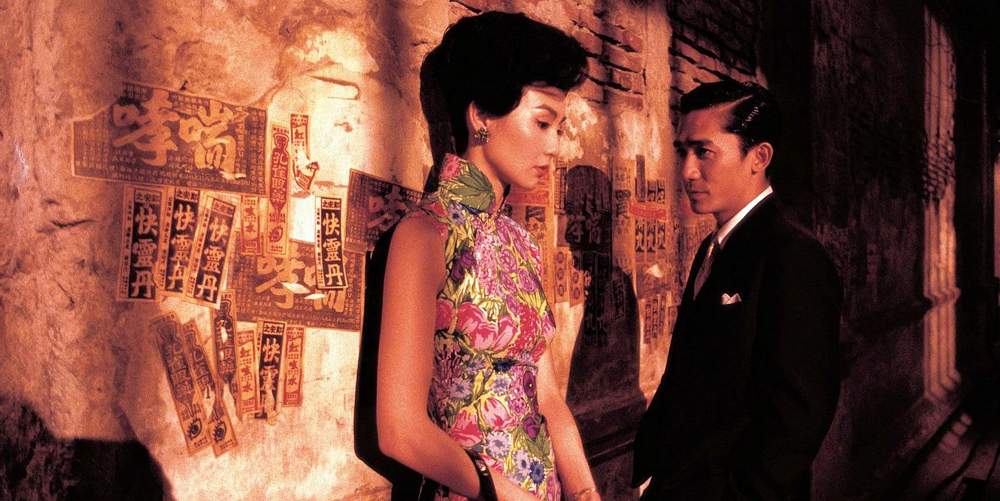

Wong Kar-wai’s In the Mood for Love (2000) is set in 1962 Hong Kong, where two neighbors, the reserved, impeccably groomed Chow Mo-wan and the poised, watchful Su Li-zhen, discover that their spouses are having an affair with each other.
Bound by shared grief, Chow and Su fall quietly and unmistakably in love. They know it, and they choose not to act on it. “We won’t be like them,” they tell each other. The film lives in the space between feeling and action, in touches that never land and words that go unsaid.
It’s one of my favorite films, and one of the most beautiful I know. Cinematographers Mark Lee Ping-bin and Christopher Doyle frame the city through doorways and narrow corridors, so the characters always seem boxed in. The palette runs to deep reds and greens, lit as if by a lamp burning low. Maggie Cheung wears costume designer William Chang’s high-collared cheongsams like armor, and Umebayashi Shigeru’s waltz loops until it starts to sound like longing.
But what holds me is the problem underneath all that beauty: what to do with a feeling you’ve decided not to act on.

Wong tells the story with the same restraint. The faces of the careless, faithless spouses are never shown, so we’re denied the satisfaction of a confrontation. The camera peers through gaps like a nosy neighbor. In one scene, Chow and Su rehearse confronting their spouses, which comes close to the Stoic habit of practicing hard encounters (premeditatio malorum) in advance, until the rehearsal bleeds into real feeling.
But the Stoic reading breaks at a revealing point.
Strictly speaking, the Stoic ideal isn’t restraint but apatheia, freedom from the passion itself. Chow and Su are closer to enkrateia: they feel everything and hold the line anyway, and it shows. At the end, a haunted Chow whispers his secret into a wall at Angkor Wat and seals it with mud. A sage would have let the feeling dissolve. Chow buries it, and it stays alive.
That’s what the film knows that the Stoics don’t: residue. You can choose well and still carry what you didn’t do. The film honors the restraint and grieves it, and it won’t resolve the two. It’s also famously ambiguous about whether the couple ever consummate, which only sharpens the point, because either way something remains.
Some of that restraint is plain fear of gossip and shame, and fear alone isn’t virtue. The Remains of the Day (1993,) James Ivory’s adaptation of Kazuo Ishiguro’s novel, shows the difference. Anthony Hopkins plays Stevens, a rigid, dutiful butler in 1930s England who spends decades suppressing his love for the sharp-witted housekeeper, Miss Kenton, played by Emma Thompson. He hides behind service, and his restraint becomes an identity he never examines.

Idea for Impact: We live in a world built to collapse the gap between impulse and action. Epictetus advised telling an impression, “Wait for me a little.” Try it. Name the feeling in one plain sentence and put some time between it and any action. Then ask whether your restraint serves a value you can state or only a fear of being seen. If you choose well and it still aches, that doesn’t mean you chose wrong. Give the ache somewhere to go, like a letter you never send or a friend who’ll listen.
Chow and Su kept their dignity in a situation designed to strip it. The Stoics wouldn’t have called that a tragedy, but they couldn’t fully explain it either. They gave us a way to choose, and Wong shows what’s left afterward.