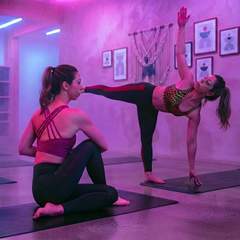

I grew up in South India, where Virabhadra is my family’s deity: the fierce warrior called forth by Shiva’s rage. He was a presence in stories, rituals, and memory long before he became a posture in a yoga studio. Being corrected on his name by someone whose acquaintance with the word began in a certification course felt like an inversion of expertise, delivered with complete confidence.
She wasn’t malicious. She was a flawless product: philosophy removed, vacuum-packed, and re-engineered for mass consumption. Somewhere along the way, millennia of metaphysics became a pop-up artisan bakery.
Yoga’s original purpose was liberation (moksha): the dissolution of the ego and the quieting of the mind. Around two thousand years ago, give or take a few centuries that scholars still argue over, Patanjali compiled the Yoga Sutras, codifying a tradition passed from teacher to student. It centered on discipline, breathwork, meditation, and self-study.
Physical postures, or asana, were the third limb of an eightfold path. Their job was practical: to prepare the body to sit through long meditation without your knees filing a complaint. All that bending and twisting was the warm-up act.
The main event was sitting still, which is what yoga means: union of mind, body, and consciousness. It was a demanding discipline with no interest in comfort, status, or shopping, and it did not come with a merchandise range.
Which makes it all the more impressive that someone took an ascetic blueprint for transcending the self and flogged it back to us as a lifestyle choice. You have to admire the gumption.
Today, yoga happens in neon-lit studios with curated playlists, ambient heating, and floor-to-ceiling mirrors, because nothing says “dissolve the ego” like watching yourself do it from four angles. Teachers are certified in a matter of weeks rather than a lifetime of study. The Sanskrit survives, but as branding, delivered with total confidence and no supporting evidence.
The commercialization was swift. Bikram Choudhury claimed ownership of a sequence of poses and built an empire of luxury cars and litigation, until U.S. courts ruled that he cannot own a yoga stretch. The cars stayed. Om symbols migrated onto fast-fashion T-shirts. Studios began competing on calorie burn and sweat volume rather than stillness. The eight limbs collapsed into one profitable limb, and the other seven were quietly pensioned off for being insufficiently photogenic.
Everyone’s Flogging It
It would be easy to pin this on the West. It would also be wrong.
Then there is Mysore, home of the Ashtanga tradition. Seekers arrive from around the world in search of authenticity, and a local economy has grown up to supply it by the month: accommodation, shala fees, workshops, teacher-training certificates, and the obligatory photograph with the teacher. I don’t entirely blame anyone for it. If strangers fly halfway round the world to pay you for being from somewhere, you take the money. But there is something rich in the sight of people traveling thousands of miles to dissolve the ego, then paying handsomely for a certificate to prove they did. Detachment, it turns out, has a rate card.
The state has also joined in. Since 2014, India has promoted yoga as a tool of cultural diplomacy, even securing a UN International Day of Yoga. Through the ministry of AYUSH (Ayurveda, Yoga & Naturopathy, Unani, Siddha, and Homoeopathy,) it stages large public events that turn a traditionally inward-looking practice into a symbol of national soft power and global image-building.
And lest anyone think the version on sale is all that ancient: scholars trace much of modern postural yoga to the early twentieth century, when traditional practices met Indian physical culture and European gymnastics. The athletic, sweat-forward yoga on every high street is about as old as the Hindustan Ambassador, India’s beloved “national car,” which was a 1950s British Morris Oxford that emigrated, stayed in production for half a century, and was passed off as timeless Indian heritage. It is the downward dog’s career path exactly: a foreign import, lightly adapted, now so thoroughly rooted that questioning its ancestry feels rude. The philosophy is old. The poses, like the car, are the newcomer, and they’ve done remarkably well for themselves.
The philosophy of yoga survived dynastic wars, invasions, colonization, and centuries of upheaval with its core ideas intact. Its greatest challenge today is less dramatic: a global wellness industry that cared nothing for the philosophy but spotted a magnificent margin in the mat.