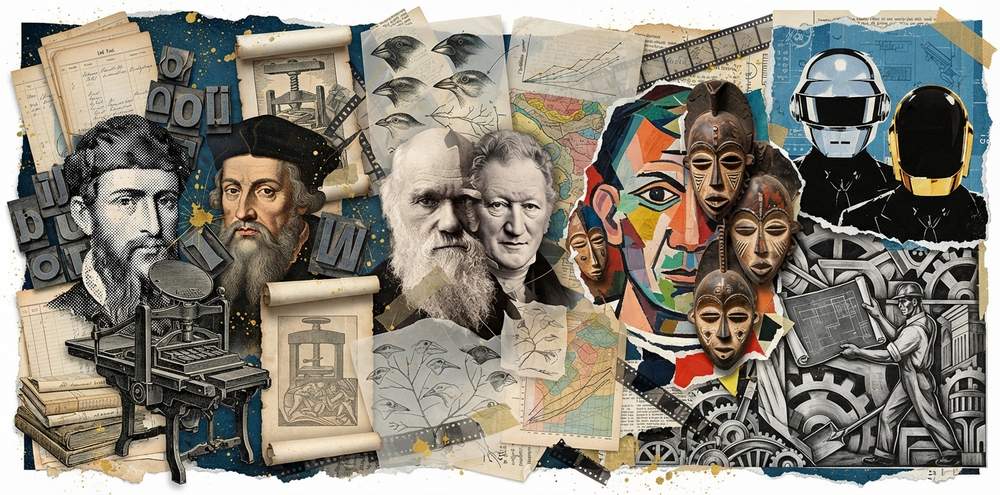

In 1455, a court in Mainz sided with a financier named Johann Fust in his lawsuit against Johannes Gutenberg, and by most accounts Fust ended up controlling Gutenberg’s printing workshop. Gutenberg, the man who synthesized disparate technologies to invent modern printing, was himself unseated by the financial mechanics of debt and partnership. His press had blended the winemaker’s screw press and Asian block printing with the precision of a metalworker. Fust wrested control of the workshop from its creator by remixing a different set of ideas in a different realm: using the legal and financial systems of the era. Both men were remixers. Only one of them did it in a courtroom.
We like to picture originality as a flash of genius that produces something from nothing. In practice, creative work in art, science, politics, and technology is recombination. That doesn’t shrink creativity. It moves it from the raw material to the arrangement. Even the phrase is borrowed. Filmmaker Kirby Ferguson made a series called Everything Is a Remix, which proves the point about as neatly as anything could.
The pattern shows up everywhere once you look for it. Darwin combined Malthus on population with the selective breeding done by farmers and Lyell’s geology of deep time to arrive at natural selection. Picasso drew on Iberian sculpture, African masks, and Cézanne’s fractured planes to build Cubism, although scholars still argue over how much each contributed, and Picasso himself denied the African influence. Hip-hop producers layer old funk and soul samples under new rhythms. Kanye West’s Stronger rebuilt Daft Punk’s Harder, Better, Faster, Stronger into a song that sounds like him, and Daft Punk’s track was itself built on an Edwin Birdsong sample. Tim Berners-Lee laid hypertext over the existing TCP/IP protocols to build the web. Steve Jobs introduced the iPhone as an iPod, a phone, and an internet communicator in one device. Even fusion cuisine, from Korean tacos to sushi burritos, runs on the same logic.
Remixing isn’t always benign, though. Roosevelt’s New Deal leaned heavily on the machinery of World War I mobilization, and one historian found that almost no New Deal agency owed nothing to it. Modern campaigns revive civil rights-era language or repurpose nationalist themes to move audiences. The technique is the same, and the intentions vary widely. Fust’s win in Mainz belongs in that company.
Invention is Refined Theft
All of this raises an obvious problem. If everything is a remix, the word stops meaning much, because a lazy mashup and Cubism both qualify. The difference lies in how the remixing gets done, and four habits account for most of it.
- Reach far. Obvious combinations produce obvious results. Gutenberg’s leap came from joining crafts that had never had reason to talk to each other. The further apart your sources are, the fresher the collision.
- Make a lot. Most remixes fail. Picasso is credited with roughly 50,000 works, and the famous ones are a small fraction. Volume isn’t the goal. It’s the cost of finding out what works, and every attempt sharpens your taste, which is the skill that matters most.
- Give credit. Citing your sources does more than head off plagiarism. It marks the line between borrowing and taking, and it places your work inside a lineage. Academia formalizes this with citations, fashion with homage, and music with licensing, which is a reminder that remixing has legal and ethical boundaries as well as aesthetic ones. Birdsong’s credit on Stronger is that principle at work. The Mainz court settled who controlled the press, not who had conceived it, and that gap between invention and ownership is where most disputes over borrowing begin.

Seen this way, the pressure to be wholly original eases, and it was never a standard anyone could meet. The job becomes finding combinations worth making and being honest about where the ingredients came from. Creativity doesn’t thrive in isolation. It develops in conversation with the past, so the practical advice is to read widely, run more experiments, and keep remixing.
A scientist doesn’t invent physics from scratch, and a novelist doesn’t invent language. Each rearranges what they inherited into something that feels both timeless and current. Creativity isn’t making something from nothing. It’s making something new from everything.
Idea for Impact: Wisdom is knowing when to borrow and remembering whom to thank. Originality is overrated.