‘Stealth’ Layoffs and Employee Morale
June 28th, 2008 at 4:40 pm (News Analysis, Managing People)

‘For Wall Street Workers, Ax Falls Quietly’
Last month, the New York Times reported about ’stealth’ layoffs in the financial services industry. The story refers to a trend of Wall Street firms downsizing their workforces by laying people off without formal announcements. It appears that, at these firms, managements rarely discuss layoffs in meetings or formal communications to preclude negative publicity. As a result, employees cannot easily identify what divisions are targeted for layoffs or whether they’ll stay or go.
Here are excerpts from the “For Wall Street Workers, Ax Falls Quietly” story.
- Some bosses hardly say a word after people are fired. At Citigroup, Goldman Sachs and Morgan Stanley, for example, the first clue that someone is gone can be e-mail messages that are returned to senders from a former colleague’s inactivated corporate address.
- Some Lehman Brothers investment bankers found out their jobs were in peril when they saw cardboard boxes and dumpster bins in the hallways in March.
- And when Bank of America dismissed some bankers recently, it told them that their annual bonuses had been almost wiped out and that their personal belongings would arrive in the mail.
- “Nobody knows who is coming in; nobody knows who is going out,” said JoAnne Kennedy, who was laid off by JPMorgan Chase this year. “They want to keep it all as quiet as possible.” In January, when Ms. Kennedy was temporarily out of the office at JPMorgan because of surgery, her boss called to say her job had been eliminated. She did not return to her office and ended up asking the bank to send her the photos of her son that she kept on her desk. [Note: Reorganized]
Impending Layoffs Initiate Distraction and Poor Employee Morale
After about five years of terrific across-the-industry performance and sky-high compensations, the financial services sector is presently reeling in a downturn—triggered by the sub-prime crisis, credit crunch and stunted returns in capital markets. Under present circumstances, Wall Street firms can justify downsizing their workforce. Still, the trend of ’stealth’ layoffs amounts to unfair treatment of employees. Ironically, it is likely that these very companies publicly pride themselves on the talent of their workforce and boast “our people are our most important assets” in annual reports.
The practice of ’stealth’ layoffs establishes an environment of mistrust and apprehension. Employees cannot focus on their work, speculate on ‘who is next,’ and prepare themselves for a potential dismissal. Employees may even hesitate to take vacations for fear of returning to a dismissal. The end result is poor morale and possible defections of talented people to competing firms.
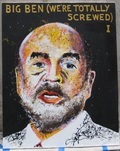
[Image above: A portrait of Ben Bernanke, Chairman of the US Federal Reserve, with the caption ‘Big Ben, We’re Totally Screwed’ in reference to the sub-prime crisis. I photographed this portrait across from the New York Stock Exchange (NYSE) in November ‘07. The artist had placed this portrait on auction at eBay.]
Layoffs are Never Easy
Often, business decisions entail some pain. Layoffs are never easy—for executives of a large organization facing the need to downsize by thousands or for a manager trying to dismiss one of his/her employees. Habitually, managers dread the prospect of facing employees being dismissed. Formal top-to-bottom communication and candid conversations with affected employees are obligations of the management. Employees being dismissed rightfully deserve to hear a respectful and honest assessment of the reasons for layoffs. They merit an offer for support through the transition and in pursuing employment elsewhere. This is the essence of true corporate character.
Recommended Reading
- Case Study: RadioShack laying off 400 workers and informing them of the decision via email
- Case Study: Northwest Airlines advising likely-to-be-laid-off ground workers: “don’t be shy about pulling something you like out of the trash”
- New York Times story ‘For Wall Street Workers, Ax Falls Quietly’
***See other articles related to Respect, fair treatment, dismissals, layoffs, downsizing, employee morale, corporate culture, Wall Street

The five macroeconomic trends identified by Hamish present an opportunity to understand the future in a broad context. Translate these trends into microeconomic indicators and examine how they may affect your lives: your society, marketplace, industry and the economy. What opportunities do these trends present to your career, your personal and professional growth, your choice of investments, etc? How will you capitalize on these opportunities?

Stores hope that once shoppers are tempted to start the day at their stores, they will buy less-discounted and regular merchandise. Clearly, they risk margins in an effort to boost sales numbers, one of the key metrics in the retailing industry.
On Wednesday, Apple’s iPod support website acknowledged that a
This reminds me of another instance of careless mistakes at
As alluded to every year in
Traditional philanthropy, whether personal, institutional or corporate, takes three forms: cash capital, volunteer-time in programming support, and cause-related sponsorship. I believe a fourth avenue, corporate and non-profit collaboration, can make an important difference in the society.
Interestingly, Airbus announced no aircraft for the 200 to 230 seat market. Airbus will discontinue the A310 from mid-2007 and its smallest wide-body is the popular A330-200, which can set 250 seats in 3-class configuration. So does not offer a competition for the B787-800, which has captured 281 of the 404 orders for the B787 thus far. If Airbus expects few other airlines to order aircrafts of this size in the next few years, it can shrink the A350-800 at a later date to cater to this market whenever demand arises.