Inspirational Quotations #209

Not being able to do everything is
no excuse for not doing everything you can.
* Ashleigh

The secret of happiness is not doing what
one likes to do, but in liking what one has to do.
* James M. Barrie

Your talent is God’s gift to you.
What you do with it is your gift back to God.
* Leo Buscaglia

Go to college
And get some knowledge.
Stay there till you’re through.
If they can make penicillin out of mouldy bread,
They can sure make something out of you!
* Muhammad Ali

No matter how old you are,
you are always somebody’s child,
and if you are loved,
you are always in somebody’s thoughts.
* Unknown

Whether the philosophers praise him or criticize,
whether wealth enters the house or goes away as it wishes,
whether death is today itself or after an eon,
great men never step a foot away from the path of justice.
* Subhashita

A friend is someone who knows the song in your heart
and can sing it back to you when you have forgotten the words.
* Unknown

Behold the turtle,
he makes progress only when he sticks his neck out.
* Bruce Levin

Are you bored with life? Then throw yourself into some work you
believe in with all your heart, live for it, die for it, and you will
find happiness that you had thought could never be yours.
* Dale Carnegie

Visit www.Inspiration.RightAttitudes.com for my compilation of inspirational quotations by author and topic. You may also subscribe to the weekly newsletter of inspirational quotations by sending a blank email to iqml-subscribe@yahoogroups.com.

*Keyword(s): Inspiration, Quotations

Ideas for Impact #31: Manager Tools’ Feedback Model

Preamble

Interpersonal feedback, managerial skills The last two articles discussed the popular ‘sandwich technique‘ for giving interpersonal feedback. The first article introduced the sandwich feedback technique. The second article critiqued this method and discussed three common mistakes that render the sandwich technique ineffective.

This follow-up article will introduce an effective feedback technique and list links for further information.

This article focuses on manager-to-employee feedback. However this feedback model can be the foundation for giving feedback in other interpersonal contexts as well—between peers or between spouses, for instance.

The Manager Tools Feedback Model

Manager Tools is a widely-admired suite of management techniques to help shape effective managers and leaders. The weekly podcasts on this site feature Manager Tools’ principals, Mark Horstman and Mike Auzenne, discussing their tools and tips to help audiences advance their managerial and leadership skills. The discussion forums are useful as well.

Perhaps the most popular and most effective of the Manager Tools ideas is the effective feedback model. Here is a summary of the four steps in this feedback technique.

  1. Ask an employee whether they are open to some feedback. Example: “Jack, may I give you some feedback?”
  2. Describe specific behavior you saw, heard, or read about. Example: “Jack, when you roll your eyes in meetings when others talk; when you say “you guys don’t get it”; when you come late to meetings and leave in the middle…”
  3. Describe the impact of the behavior. Once you have described what you observed, tell them what you felt or what impact it had on the company, project, or team. Example: “Jack, when you roll your eyes and tell others they “don’t get it”, here’s what happens. We lose good people. You lose opportunities you want, like that last move that you didn’t get.”
  4. Discuss next steps. Even with affirmative (positive) feedback, state “Good work. Keep it up.” For corrective (negative) feedback, ask open-ended or leading questions to encourage the employee to suggest change. Example: “What can you do about this? How can I help you?”

Further Information

Here are links to podcasts and references for further information on the Manager Tools effective feedback model.

Call for Action

Feedback is a central component of the manager-employee relationship. Employees get better at their jobs only when their managers give them timely, relevant and forthright feedback — both affirmative and corrective feedback.

Use the Manager Tools feedback model to enhance your feedback skills and communicate effectively with employees.

***See other articles related to Giving feedback, criticism, manager skills, interpersonal skills, praise

Why the Sandwich Feedback Technique is Ineffective

Sandwich feedback technique

Preamble

Yesterday’s article presented the popular ‘sandwich technique‘ for giving interpersonal feedback. This follow-up article will critique this method and discuss three common mistakes that render the sandwich technique ineffective. The next article will introduce an effective feedback technique with pointers for further information.

These discussions and examples focus on manager-to-employee feedback. This analysis is, however, relevant to other interpersonal contexts–between peers or between spouses, for instance.

Mary Kay Ash on the Sandwich Technique

Mary Kay Ash, American entrepreneur and founder of Mary Kay Cosmetics, discusses the sandwich feedback technique in her popular book ‘People Management.’

Sandwich feedback technique Sandwich every bit of criticism between two heavy layers of praise. … A manager should be able to tell someone when something is wrong without bruising an ego in the process.

Never giving criticism without praise is a strict rule for me. No matter what you are criticizing, you must find something good to say — both before and after. This is called sandwich technique.

Try to praise in the beginning and then again after discussing the problem. You don’t subject people to harsh criticism or provoke anger.

Common Mistake 1: Praise is substantial and obscures the criticism

Sandwich feedback is ineffective when praise obscures criticism Consider the following case. Surya was the head of a committee that organized the annual family picnic at his company. The committee exceeded the picnic budget by 35%. Surya’s boss uses the sandwich technique to criticize him for his failure to control expenditure.

  • Praise: “Surya, our management was very impressed with the attendance at our annual family picnic. The weather was great. The catered food was excellent. The activities for children were wonderful. You even organized contests for children and family.”
  • Criticism: “By the way, you overspent by 35%. You should check your expenses and try to be within budget.”
  • Praise: “I understand you worked very hard to coordinate the logistics. I congratulate you for doing a remarkable job leading the committee and for your enthusiasm. Thank you for a job well done.”

In the above example, the praise is substantial and obscures the criticism. Surya may neglect the criticism since the criticism is insignificant— therefore, lost—when sandwiched between “heavy layers of praise.”

Common Mistake 2: Praise is trivial or just-for-sake and serves no function

Sandwich feedback is ineffective when is trivial or just for sake Suppose that Charlie led a brainstorming meeting for a new product. One of his new fresh-from-college employees proposed an idea that was not practicable. Charlie was annoyed with the idea and responded, “That is a stupid idea. You are thoughtless. You have been here for less than a week. I don’t think you are knowledgeable enough to contribute to our discussions here.”

Janet, Charlie’s boss, observed this interaction. After the meeting, she wanted to criticize Charlie for condemning the new employee in the presence of several other employees. Janet recalled the sandwich feedback technique she had learnt. However, she could not conceive praise for Charlie. Hastily, she stated something trivial just for the sake of paving the way to her criticism.

  • Praise: “Charlie, good job organizing the meeting.”
  • Criticism: “I noticed that you openly called the new employee’s idea “foolish” and dismissed his idea. Don’t you realize he is fresh from college? Did you see his reaction? He felt dejected and showed no enthusiasm during the rest of the meeting. He was probably there to meet many people from our department and learn how we manage projects. How can you expect him to feel happy about joining your team? I have noticed that you jump to criticize other people’s ideas in meetings. Look, a good manager encourages participation in meetings. I think you should apologize to the new employee. [Pause]”
  • Praise: “Hmm … anyway. Good meeting. I liked your flowchart.”

As in the above example, for the sake of sandwiching their criticism, managers tend to offer unrelated—often trivial—praises when faced with the challenge of criticizing their employees. Such praise is inconsequential and, therefore, defeats the purpose of the sandwich technique.

Common Mistake 3: Employees get tuned in to the praise-criticism-praise pattern

Sandwich feedback is ineffective since employees get tuned in to the pattern Once managers learn and use the sandwich feedback technique a few times, employees recognize the praise-criticism-praise pattern. Employees realize that the managers offer criticism after initiating their conversations with praise. Subsequently they learn to discount this praise since such praise is just a lead-in to the criticism.
Conclusions: Sandwich feedback is often ineffective

Sandwich feedback technique Frequently, from the mistakes explained above, the sandwich technique amounts to undercutting praise with criticism. A praise followed by criticism undermines the positive impact of praise and weakens the significance of the corrective feedback.

Sandwich feedback is perhaps best used to help new managers develop feedback skills: to provide affirmative feedback to encourage employees to repeat desired behaviors and to offer corrective feedback to influence change. Once managers are at ease with giving feedback, they can focus on discussing what their employees do right and defer offering corrective feedback for other conversations.

Effective feedback is timely, relevant and forthright. Tomorrow’s article will introduce an effective feedback technique.

***Related Article: On the use of the word but‘ to undercut praise with criticism. ‘But’ as in “Great job on the PowerPoint presentation Tom, but, you used small fonts — the audience was not able to read text on your slides.”

***See other articles related to Giving feedback, criticism, manager skills, interpersonal skills, praise

Sandwich Feedback Technique

Sandwich Feedback Technique

Preamble

This article presents the popular ’sandwich technique’ for giving interpersonal feedback. Tomorrow’s follow-up article will critique this method and discuss three common mistakes that render the sandwich technique ineffective. A third article will introduce an effective feedback technique with pointers for further information.

These discussions and examples focus on manager-to-employee feedback. This analysis is, however, relevant to other interpersonal contexts–between peers or between spouses, for instance.

Managers Often Resent Giving Corrective Feedback

Managers Often Resent Giving Corrective Feedback Feedback is a central component of the manager-employee relationship. Often, managers resent giving corrective (or negative) feedback. They assume employee defensiveness and fear that negative feedback will offend the employee and thus affect their rapport with the employee. Such managers are likely to withhold criticism. They fail to provide timely, relevant feedback in various circumstances—employee tardiness to inappropriate attire (especially if the employee is of the opposite gender.)

Sandwich Feedback & Purported Benefits

The sandwich feedback technique is a popular three-step procedure to help managers who are ill at ease with providing corrective feedback. The sandwich feedback method consists of praise followed by corrective feedback followed by more praise. In other words, the sandwich feedback method involves discussing corrective feedback that is “sandwiched” between two layers of praise.

The purported benefits of this technique are twofold: (1) it “softens” the impact of the criticism or corrective feedback on an employee, and, (2) given that a manager is probably more comfortable with praising the employee, the manager finds it easier to discuss problems with the employee’s behavior if this discussion begins and ends with praising the employee.

Sandwich Feedback, Example 1

Sandwich Feedback & Purported Benefits Suppose that Andy, a new employee at a financial services firm, attended a week-long, offsite training program in New York. Each night during his stay at a hotel in New York, Andy purchased on-demand movies in his room. He included the corresponding $65 charge in his expense report. Further, Andy dined at very pricey restaurants in New York.

Jean, Andy’s manager, received the expense report for approval. Clearly, the charge for the movies had no business-justification. Jean uses the sandwich feedback technique to decline reimbursement for this expense and instruct Andy to be more prudent about expenses when on travel:

  • Praise: “Andy, I am impressed with your development since you joined my team last month. You have used the skills you learnt during your training in New York to systematically review the accounts of our customer.”
  • Criticism: “By the way, earlier this morning, I was reviewing the expense report from your trip to New York. I notice a $65 charge for on-demand movies. I have to deny this expense since it has no business-justification. I also noticed very expensive meals too. I will approve these charges this time. Given our limited travel budgets, I would ask you to be more careful about your trip expenses. You are probably not aware of our company’s travel policy. I have asked Human Resources to give you a copy of our travel policy booklet that details the acceptable expense report practices.”
  • Praise: “I am glad you were able to use the skills you learnt at this training in New York. I appreciate your hard work and your persistence with this customer. Keep up the good work.”

Sandwich Feedback, Example 2

Assume Geeta led a brainstorming meeting for an important project. Habitually, Geeta does not circulate the agendas prior to the meetings she leads. After one such meeting, Geeta’s manager uses the sandwich feedback technique to persuade her to be more organized:

  • Praise: “Geeta, we had a very productive meeting. We had the right participants. We did collect all the necessary inputs from other departments. Thanks for your coordination.”
  • Giving feedback is a central component of the manager-employee relationship Criticism: “Did you observe that the discussions were unsystematic? When you do not distribute an agenda prior to the meeting, the participants do not come prepared. During the meeting, they have to go back to their desks to collect information. Additionally, we tend to spend a lot of time digressing from the meeting objectives. How can you avoid this?” A discussion ensues.
  • Praise: “You are doing so well with gathering all the inputs. I am pleased about your diligence in circulating minutes of your meetings and following-up on action items. “

Concluding Thoughts

The sandwich feedback technique enables a manager to restructure feedback so it is easier to deliver, reinforce good behavior and ask for improvements to the employee’s behavior.

Tomorrow’s article will discuss, with simple examples, three common mistakes that defeat the purpose of sandwiching corrective feedback between two layers of praise.

***See other articles related to Giving feedback, criticism, manager skills, interpersonal skills, praise

Inspirational Quotations #208

Make yourself an honest man, and then you may be
sure that there is one less scoundrel in the world.
* Thomas Carlyle

We’re drowning in information and starving for knowledge.
* Rutherford D. Rogers

When you call yourself an Indian or a Muslim or a Christian or a European,
or anything else, you are being violent. Do you see why it is violent?
Because you are separating yourself from the rest of mankind.
When you separate yourself by belief, by nationality, by tradition,
it breeds violence. So a man who is seeking to understand violence
does not belong to any country, to any religion, to any political party
or partial system; he is concerned with the total understanding of mankind.
* Jiddu Krishnamurti

There is only one happiness in life; to love and be loved.
* George Sand

I’ve learned one thing during my time on the soccer fields:
It’s amazing how fast you can run
And the things you can do when you have a goal in mind.
It applies to the rest of my life, too.
* Jeremy Monnin

Real difficulties can be overcome;
it is only the imaginary ones that are unconquerable.
* Theodore N. Vail

Behold the turtle. He makes progress only when he sticks his neck out.
* James B. Conant

The hardest years in life are those between ten and seventy.
* Helen Hayes

Smile at each other,
smile at your wife, smile at your husband,
smile at your children, smile at each other
– it doesn’t matter who it is –
and that will help you to grow up
in greater love for each other.
* Mother Theresa

Visit www.Inspiration.RightAttitudes.com for my compilation of inspirational quotations by author and topic. You may also subscribe to the weekly newsletter of inspirational quotations by sending a blank email to iqml-subscribe@yahoogroups.com.

*Keyword(s): Inspiration, Quotations

Ideas for Impact #30: The Power of Apology

The Power of an Apology

Value of Apology in Customer Service

Southwest Airlines' focus on customer service is legendary Southwest Airlines is perhaps one of best-run airlines in the world and a pioneer of the low-cost-carrier model. The company’s culture and focus on customer service are legendary. A recent article on the company’s official blog discusses the value of apologies.

Don’t be afraid to say “I’m sorry.”

People often misunderstand the intent of an apology. It is not an admission of fault. It’s an acknowledgment of a bad experience-no matter what happened. It’s doesn’t mean the Customer is always right-there’s no need to support, tolerate, or reward abusive behavior.

The importance of Apologies » Southwest Airlines Blog When things don’t go according to plan, an apology provides the opportunity to offer the Customer an assurance that you care about their feelings. An apology lets you reach out to the Customers who are affected by acknowledging the disruption/inconvenience, offering your assistance, providing an explanation, and letting them know you’re working to prevent a repeat performance (if applicable).

If you don’t know the answer to a question, it’s okay to admit that-just don’t speculate and be sure you let the Customer know that you will try to provide them with an answer within a reasonable timeframe.

Call for Action: Learn to Express Regret

In business, social or personal settings, many of us balk at offering apologies, even if we are wrong. We do not realize that a sincere expression of regret is healing: an honest ‘I am sorry’ can soften negative emotions (anger, resentment, etc.) our actions trigger in other people. An apology can restore goodwill and mend relationships.

Here are three steps to an apology.

  1. Take responsibility and acknowledge the impact of your actions. “I realize … I caused …”
  2. Express regret for your actions. “I am sorry.”
  3. Offer a remedy and pledge to change. “I will improve.”

Call for Action -- Learn to Express Regret Here is an example. Suppose you promised to watch a movie with your spouse on Valentine’s Day. However, your boss asked you to attend a late-evening teleconference with an international client. You could not go home in good time for the movie. Your spouse is upset. Say, “I realize I am late for the movie. I regret I did not excuse myself from the meeting early. I am sorry. Shall we watch the movie on Friday evening?”

The secret to truthful apologies is to keep your apology-statements straightforward and short. Do not attempt to explain or rationalize your behavior–these just dilute the sincerity of your apology.

Related Articles

***See other articles related to Expressing regret, apologizing, saying sorry, handling mistakes, leadership skills, people skills

Inspirational Quotations #207

There is nothing so powerful as the truth.
* Anonymous

Never let a day go by without giving at least three people a compliment.
* H. Jackson Brown, Jr.

Hope for the best but prepare for the worst.
* English Proverb

Man is never helped in his suffering by what he thinks for
himself, but only by revelation of a wisdom greater than his
own. It is this which lifts him out of his distress.
* Carl Gustav Jung

When one is out of touch with oneself, one cannot touch others.
* Anonymous

To succeed, you will soon learn, as I did,
the importance of a solid foundation in the basics of education–
literacy, both verbal and numerical, and communication skills.
* Alan Greenspan

Men should be judged, not by their tint of skin,
the Gods they serve, the Vintage they drink,
nor by the way they fight, or love, or sin,
But by the quality of the thought they think
* Laurence Hope

Take up one idea. Make that one idea your life -
think of it, dream of it, live on idea.
Let the brain, muscles, nerves, every part of your body,
be full of that idea, and just leave every other idea alone.
This is the way to success.
* Swami Vivekananda

I know only what is moral is what you feel good
after and what is immoral is what you feel bad after.
* Ernest Hemmingway

Visit www.Inspiration.RightAttitudes.com for my compilation of inspirational quotations by author and topic. You may also subscribe to the weekly newsletter of inspirational quotations by sending a blank email to iqml-subscribe@yahoogroups.com.

*Keyword(s): Inspiration, Quotations

Ideas for Impact #29: Remembering Names at a Meeting

Remembering Names around a Table at a Meeting

Ever wonder how a waiter/waitress serving an eight-seat table at a restaurant remembers each guest’s food orders? At many restaurants, the order-sheets contain a layout of the table and a letter or number associated with every seat. As each guest orders food, the waiter/waitress writes down the order along with the letter or number associated with that guest’s seat.

At Southwest Airlines, flight attendants go to every seat, ask customers for their choice of beverage, and record the passenger’s choice on a seat-map.

Remembering Names around a Table at a Meeting

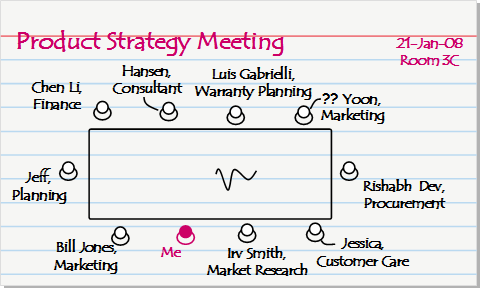
Blogger Adam Gurno presents an extension of the two practices listed above for remembering names around a table at a meeting.

  1. Draw a quick map of the table/layout of the meeting. Place yourself on it, to give yourself a reference point.
  2. As people introduce themselves around the table, fill them in. If you feel last names are necessary add those too, but don’t do it at the expense of writing down someone else’s name. You can guess at the last names later. If you miss one, leave it blank and fill it in as soon as you can - if someone else refers to them, etc, etc.
  3. If everyone introduces themselves, try and jot down as much information as possible. If you think that you will run across them later, include information that will help you recognize them down the road.
  4. Refer back to the map during the meeting when you are going to need to speak. This way you will be prepared with a person’s name.

Positive impressions are invaluable. As we discussed in a previous blog article, remembering names is an important social skill — mastering this skill can offer a distinct advantage in networking and building relationships.

***See other articles related to personality development, networking, building relationships, leadership skills, people skills, interpersonal skills

Ideas for Impact #28: Jack Welch’s Four Types of Managers

Jack Welch's Four Types of Managers

Four Types of Managers

Jack Welch, Chairman and CEO of General Electric from 1981 to 2001, described four categories of managers in General Electric’s year 2000 annual report.

Type 1: shares our values; makes the numbers — sky’s the limit!

Type 2: shares the values; misses the numbers — typically, another chance, or two.

Type 3: doesn’t share the values; doesn’t make the numbers — gone.

Jack Welch, former Chairman and CEO of General Electric Type 4 is the toughest call of all: the manager who doesn’t share the values, but delivers the numbers. This type is the toughest to part with because organizations always want to deliver and to let someone go who gets the job done is yet another unnatural act. But we have to remove these Type 4s because they have the power, by themselves, to destroy the open, informal, trust-based culture we need to win today and tomorrow.

We made our leap forward when we began removing our Type 4 managers and making it clear to the entire company why they were asked to leave — not for the usual “personal reasons” or “to pursue other opportunities,” but for not sharing our values. Until an organization develops the courage to do this, people will never have full confidence that these soft values are truly real.

Living by Values

Hold employees responsible for their behaviors Organizations face the challenge of developing and sustaining a culture that is both values-centered and performance-driven. They begin by developing mission and value statements that, in due course, become little more than wall decorations because the organization’s leaders and managers fail to uphold these values.

Nothing hurts morale more than when leaders tolerate employees who deliver results, but exhibit behaviors that are incongruent to values of the company. For instance, an organization that thrives on teamwork will suffer, over the long term, if a manager habitually claims all credit for his team’s accomplishments.

Call for Action

As a manager, drive accountability. Hold employees responsible for their behaviors. Reward employees for proper behaviors and publicly discourage behaviors that do not uphold values. Do not make exceptions — exceptions signify your own indifference to the upholding of values.

As an employee, understand that an essential requirement for your success in your organization is your fit. Your behaviors must be congruent with the character and needs of your organization. Even if you are talented, you will not fare well if your behaviors are inconsistent with the values of your organization. Reflect on your behavior. On a regular basis, collect feedback from your managers, peers and employees. Seek change.

***See other articles related to credibility, leadership skills, managerial skills, values, mission, behaviors, attitudes

Inspirational Quotations #206

For every mountain, there is a miracle.
* Robert Schuller

A person is only as big as the dream they dare to live.
* Unknown

To enhance the quality of the day…
That is the highest of the arts.
* Henry David Thoreau

Kindness is the language which the deaf can hear and the blind can see.
* Mark Twain

It is our experience that, 90% of the time,
what passes for commitment is compliance.
* Peter Senge

If you are patient in one moment of anger,
you will escape a hundred days of sorrow.
* Chinese Epigram

She didn’t know it couldn’t be done,
so she went ahead and did it.
* Mary’s Almanac

But though I am an old man,
I am but a young gardener.
* Thomas Jefferson

It is amazing what you can accomplish
if you do not care who gets the credit.
* Harry S. Truman

Take Time
Take time to be friendly -
It is the road to happiness.
Take time to dream -
It is hitching your wagon to a star.
Take time to love and to be loved -
It is the privilege of the Gods.
Take time to look around -
It is too short a day to be selfish.
Take time to laugh -
It is the music of the soul.
* English Prayer

Visit www.Inspiration.RightAttitudes.com for my compilation of inspirational quotations by author and topic. You may also subscribe to the weekly newsletter of inspirational quotations by sending a blank email to iqml-subscribe@yahoogroups.com.

*Keyword(s): Inspiration, Quotations

« Previous entries ·