Inspirational Quotations #196

If you judge people, you have no time to love them.
* Mother Theresa

The most important thing I have learned over the years is
the difference between taking one’s work seriously and taking
one’s self seriously. The first is imperative, and the second disastrous.
* Margot Fonteyn

Life seems nothing more than a quick succession of busy nothings.
* Unknown

Anger is the most important of passions.
It effects nothing it goes about,
and hurts the one who is possessed by it
more than the one against whom it is directed.
* Clarendon

It is not enough to fight. It is the spirit
which we bring to the fight that decides
the issue. It is morale that wins the victory.
* George C. Marshall

People don’t care how much you know, until they know how much you care.
* Unknown

Dharma means the natural state or condition of beings and things,
what sustains, the law of their being,
what is right for them to be,
the very stuff of their being.
* S. N. Tandon

A bird doesn’t sing because it has an answer,
it sings because it has a song.
* Maya Angelou

War educates the senses,
calls into action the will,
perfects the physical constitution,
brings men into such swift and close collision
in critical moments that man measures man.
* Ralph Waldo Emerson

Oh, the comfort, the inexpressible comfort of
feeling safe with a person, having neither
to weigh thoughts nor measure words,
but pouring them all right out, just as they are,
chaff and grain together; certain that a faithful hand
will take and sift them, keep what is worth keeping,
and then with the breath of kindness, blow the rest away.
* Dinah Craik

Visit www.Inspiration.RightAttitudes.com for my compilation of inspirational quotations by author and topic. You may also subscribe to the weekly newsletter of inspirational quotations by sending a blank email to iqml-subscribe@yahoogroups.com.

*Keyword(s): Inspiration, Quotations

Ideas for Impact #22: Establishing Credibility for Persuasion

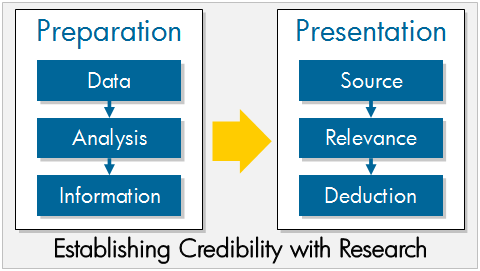
Establishing Credibility with Research

‘Facts bridge the credibility gap.’

In “The McKinsey Way,” author Ethan M. Rasiel presents numerous insights to problem solving, analytical reasoning and effective communication practiced by consultants from McKinsey & Company, one of the foremost management-consulting firms.

When a typical associate joins McKinsey & Company, she “will have graduated near the top of her college class, spent two or three years working for a large company, then received her MBA from a top business school. She will be in her mid- to late-twenties. On her first engagement, she may have to present her analysis to the CEO of a Fortune 50 company, who will not give much credence to what some newly minted, 27-year-old MBA has to say — unless she has an overwhelming weight of facts to back her up. This is just as true for a junior executive presenting a proposal to his boss.

Call for Action

One of the primary facets of our work is to sell ideas — to lead and persuade an audience to appreciate our arguments or our perceptions on a certain topic or problem.

Credibility is the cornerstone of persuasive communication. Many of us mistakenly presume that credibility is an entitlement—a function of our positions or affiliations. We fail to realise that credibility is a virtue we earn and preserve over time.

Establishing Credibility with Research

The single most effective approach to establishing credibility is to demonstrate concrete foundations to our proposed thoughts — to draw on meaningful information and deduce concrete inferences in support of our positions.

  • Collect facts and data from reliable sources. Interpret data and demonstrate its relevance. Deduce and structure your arguments in a logical manner to lead people to draw conclusions you would like them to.
  • Include particulars (data, analyses, information) of your background work in an appendix to your presentation or report.
  • Consider your position from every angle and prepare to answer questions. Address counter-arguments in your communication: “Some of you may argue that… Let me assess the risk and suggest a contingency plan.”

Bear in mind that people trust a person’s thoughts so long as they trust the underlying research.

***See other articles related to persuasive communication, persuasion, selling ideas, research, presentations

Inspirational Quotations #195

We can only learn to love by loving.
* Iris Murdock

When a man begins to understand himself he begins to live.
When he begins to live he begins to understand his fellow men.
* Noruin G. McGranahan

Accountability starts with yourself. “I am responsible.”
* Rudolph W. Giuliani

In spite of all wanderings,
happiness is always found within a narrow compass and
among objects which lie within our immediate reach.
* Bulwer

Every human mind is a great slumbering power until
awakened by keen desire and by definite resolution to do.
* Edgar F. Roberts

No matter what I do,
someone is going to hate me for it,
so I might as well do it anyways.
* Thomas Shank

Doubt is the vestibule through which all must pass
before they can enter into the temple of wisdom.
* Charles Caleb Colton

There is no scarcity of opportunity to make a living at what you love;
there’s only a scarcity of resolve to make it happen.
* Wayne Dyer

Failure is only the opportunity to more intelligently begin again.
* Henry Ford

Let a man strive to purify his thoughts. What a man
thinketh, that is he; this is the eternal mystery.
Dwelling within himself with thoughts serene,
he will obtain imperishable happiness.
Man becomes that of which he thinks.
* The Upanishads

Real generosity is doing something nice for someone who’ll never find out.
* Frank A. Clark

Visit www.Inspiration.RightAttitudes.com for my compilation of inspirational quotations by author and topic. You may also subscribe to the weekly newsletter of inspirational quotations by sending a blank email to iqml-subscribe@yahoogroups.com.

*Keyword(s): Inspiration, Quotations

Inspirational Quotations #194

Flowers are the sweetest things that God
ever made, and forgot to put a soul into.
* Henry Ward Beecher

Talent is that which is in a man’s power;
genius is that in whose power a man is.
* James Russell Lowell

Never let the fear of striking out get in your way.
* Babe Ruth

Joy increases as you give it, and diminishes as you try to keep it for yourself.
In giving it, you will accumulate a deposit of joy greaterthan you ever believed possible.
* Norman Vincent Peale

Be brave. Even if you’re not,
pretend to be. No one can tell the difference.
* Unknown

When you judge others, you are revealing your own fears and prejudices.
* H. Jackson Brown, Jr.

Pain is inevitable but suffering is your own decision.
* Unknown

The key is not to prioritize your schedule,
but to schedule your priorities.
Do the important things first – because
where you are headed is more important than how fast you are going.
* Unknown

There is nothing so comfortable as money, but
nothing so defiling if it be come by unworthily;
nothing so comfortable, but nothing so noxious if
the mind be allowed to dwell upon it constantly.
If a man have enough, let him spend it freely.
If he wants it, let him earn it honestly.
* Anonymous

Live, Love, Laugh.
* Anonymous

Visit www.Inspiration.RightAttitudes.com for my compilation of inspirational quotations by author and topic. You may also subscribe to the weekly newsletter of inspirational quotations by sending a blank email to iqml-subscribe@yahoogroups.com.

*Keyword(s): Inspiration, Quotations

Etiquette: Protocol of Introducing People

Professional Etiquette: Protocol for Introducing People to One Another

The purpose of introducing people is to give them an opportunity to know each other. Beyond just stating names of the two parties, it is often the obligation of the person making the introduction to establish an acquaintance and help the two parties initiate a conversation.

Four Steps for Introductions

Four Steps for Introducing People to One Another The basic protocol of introductions calls for introducing the ‘lesser-ranking’ (socially, professionally, by age or seniority) to the ‘higher-ranking’ person. Here are four steps.

  1. Firstly, state the name of the person being introduced to. This is the ‘higher-ranking’ person.
  2. Secondly, say “I would like to introduce” or, “please meet” or, “this is,” etc.
  3. Thirdly, state the name of the person being introduced. This is the ‘lower-ranking’ person.
  4. Finally, offer some details of each other, as appropriate. As I wrote in a previous blog article, add a snippet of information about a topic of common interest between the two parties. Do not elaborate. This will help them connect and pursue a conversation.

When introducing people of equal seniority or status, you may introduce any person to the other.

A Few Examples

  • Examples of Introducing People to One Another Introduce a younger person to an older person. “Grandma, please meet Alicia and Carlos Sanchez, my neighbors.”
  • Introduce a relatively junior professional to a senior professional. “Ms. Director, I would like to introduce Mr. Ram Prasad Rao, the Chief Product Architect for our software division.”
  • Introduce an employee to a customer. “Mr. Sung, I would like to introduce our plastics engineering team. This is Mark Smith, Jessica Ramos and Liang Zhu. All three participated in last week’s teleconference regarding product definition.”
  • Introduce a host to a guest. “Elaine, I don’t think you have met my daughter, Archana. Archana arranged for all the food at this festival party. Archana, Elaine is my Project Manager.”
  • Introduce a local guest to a from-another-town guest. “Suresh, this is Debbie. Debbie is my colleague from work. Debbie, Suresh is visiting me from Ann Arbor. We shared an apartment when we went to school at the University of Michigan.”
  • Introduce a peer from your company to a peer from another organization. “Mellissa, I would like you to meet Subramani Iyer, our Systems Engineer. Subramani, Melissa Hoffmann is from Marketing. She is the Account Manager for Wal-Mart.”

Gender Distinction

Gender Distinction in Introducing People Customarily, a number of people introduce a man to a woman out of respect, regardless of the guidelines presented above.

When introducing a man and a woman at work, consider their positions and seniorities alone. Outside of work, it may be more appropriate to introduce a man to a woman, in contradiction to the above guidelines. Only be judicious and sensitive.

Concluding Thoughts

Many people have difficulty introducing people to one another and helping establish a conversation. With some practice and a sense of social and/or professional ranking, you too can master the art of introductions.

***See other articles related to introductions, conversations, people skills, hosting, meetings, parties, professional etiquette

Ideas for Impact #21: An Essential Secret of Great Speakers—Pauses in Talking

Seven Steps to Better Presentations

Jeffrey Veen of Adaptive Path, and now, Google, lists seven steps for better presentations here. Here is a summary.

  1. Tell stories
  2. Show picture and use good metaphors
  3. Don’t apologize for something out of order or for a mistake.
  4. Start strong
  5. End strong too
  6. Stand away from the podium and out from behind the presenter table
  7. Pause while speaking

Pausing While Speaking

Pause While Speaking Often, speakers and presenters talk quickly—sometimes to an extent that the audience cannot clearly understand the speakers’ words. Perhaps these speakers are nervous. Or, they may be excited about their speeches and hence, are in a rush to express their ideas.

An effective speaker uses lots of pauses in speeches. By pausing after important segments along a speech, a speaker can gather his/her thoughts. And, the audience gets a chance to absorb the contents of the speech.

On the other hand, some speakers tend to be slow, especially if they are contemplative. These speakers quickly lose the attention of the audience.

How to Improve Pausing in Speaking

  1. How to Improve Pausing in Speaking While listening to radio or watching television, observe the speeches of newsreaders, stand-up comedians, broadcasters or background-narrators. Observe how they pause along their talking.
  2. Choose a few newspaper- or magazine-articles and read them out aloud as you would in a speech. At each punctuation mark—a comma, period, semicolon, etc., —pause before you proceed to the next phrase or sentence. Record your speech on a tape-recorder or on your computer (use Audacity software, a freeware) and review.
  3. As you prepare for an important presentation or speech, write down the entire text of your speech with plenty of punctuations. Practice your speech, record and review.

Concluding Thoughts

Audiences typically remember a very small portion of what they hear in speeches and presentations. By using plenty of pauses and pacing yourself, you can improve your ability to articulate and help your audience appreciate your thoughts.

***See other articles related to PowerPoint, presentation skills, presentations, public speaking, verbal communication