Ideas for Impact #1: Dale Carnegie on the Use of ‘but’ in Interpersonal Feedback

Dale Carnegie's classic, How to Win Friends and Influence PeopleDale Carnegie’s classic, “How to Win Friends and Influence People,” is one of the most popular self-help books ever written. The book was first published in 1936 and has since sold millions of copies worldwide. In all my personality development seminars, I recommend this book as a must-read for improving interpersonal dynamics. Here is a detailed summary of the book.

Dale Carnegie on the Choice of Words in Giving Feedback

Many people begin their criticism with sincere praise followed by the word ‘but’ and ending with a critical statement. For example, in trying to change a child’s careless attitude toward studies, we might say, “We’re really proud of you, Johnnie, for raising your grades this term. But if you had worked harder on your algebra, the results would have been better.”

In this case, Johnnie might feel encouraged until he heard the word ‘but.’ He might then question the sincerity of the original praise. To him, the praise seemed only to be a contrived lead-in to a critical inference of failure. Credibility would be strained, and we probably would not achieve our objectives of changing Johnnie’s attitude toward his studies.

This could be easily overcome by changing the word ‘but’ to ‘and.’ “We’re really proud of you, Johnnie, for raising your grades this term, and by continuing the same conscientious efforts next term, your algebra grade can be up with all the others.”

Now, Johnnie would accept the praise because there was no follow-up of an inference of failure. We have called his attention to the behavior we wished to change indirectly and the chances are he will try to live up to our expectations.

Call for Action

Effective Interpersonal FeedbackGiving interpersonal feedback and facilitating change is a critical people-skill. Prior to delivering feedback, we rarely plan exactly what we want to say and how we want to say. The words we choose to use are important.

Observe how you deliver feedback. Use the “You are good and if you improve at this skill, you will be better” structure for effective feedback.
***See other articles related to Ideas for Impact, personality development, leadership skills, people skills, interpersonal feedback, managerial skills, performance appraisal, performance review

Ideas for Impact: A New Series of Articles

'Ideas for Impact': A New Series of Articles on Right Attitudes

Quite a few regular readers of my Right Attitudes blog and its predecessor website have proposed that I use this forum to share ideas and insights from various sources. In response to your requests, I am announcing a new series of articles entitled ‘Ideas for Impact.’

Every week, I will present valuable insights drawn from a variety of sources—books, magazines, blogs, interviews, and, speeches. Each article will feature a brief summary or excerpt of ideas for personal and organisational development. Additionally, I will include a call for action that will help you reflect and act on these influential thoughts.

I hope that you will apply these practical wisdoms to change yourselves—your mindsets, thoughts and actions. I am confident that this ‘Ideas for Impact’ series of articles will further the mission of my Right Attitudes blog in leading you and your organisations to effectiveness in your personal and professional lives.

I love to hear from you and get your feedback. If you have ideas or contributions for future ‘Ideas for Impact’ articles, do not hesitate to contact me.

Do good work and enjoy life!

****See other articles related to personality development, Ideas for Impact

Inspirational Quotations Newsletter: Issue #158

The fastest way to succeed is
to look as if you’re playing by other people’s rules,
while quietly playing by your own.
* Michael Korda

Do not go where the path may lead,
go instead where there is no path and leave a trail.
* Ralph Waldo Emerson

If there is one thing upon this earth that
mankind loves and admires better than another,
it is a brave man, it is the man who dares to
look the devil in the face and tell him he is a devil.
* James Abram Garfield

Life is about not knowing, having to change,
taking the moment and making the best of it,
without knowing what’s going to happen next.
Delicious ambiguity.
* Gilda Radner

Don’t worry about people stealing your ideas.
If your ideas are any good,
you’ll have to ram them down people’s throats.
* Howard Aiken

The competitor to be feared is
one who never bothers about you at all,
but goes on making his own business better all the time.
* Henry Ford

I just want to leave a committed life behind.
* Martin Luther King, Jr.

Thinking is the hardest work there is,
which is probably the reason why so few engage in it.
* Henry Ford

Nothing is a waste of time if you use the experience wisely.
* Francois Auguste Rene Rodin

Visit www.Inspiration.RightAttitudes.com for my compilation of inspirational quotations by author and topic. You may also subscribe to the weekly newsletter of inspirational quotations by sending a blank email to iqml-subscribe@yahoogroups.com.

*Keyword(s): Inspiration, Quotations

Presentation Tips #3: Compressing Photos in PowerPoint

Suppose you are preparing a PowerPoint presentation with pictures from prototype testing of a design or pictures from your vacation. When you insert pictures into the PowerPoint file, you may realize that the file’s size will balloon with addition of each picture. You may end-up with a large PowerPoint file that may perhaps be difficult to distribute or email.

The reason for larger PowerPoint files is twofold. Firstly, Microsoft PowerPoint may not store picture data in an optimum format. Secondly, while today’s digital cameras can capture pictures at high resolutions (between three to five megapixels per picture,) on-screen display requires pictures of just 96 DPI (dots per inch) resolutions. In addition, typical office-document printing requires pictures of no more than 200 to 300 DPI resolutions.

The more-recent versions of Microsoft PowerPoint facilitate compressing pictures easily to create smaller files.

Compressing Photos in PowerPoint

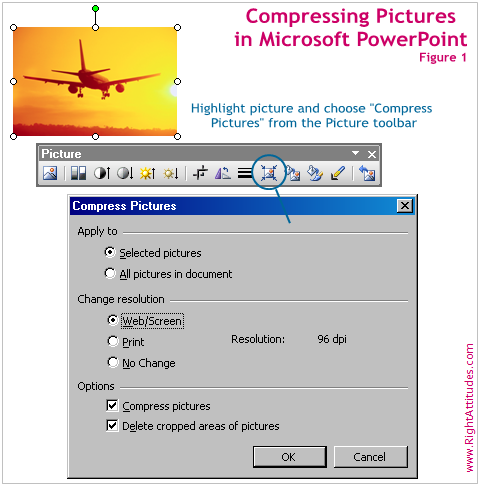
If you desire to compress a single picture or a group of pictures, highlight the pictures. The Picture toolbar will appear, as illustrated in Figure 1. Now, choose “Compress Pictures” from the Picture toolbar. In the resulting dialogue box, make appropriate selections to execute the command.

Compressing Photos in PowerPoint

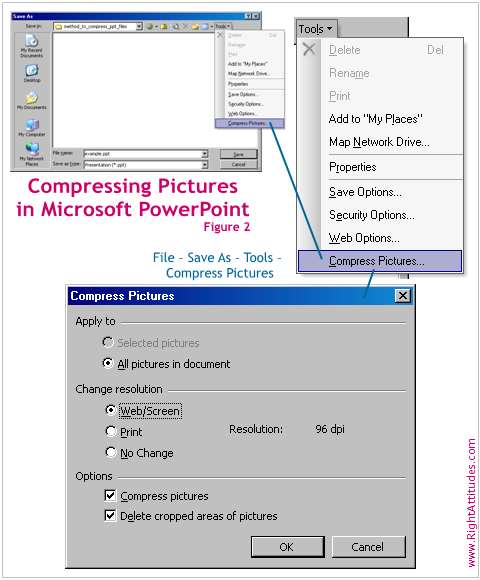
If you desire to compress all the pictures in your PowerPoint file, an easier approach involves the “Save As” dialogue. From the menu bar, choose “File” - “Save As … .” In the resulting dialogue box, open the “Tools” dropdown and choose the “Compress Pictures” command, as illustrated in Figure 2.

***See other articles related to presentation skills, public speaking, verbal communication, PowerPoint, digital pictures

Inspirational Quotations Newsletter: Issue #157

Experience teaches only the teachable.
* Aldous Huxley

There are souls in this world which have the gift of finding
joy everywhere and of leaving it behind them when they go.
* Frederick William Faber

Let your enthusiasm radiate in your voice,
your actions, your facial expressions,
your personality, the words you use,
and the thoughts you think!
Nothing great was ever achieved without enthusiasm.
* Ralph Waldo Emerson

The man who goes farthest is generally
the one who is willing to do and dare.
The sure-thing boat never gets far from shore.
* Dale Carnegie

It is what you do from now on that will either
move our civilization forward a few tiny steps,
or else… begin to march us steadily backward.
* Patrick Stewart

The joys we expect are not so bright,
nor the troubles so dark as we fancy they will be.
* Charles Reade

I am alone and helpless. I am weak and destitute.
Even in its dreams the lion does not think like this.
* Subhashita

If someone is too tired to give you a smile,
leave one of your own, because no one
needs a smile as much as those who have none to give.
* Unknown

The sages do not consider that making no mistakes
is a blessing. They believe, rather, that the
great virtue of man lies in his ability to correct
his mistakes and continually make a new man of himself.
* Wang Yang-Ming

Shoot for the moon.
Even if you miss, you’ll land among the stars.
* Les Brown

Visit www.Inspiration.RightAttitudes.com for my compilation of inspirational quotations by author and topic. You may also subscribe to the weekly newsletter of inspirational quotations by sending a blank email to iqml-subscribe@yahoogroups.com.

*Keyword(s): Inspiration, Quotations

Written Communication Tips #2: On date formats

Date formats and representations The interpretation of a date written in the ‘02-12-06′ format can differ. For instance, a reader in the United States may interpret the above date as the 12th of February 2006, where as another from India or the United Kingdom may interpret the date as the 2nd of December 2006. A computer programmer may interpret the date as the 6th of December 2002. Avoid using all-digit date formats.

The most popular formats for expressing dates are 12th February 2006 (more formal,) 12 February, 2006 (the comma is optional) or 12-Feb-2006 (shorter, inexplicit form.)

  • The most significant part of a date is the day. Hence, write the day first, followed by the month (spelled in complete or as a three-letter abbreviation) and then include the year. The least significant part of a date is the year; you may omit the year in informal communication.
  • You can easily avoid confusing a reader about your intended date format by spelling out the entire month or by using a three-letter abbreviation for the month. Further, in speech or thought, we rarely express months in terms of numbers. For instance, while reading out a date, we rarely express February as the second month of the year.

Date formats and representations Whatever format you choose to use, be consistent throughout a document: use an identical format all the dates in the document. Consistency in formats is important for both form and function of the dates.

P. S: International Standard ISO 8601 stipulates numeric representations for date and time. The international standard date notation is YYYY-MM-DD. Accordingly, you would denote the 12th of February 2006 as 2006-02-12. Clearly, this format does not impart order-preference to the more significant parts of the date, viz., the day and the month. However, this date format offers advantages in computer usage; I plan to cover these in a future blog article.

***See other articles related to written communication, date formats, date notations, date representations

Inspirational Quotations Newsletter: Issue #156

The best rules to form a young man, are,
to talk little,
to hear much,
to reflect alone upon what has passed in company,
to distrust one’s own opinions,
and value others that deserve it.
* William Temple

Hail thy brother’s boat across,
and lo! thine own has reached the shore.
* Hindu proverb

Everything that is really great and inspiring is
created by the individual who can labour in freedom.
* Albert Einstein

If you pick the right people and give them
the opportunity to spread their wings and
put compensation as a carrier behind it,
you almost don’t have to manage them.
* Jack Welch

Humility does not mean
thinking less of yourself than of other people,
nor does it mean having a low opinion of your own gifts.
It means freedom from thinking about yourself at all.
* Sir William Temple

One of the greatest pains to human nature
is the pain of a new idea.
* Walter Bagehot

In modern business it is not the crook who is to be feared most, it is the honest man who doesn’t know what he is doing.
* William Wordsworth

The chief duty I long to accomplish great and noble tasks,
but it is my chief duty to accomplish humble tasks
as though they were great and noble.
The world is moved along, not only by the
mighty shoves of its heroes, but also
by the aggregate of the tiny pushes of each honest worker.
* Helen Keller

When a person can no longer laugh at himself,
it is time for others to laugh at him.
* Thomas Szasz

Don’t think there are no crocodiles because the water is calm.
* Malayan Proverb

Visit www.Inspiration.RightAttitudes.com for my compilation of inspirational quotations by author and topic. You may also subscribe to the weekly newsletter of inspirational quotations by sending a blank email to iqml-subscribe@yahoogroups.com.

*Keyword(s): Inspiration, Quotations

General Communication Skills #1: Begin at the End

General Communication Skills: Begin at the EndAn effective way to prepare a speech, presentation, report, résumé, or, an email is to begin at the end. Place yourself in the recipient’s or the audience’s shoes and look from the outside in by asking a few questions on the outcome of your communication. Write down all the outcomes you desire from your communication; write down everything that comes to mind without filtering any probable outcomes.

Suppose, for example, you are preparing for a speech. Ask yourself “Who is my audience? What do my listeners want to know? What should be the key take-away messages from my speech? What do I want the audience to remember or do following my speech?”

Once you gather all the intended outcomes, prioritize and collect the core conclusions you intend to present your audience. Then, work backwards: assemble your concepts, anecdotes and statistics that support them, and compose a logical flow of thoughts leading to those conclusions.

The key advantage of beginning at the end is a unique perspective that enables you to control the direction of your thoughts during preparing your communication. Consequently, you can toss out any idea that does not directly relate to the messages you want to deliver.

Communication is all about the audience. Beginning at the end effectively helps you focus on the messages you want to deliver to your audience.

***See other articles related to general communication, public speaking, presentation skills, written communication, resume skills

Telephone Skills #2: Avoiding Telephone Interruptions

Avoiding telephone interruptionsThe ring of a telephone is one of the most annoying of intrusions at work.

Productive work requires extended periods of concentration. Incoming calls impair your efficiency by breaking your concentration, especially during your productive work-hours. Additionally, a ringing telephone can easily interrupt a conversation, even if you do not intend to answer the ring. If you have a visitor, he or she may let you pickup a ringing telephone, out of courtesy: “Do you want to pickup the phone?” “No. Let’s continue.”

Here are two practices to avoid telephone interruptions.

  • Use voicemail to avoid telephone interruptionsTurn-off your telephone during your productive work-hours or when you are meeting somebody at your desk. Instead, use a voicemail system. The voicemail system allows you to pick the moments at which you pay attention to incoming telephone calls. Check voicemail once or twice a day and return telephone calls promptly. For example, at work, I unplug the telephone cable at my desk until 11:00am and check voicemails after lunch.
  • A large fraction of your unscheduled incoming calls are likely to be from specific people: a project manager calling you to inform you of customer specifications, off-site colleagues requesting help, or, family members updating you of some information. These conversations are probably not on pressing matters that require your immediate attention. Inform the people most likely to call you of times when you are not available to take their calls and request them not to call during these periods. People will respect your request if you inform them of your reason, viz., your desire to be productive during those times, and promptly follow-up on voicemails they may leave. For example, I request people not to call me in the mornings and encourage them to send email.

Your efficiency at work depends directly on how productively you use your work-time. Avoiding telephone interruptions thus provides a greater control over how you organize your time.

***See other articles related to telephone skills, professional etiquette, people skills, productivity

Inspirational Quotations Newsletter: Issue #155

In the animal kingdom, the rule is, eat or be eaten;
in the human kingdom, define or be defined.
* Thomas Szasz

We all have ability.
The difference is how we use it.
* Stevie Wonder

I have yet to meet a successful business owner who has
not failed before. What’s the difference between them
and the Owner-turned-9-to-5? They didn’t let one
setback cripple their hunger for success. Don’t you!
* Wild Bill

To free us from the expectations of others,
to give us back to ourselves–
there lies the great, singular power of self-respect.
* Joan Didion

Kindness is the golden chain by which society is bound together.
* Johann Wolfgang von Goethe

Life can only be understood backwards;
but it must be lived forwards.
* Soren Kierkegaard

I like thinking big.
If you’re going to be thinking anything,
you might as well think big.
* Donald Trump

The policy of being too cautious is the greatest risk of all.
* Jawaharlal Nehru

You have enemies? Good. That means
you’ve stood up for something, sometime in your life.
* Winston Churchill

Visit www.Inspiration.RightAttitudes.com for my compilation of inspirational quotations by author and topic. You may also subscribe to the weekly newsletter of inspirational quotations by sending a blank email to iqml-subscribe@yahoogroups.com.

*Keyword(s): Inspiration, Quotations

« Previous entries ·