Avoiding a Deer Hit, Part 1: My Seatbelt Saved my Life

Deer hit result

In November of last year, while returning from Chicago, I hit a deer approximately ten miles north of metropolitan Indianapolis. Fortunately, I survived the mishap without any injuries.

Sequence of Events

Sequence of events in a deer hitThe entire incident, from the moment I spotted the deer to when I hit the deer, happened in less than two seconds. Here is the sequence of events; see the accompanying illustration. (I used present tense to recall the incident.)

  1. At 3:15am, I am cruising at 70mph (112 kmph) on an interstate highway. I am very alert. There is very little traffic. While negotiating a curve, I notice two deer enter my field of vision from the far left side of the interstate. “Ah, deer there.”
  2. Within moments, one of the deer starts to run cross the interstate. The other stands still. I realize I cannot avoid hitting the deer. I steady my grip on the steering wheel and try to hit the brake pedal. “Is this the end?”
  3. I crash into the deer. I get a glimpse of the deer in my windshield and feel a big impact. Suddenly, I see smoke everywhere on the dash. I also notice some sky-blue colored, cloth-like object in front of my body. “What has happened?”
  4. I clear the sky-blue colored object and realize I am still steady on the right lane. My speed has reduced to 30mph (48 kmph). I discover that the airbags (sky-blue colored) were just deployed and that the smoke is from the explosion-activation of the airbags. [See the ‘How Air Bags Work’ article on the How Stuff Works website.]
  5. I apply brakes and gradually come to stop on the pavement. I examine myself and perceive no injuries. I get out of my car and examine the mess. The impact is so bad that hair from the deer’s body have stuck to the corner of the bumper upon contact. The radiator is damaged. “I cannot drive any further.”
  6. I look back to see the deer or any remnants. I do not notice anything. I guess the deer rebounded from the car, ran away from the interstate and passed away by the side of the road. “Why did this happen to me?”
  7. I notice a few lights down the interstate and guess I could reach an exit before long. I drive slowly, stop at a gas station at the exit and call the police. After a couple of hours, I get my car towed to a Honda service station and have my friend pick me up from there.

For the next six weeks, I depended on my neighbors and friends to drive me around town. Luckily, the insurance company decided not to total my car and paid nearly $8,000 to fix the damages.

Deer hit result

My Seatbelt Saved my Life

Avoiding hitting deerIn retrospect, I was very fortunate that I survived the accident.

  • The only injury I had was a scratch on my right-wrist. Passenger-side airbags are usually folded into the middle section of the steering wheel. This section cracked open to activate the airbag and thus scratched my wrist.
  • Had I not held the steering wheel firmly, I may have swerved off the lane I was in.
  • Had the deer started running across the interstate a few moments later, it would have hit the side of my car. The side of my car is not as protected for impact as the front.
  • Had the deer started running across the interstate a few moments sooner, it would have hit the middle section of the front of my car. The impact could have been worse; the deer could have landed on my windshield.
  • Had there been traffic on the interstate, any vehicle behind my car would have hit me.
  • I do not remember my chest or face coming in contact with the airbag. My seatbelt had restrained me thoroughly. My seatbelt had saved my life.

In the second half on this topic, I will feature precautions we can take to avoid deer hits.
*Keyword(s): Deer hit, automobile safety, seatbelt

Inspirational Quotations Newsletter: Issue #145

You cannot teach a man anything;
you can only help him to find it within himself.
* Galileo

There’s so much good in the worst of us,
And so much bad in the best of us,
That it hardly behooves any of us
To talk about the rest of us.
* Unknown

We will not be measured by our aspirations,
we will be measured by our actions.
* Lee Scott

We are responsible for what we are,
and whatever we wish ourselves to be,
we have the power to make ourselves.
If what we are now has been the result of our own past actions,
it certainly follows that whatever we wish to be in future can be
produced by our present actions; so we have to know how to act.
* Swami Vivekananda

Be active, be energetic,
be enthusiastic and faithful,
and you will accomplish your objective.
* Ralph Waldo Emerson

Yesterday is ashes; tomorrow wood.
Only today does the fire burn brightly.
* Inuit Proverb

Believe those who are seeking the truth; doubt those who find it.
* Andre Gide

Here is the test to find out whether your mission
on earth is finished. If you are alive, it isn’t.
* Richard Bach

Whatever we expect with confidence becomes our own self-fulfilling prophecy.
* Brian Tracy

Visit www.Inspiration.RightAttitudes.com for my compilation of inspirational quotations by author and topic. You may also subscribe to the weekly newsletter of inspirational quotations by sending a blank email to iqml-subscribe@yahoogroups.com.

*Keyword(s): Inspiration, Quotations

‘Black Friday’ and the Shopping Craze

'Black Friday' and the shopping craze

Today, the day after Thanksgiving, marks the first day of the holiday shopping season. The retailing industry terms this day ‘Black Friday’.

In theory, stores expect to switch from losses (accounted for in red color in financial statements) to profits (accounted for in black color.) Stores, big and small, offer hefty discounts and attractive promotions to lure shoppers. Consequently, Black Friday is one of the busiest shopping days of the year.

  • Stores open as early as 5:00am and publicize low-ticket items to attract shoppers. Often, stores carry limited quantities of deeply discounted items. Thus, shoppers scramble to enter the stores and fight to lay their hands on these items. See interesting news stories of shoppers fighting for bargains here, here and here.
  • Most stores offer discounts for only a few hours in the morning. For instance, today, Wal-Mart’s discounts were limited to 5a.m. to 11a.m. Shoppers transit from store to store and families split-up to reach various stores before discounts terminate.
  • 'Black Friday' and the shopping crazeStores hope that once shoppers are tempted to start the day at their stores, they will buy less-discounted and regular merchandise. Clearly, they risk margins in an effort to boost sales numbers, one of the key metrics in the retailing industry.
  • In 2004, Wal-Mart decided to scale down on Black Friday offers in an effort to increase margins. Sales were poor; Wal-Mart stock dropped 4% the day it announced poor sales figures.
  • This year, major retailers including Wal-Mart [WMT] and Target [TGT] reported weaker-than-expected sales numbers for October. Wal-Mart announced just 0.5 percent increase in same-store sales for October; these numbers were short of the 2 to 4 percent increase that it had initially expected. Consequently, Wal-Mart announced aggressive discounts on a wide-range of goods including consumer electronics.

As I hopped from store to store hunting for bargains and gifts this morning, I ignored a few questions the investor in me had: Do Black Friday promotions pull sales from later in the shopping season? How many customers return goods they purchased on Black Friday? If a retailer fails to capitalize on the Black Friday craze, can it make up during the rest of the shopping season? Are sales numbers more important than margins?

*Keyword(s): Consumerism, retailing, shopping, Wal-Mart, Target

You don’t praise people? What are your excuses?

“The deepest human need is the need to be appreciated.”
* William James

Offering praise and recognitionAll of us have an innate desire to be appreciated and valued for our contributions at work, home and elsewhere. However, we often fail to recognize the positive contributions of people around us. We neglect opportunities to talk about them in positive regard, appreciate their work and encourage them.
Why we don’t praise

Here are the typical excuses we offer for not praising people around us.

  • “They don’t need to be praised for just doing their jobs.”
  • “I have too much to do. I just don’t have time.”
  • “I don’t think people care about being praised that much.”
  • “I just don’t think about it.”
  • “I have high expectations and expect a lot from others.”
  • “Hey, it’s not my job.”
  • “My boss doesn’t praise me. Why should I praise others?”
  • “My (company or national) culture encourages modesty; so, people around me don’t expect praise.”
  • “Negative reinforcement is important. Only when my employees are criticized, will they improve.”
  • “If I praise people, they think they have made it. They will stop improving.”
  • “I find it difficult to express my feelings.” “I don’t like to praise”

Praise Matters

Offering praise and recognitionNone of the above is a valid reason. Offering praise and recognizing people amounts to acknowledging and favorably noticing their efforts. Our recognition serves as a powerful positive motivator because it nourishes their self-esteem and makes them feel confident of their abilities. This increases the likelihood that they will continue to grow and will keep improving in their roles.

Praising and recognizing people around us are an essential skill that we need to develop to be effective around people. Look for opportunities to recognize your peers, team members, friends, family members, bosses and other people you interact with everyday. Offer sincere appreciation and make them feel valued. At the minimum, just smile and say “Thank you” more often.

Postscript Notes

  • Happy Thanksgiving to our readers in the United States. Make sure you offer praise to your hosts and / or the people who prepared for the festivities. Do not eat too much.
  • Readers not familiar with Thanksgiving celebrations in the United States can find more information here and here.
  • Thank you all for reading my thoughts on this blog; I appreciate your support.

*Keyword(s): appreciation, recognition, encouragement, likeability, motivating people, thanking, managing relationships, respect, teamwork, people skills

Inspirational Quotations Newsletter: Issue #144

An overburdened, overstretched executive is
the best executive, because he or she doesn’t have the time
to meddle, to deal in trivia, to bother people.
* Jack Welch

As a spider emits and draws in its thread,
As plants arise on the earth,
As the hairs of the head and body from a living person,
So from The Eternal arises everything here.
* Upanishads

If you think you can, you can.
And if you think you can’t, you’re right.
* Mary Kay Ash

Expecting the world to treat you fairly because
you are a good person is a little like expecting
the bull not to attack you because you are a vegetarian.
* Dennis Wholey

The road to knowledge begins with the turn of the page.
* Anonymous

The surest way not to fail is to determine to succeed.
* Richard B. Sheridan

The world of reality has its limits;
the world of imagination is boundless.
* Jean-Jacques Rousseau

I’ve learned that mistakes can
often be as good a teacher as success.
* Jack Welch

Doubt that the stars are fire;
Doubt that the sun doth move;
Doubt truth to be a liar, but never doubt love.
* William Shakespeare

Visit www.Inspiration.RightAttitudes.com for my compilation of inspirational quotations by author and topic. You may also subscribe to the weekly newsletter of inspirational quotations by sending a blank email to iqml-subscribe@yahoogroups.com.

*Keyword(s): Inspiration, Quotations

You, not Your Slides, are Your Presentation

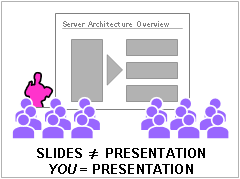
You, not Your Slides, are Your PresentationLast week, I attended a training seminar where the speaker stood by the side of a projection screen and behind a table where he had his laptop. He hardly moved from his position during the hour-long seminar. He was short and was barely visible from the back of the thirty-people room, as shown in the illustration. Despite his interesting content and compelling arguments, he was physically disconnected from his audience.

One of the common mistakes speakers make is that they regard their slides as the core of their presentation—they give their slides the center stage during their presentations. Sometimes they stand behind a podium or by the side of a projection screen and command very little attention from the audience.

You, not Your Slides, are Your PresentationHere are a few tips to help you engage your audience.

  • Get a handheld or a clip-on microphone and a remote control to advance your PowerPoint or Keynote slides. Walk around the room and establish a positive rapport with your audience.
  • Maintain a relaxed body language and tone, smile and engage the audience in discussions. A relaxed stance and engaging conversations quickly establish your authority over the subject matter and your credibility with the audience.
  • Maintain eye contact with all the members of your audience. Observe their body language for non-verbal feedback to your presentation content.
  • Have a friend or family member attend your presentation and request that he or she observe your non-verbal communication, viz., your appearance, enthusiasm, tone and volume, gestures, eye contact, audience engagement, pauses, and pace of delivery.

As you prepare for your next public speaking assignment or presentation, remember that your slides or handouts just augment your presentation and support your line of reasoning. You are the presentation; you should be the focus.

*Keyword(s): presentations, public speaking, non-verbal communication, PowerPoint

Inspirational Quotations Newsletter: Issue #143

Go confidently in the direction of your dreams!
Live the life you’ve imagined!
As you simplify your life, the laws of the Universe will be simpler,
solitude will not be solitude,
poverty will not be poverty, nor weakness weakness.
* Henry David Thoreau

The only real security that a man can have in this world is
a reserve of knowledge, experience and ability.
* Henry Ford

The man who will use his skill and constructive imagination
to see how much he can give for a dollar,
instead of how little he can give for a dollar, is bound to succeed.
* Henry Ford

Character, in great and little things, means carrying
through what you feel able to do.
* Johann Wolfgang von Goethe

Love is like a beautiful flower which I may not touch,
but whose fragrance makes the garden a place of delight just the same.
* Helen Keller

Life is divided into three terms -
that which was, which is, and which will be.
Let us learn from the past to profit by the present,
and from the present to live better in the future.
* William Wordsworth

It is what you do from now on that will either move
our civilization forward a few tiny steps, or else…
begin to march us steadily backward.
* Patrick Stewart

In the land of the blind, the one-eyed man is king.
* Desiderius Erasmus

Write your life the way you want to..
life is a book … each day is a day which you can’t rewrite
* Caitlyn

Visit www.Inspiration.RightAttitudes.com for my compilation of inspirational quotations by author and topic. You may also subscribe to the weekly newsletter of inspirational quotations by sending a blank email to iqml-subscribe@yahoogroups.com.

*Keyword(s): Inspiration, Quotations

The Legacy of Peter Drucker

The Legacy of Peter Ferdinand Drucker

Yesterday was the first anniversary of the death of Peter Ferdinand Drucker, “the father of modern management.”

Drucker is arguably the most influential management philosopher of the modern era. He is the author of about forty books and innumerable essays on managerial skills, management concepts and social analyses. As a consultant, author and speaker for over sixty years, Drucker influenced the thinking of many executives in businesses, not-for-profits and faith-based organizations. Read his detailed biographies here, here and here.

Drucker wrote about many concepts and practices decades before the trends were discernable: knowledge workers, empowering employees, decentralization, management by objectives, focus on results instead of actions, the responsibility of the corporation in society, knowledge-based society, rise of multinational businesses, etc.

Drucker’s writings are devoid of buzzwords and management jargon and easily resonate with his readers. Today, we accept Drucker’s thoughts as conventional wisdom. Consequently, scores of business school courses require reading of his books.

My first exposure to Drucker’s thoughts was when I read his manual The Effective Executiveduring my undergraduate studies. Over the last few years, I have read and re-read many of his books and essays. Drucker’s unique style of expression and simple, clear language have left a deep impression on my pursuits, thoughts and actions. Below is one of my favorite Peter Drucker instructions. See my separate blog post on his inspirational quotations.

Successful leaders don’t start out asking, “What do I want to do?” They ask, “What needs to be done?” Then they ask, “Of those things that would make a difference, which are right for me?” They don’t tackle things they aren’t good at.

On a question about his legacy, Drucker once said that he has “helped a few good people be effective in doing the right things.” Just a few? Drucker’s farsighted insights and timeless thoughts will influence management thought for generations to come.

*Keyword(s): Peter Drucker, management theory, managerial skills, management concepts

Inspirational Quotations by Peter Drucker

Yesterday was the first anniversary of the death of Peter Ferdinand Drucker, “the father of modern management.” Here is a selection of inspirational quotations from one of the most influential management philosophers of modern era. For more details, please see my article “The Legacy of Peter Drucker“.

We now accept the fact that learning is a
lifelong process of keeping abreast of change.
And the most pressing task is to teach people how to learn.
* Peter Ferdinand Drucker

Effective leadership is not about making speeches or being liked;
leadership is defined by results not attributes.
* Peter Ferdinand Drucker

Efficiency is doing better what is already being done.
* Peter Ferdinand Drucker

My greatest strength as a consultant is
to be ignorant and ask a few questions.
* Peter Ferdinand Drucker

People who don’t take risks generally make about two big mistakes a year.
People who do take risks generally make about two big mistakes a year.
* Peter Ferdinand Drucker

Plans are only good intentions unless
they immediately degenerate into hard work.
* Peter Ferdinand Drucker

Rank does not confer privilege or
give power. It imposes responsibility.
* Peter Ferdinand Drucker

The only thing we know about the future is that it will be different.
* Peter Ferdinand Drucker

The most serious mistakes are
not being made as a result of wrong answers.
The truly dangerous thing is asking the wrong question.
* Peter Ferdinand Drucker

Visit www.Inspiration.RightAttitudes.com for my compilation of inspirational quotations by author and topic. You may also subscribe to the weekly newsletter of inspirational quotations by sending a blank email to iqml-subscribe@yahoogroups.com.

*Keyword(s): Inspiration, Quotations, Peter Drucker

The Twelve Most Persuasive Words in English

“Of the modes of persuasion furnished by the spoken word there are three kinds. The first kind depends on the personal character of the speaker; the second on putting the audience into a certain frame of mind; the third on the proof, provided by the words of the speech itself.”
- A Rephrasing of Aristotle’s Rhetoric

The choice of words is one of the key components of persuasive communication. In marketing, advertising, grant- or project proposal writing, or in most other interactions, we attempt to influence someone’s mind about an idea or a product.

The Twelve Most Persuasive Words in EnglishBelow is a list (in order) of the twelve most persuasive words that have proven to be most influential on listeners’ or readers’ minds. Often, advertisements consist of crafty constructions of these words. Surprisingly, the word ‘free’ is absent. The Language Log website at the University of Pennsylvania has an interesting thread on the source of this list.

  1. You
  2. Money
  3. Save
  4. New
  5. Results
  6. Health
  7. Easy
  8. Safety
  9. Love
  10. Discovery
  11. Proven
  12. Guarantee

How will we use these words in our verbal and written communications? How will we incorporate these words into our everyday vocabulary?

*Keyword(s): persuasion, written communication, verbal communication, communication, grammar

« Previous entries ·