Choice of Fonts and Text Size for Résumés

Blog reader Michelle from the University of Kentucky, Lexington asked me

“I am preparing my résumé for an upcoming job fair, and I’d appreciate your suggestions on the choice of fonts.”

Serif and Sans-serif Fonts

Font families are classified according to their appearance: serif fonts, sans-serif fonts, mono-space fonts, cursive fonts, fantasy fonts, etc.

Characters in serif fonts have little projections or ‘tails’ (serif = tail in French) at the end of strokes and line widths that thin out on curves. The serifs guide a reader’s eyes to flow across lines of text. Conventionally, serif fonts are used for smaller text such as blocks of texts in newspapers. Serif fonts are harder to read from a distance.

Characters in sans-serif fonts have more consistent line widths and do not have tails (sans = without in French). Sans-serif fonts appear clear and balanced in shape and in form. Conventionally, sans-serif fonts are used for larger text such as headlines or text in posters. Sans-serif fonts are the most popular choice for on-screen (TV, computer, etc.) text because of their clarity in display.

Choice of Fonts and Text Size for Résumés

Fonts for a Résumé

Résumé reviewers expect résumés to be professional–readable and inviting. Serif fonts are the de-facto standard for résumé text. Times New Roman (the default font in Microsoft Word), Book Antiqua or Palatino (my personal favorite,) Garamond and Times are the most popular serif fonts for résumés. I would suggest using serif fonts for the entire résumé. You may use sans-serif fonts for section headings and/or your name.

Cursive or decorative fonts easily distract the eye and make the résumé look unprofessional. Explore fancier fonts only if you desire a career in fine arts or graphic design.

Font size: 10-, 11- or 12-point only
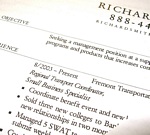
Choice of Fonts and Text Size for RésumésFont size is measured in points. A point represents 1/72 of an inch; text in 72 points prints to text of one-inch height. Use a 10-, 11- or a 12-point font for content. Begin with an 11-point font and increase to a 12-point font to fill up the page or decrease to a 10-point font if you cannot fit all the details on one page. (All primary details, academic backgrounds and professional accomplishments should fit into one page.)

Section headings can be one or two points larger than content. Subheadings, such as name of the university or employer or your job title, should be set in standard font size. Do not increase the font size for your name; your name will look disproportionate.

Consistency in Formatting

As with every other detail on the résumé, viz., content, structure, paragraph spacing, etc., use consistent font formatting. In Microsoft Word, the ‘Format Painter’ tool is handy to copy formatting to various sections of text or paragraphs.

Making your Résumé Standout

Making your Résumé Standout: Résumé ReviewerOn my recruiting trips to colleges, one of the most common questions students ask me is how one could make his/her résumé stand out. You can make your résumé standout primarily based on the content in the résumé: your accomplishments, academic strengths, extra-curricular involvement, leadership activities, etc.

However, résumé reviewers form their first impressions, mostly subconsciously, on how well the content is structured and how well the text is presented. On average, reviewers spend as little as fifteen seconds before they decide to read your résumé further for detailed consideration. Hence, the value of preparing a résumé with an orderly, consistent, professional look-and-feel cannot be overstated.
*Keyword(s): resume, resume tips, job search, career, interviewing, communication

Inspirational Quotations #140

We are what our thoughts have made us;
so take care about what you think.
Words are secondary. Thoughts live; they travel far.
* Swami Vivekananda

We learn…
10%… of what we read
20%… of what we hear
30%… of what we see
50%… of what we see and hear
70%… of what we discuss with others
80%… of what we experience personally
95%… of what we teach others
* William Glasser

Your chances of success in any undertaking can
always be measured by your belief in yourself.
* Robert Collier

The first and most important step towards success
is the feeling that we can succeed.
* Nelson Boswell

Knowledge has to be improved, challenged,
and increased constantly, or it vanishes.
* Peter Ferdinand Drucker

A merely fallen enemy may rise again, but the reconciled
one is truly vanquished.
* Johann von Schiller

He who knows Self as the enjoyer of
the honey from the flowers of the senses,
ever present within, ruler of time,
goes beyond fear. For this Self is Supreme!
* The Upanishads

Perpetual inspiration is as necessary to the life of good-ness,
holiness and happiness as perpetual respiration is necessary to animal life.
* Andrew Law

Visit www.Inspiration.RightAttitudes.com for my compilation of inspirational quotations by author and topic. You may also subscribe to the weekly newsletter of inspirational quotations by sending a blank email to iqml-subscribe@yahoogroups.com.

*Keyword(s): Inspiration, Quotations

Preparing to Attend Meetings

Preparing to Attend Meetings

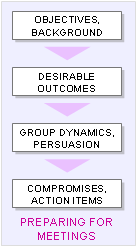
Preparing to Attend MeetingsMeetings are important organizational tools. Whether as one-on-one conversations or as larger all-employee information sharing sessions, meetings are integral components of getting work done. Despite some obvious benefits, most meetings are not very productive and are longer than necessary. One of the primary reasons for the lower productivity of meetings is that attendees come unprepared.

Assume you have consented to attend a meeting because your participation is critical to the objective of the meeting. What questions will you ask to prepare for the meeting?

  • Have I read the meeting agenda? What is the objective of the meeting? What is my role? How will I contribute to the meeting?
  • What segment of the meeting is relevant to me? Can I join late or leave early if I am not required throughout the length of the meeting?
  • Is this a follow-up to a previous meeting? What action items had I agreed on then? What results will I present? What questions will arise?
  • What relevant pre-reading material should I seek?
  • What research do I need to do? Whom on my team should I talk to regarding items on the agenda?
  • Attending MeetingsWhat is the desirable outcome? What is the undesirable outcome? Is there a compromise?
  • What positions am I prepared to take on key issues being discussed in this meeting? What facts and charts will I present to support my position?
  • Who are the other attendees? What positions are they likely to take on key issues? Why? What are the likely group dynamics: who will support me, who will oppose my positions? What counter arguments will I present?
  • What other attendees should I talk to prior to the meeting to garner support to my position? Can I invite additional attendees to the meeting to help support my position? How will I persuade other people to see my point of view?
  • What action items am I willing to take? Do I have the necessary resources? Will I participate in follow-up meetings, if scheduled?

Meetings are all about sharing thoughts in a collective setting. They are only as good as the ideas that attendees bring to the discussions. By asking the above questions, you will contribute to focused, productive meetings. You owe it to yourself, the meeting leaders and to your fellow-attendees.

*Keyword(s): meetings, communication, productivity, getting things done

Inspirational Quotations #139

We become like those with whom we associate:
“A mirror reflects a man’s face, but what he is
really like is shown by the kind of friends he chooses.”
* The Holy Bible

Concentration can be cultivated.
One can learn to exercise will power,
discipline one’s body and train one’s mind.
* Anil Ambani

Most of what we call management consists of
making it difficult for people to get their work done.
* Peter Ferdinand Drucker

Love your job, but never fall in love with your company
because you never know when the company stops loving you.
* N. R. Narayana Murthy

Do your work with your whole heart and
you will succeed — there’s so little competition.
* Elbert Hubbard

Not to be cheered by praise,
not to be grieved by blame,
but to know thoroughly one’s own virtues or powers
are the characteristics of an excellent man.
* Saskya Pandita

I long to accomplish a great and noble task,
but it is my chief duty to accomplish
small tasks as if they were great and noble.
* Helen Keller

There are many truths of which the full meaning cannot be
realized until personal experience has brought it home.
* John Stuart Mill

Visit www.Inspiration.RightAttitudes.com for my compilation of inspirational quotations by author and topic. You may also subscribe to the weekly newsletter of inspirational quotations by sending a blank email to iqml-subscribe@yahoogroups.com.

*Keyword(s): Inspiration, Quotations

Virus on iPods: Apple blames Microsoft Windows

Virus on iPods: Apple blames Microsoft WindowsOn Wednesday, Apple’s iPod support website acknowledged that a small number of video iPods were infected with a Windows virus. In addition to describing the scale of infection and providing instructions to remove the virus, the website blamed Microsoft Windows for the glitch.

“As you might imagine, we are upset at Windows for not being more hardy against such viruses, and even more upset with ourselves for not catching it.”

Apple’s “114,000 viruses? Not on a Mac” advertisements have lately targeted Windows users to ‘Get a Mac’. Presumably, someone at Apple [AAPL] believed that blaming Microsoft Windows for viruses on the iPod could extend its ‘Get a Mac’ campaign. The outcome is a cheap shot at the competition.

The iPods were apparently infected with the virus at one of Apple’s contract manufacturers. There is no reason for Apple to be “upset” at Microsoft for not being more hardy against such viruses.” Microsoft [MSFT] has invested significant resources (money and talent) fighting hackers and improving its software development process. As Jonathan Poon of the Microsoft virus-scanning group pointed out on his blog, Apple should blame its own manufacturing system.

“It’s not a matter of which platform that the virus originated. The fact that it’s found on the portable player means that there’s an issue with how the quality checks, specifically the content check was done.”

Apple should also blame hackers, who were creative enough to get malicious code embedded on an Apple product while it was connected to a Windows machine on Apple’s manufacturing line.

The take-away lessons: (1) possess a healthy respect for the competition, and, (2) blaming the competition without cause constitutes poor taste.

*Keyword(s): Competition, respect, security, Apple, Microsoft, Windows

Overcoming the Temptation to Please

Overcoming the Temptation to Please Others

You can close more business in two months by becoming interested in other people than you can in two years by trying to get people interested in you.
- Dale Carnegie

We desire that people around us like us; we yearn for their respect and affection. We depend on the choices these people make: be it in a job interview with a corporate recruiter, a performance review with a boss or a project delegation meeting with a team member. Clearly, the more likeable we are, the more people are ‘on our side,’ and therefore, the more likely they will make decisions in our favor.

Doing what others want to gain their approval regardless of the merit of their wants is, therefore, a temptation. Companies are tempted to pursue short-term profit-enhancing strategies to satisfy stock market expectations. Politicians are tempted to devise welfare schemes to help garner votes in an upcoming election. A professional is tempted to please the boss by agreeing to everything the boss asks.

We need to be tough-minded—we need to base our decisions and actions on facts, not personal inclinations. It takes courage and discipline to resist the lure of pleasing others. Making an objective decision that is unfavorable for a requestor may disappoint him/her; however, a candid explanation of the rationale behind the choice often appeases the requestor. Being tough-minded does not mean being inflexible or insensitive. Being tough-minded involves doing what is just and right after careful consideration of procedures and people.

I encourage you to reflect on your actions and decisions by asking yourselves if you make these choices to please other people or if you make these choices based on the virtue of facts. Improving your likeability should be a wish and not a goal.

*Keyword(s): Likeability, teamwork, people skills, tough-mindedness, rightness, justness, pleasing others

Inspirational Quotations #138

Sticks and stones are hard on bones.
Aimed with angry art,
Words can sting like anything
But silence breaks the heart.
* Suzanne Nichols

Luck is a losers excuse for a winners success
* Mike Lewis

When it comes to the future,
there are three kinds of people:
those who let it happen,
those who make it happen,
and those who wonder what happened.
* John M. Richardson, Jr.

Half the world is composed of those who have something to say but can’t;
the other half is of those who have nothing to say and keep on saying it.
* Muriel Strode

In doing your work in the great world,
it is a safe plan to follow a rule I once heard on the football field:
Don’t flinch, don’t fall; hit the line hard.
* Theodore Roosevelt

A fool always finds some greater fool to admire him.
* Nicholas Boileau

Where you end up isn’t the most important thing.
It’s the road you take to get there.
The road you take is what you’ll look
back on and call your life.
* Tim Wiley

Life is not a problem to be solved
But a reality to be experienced.
* Soren Kierkegaard

If you listen you will hear
If you look you will see
If you touch you will feel
If you try you will be.
* Becky Stanford

Visit www.Inspiration.RightAttitudes.com for my compilation of inspirational quotations by author and topic. You may also subscribe to the weekly newsletter of inspirational quotations by sending a blank email to iqml-subscribe@yahoogroups.com.

*Keyword(s): Inspiration, Quotations

Inspirational Quotations #137

Challenge
The Challenge is not to win,
But to conquer the fear.
It is not the other people you have to beat,
It is your self.
* Herman Melville

Wrinkles should merely indicate where smiles have been.
* Mark Twain

People love others not for who they are,
but for how they make them feel
* Irwin Federman

If you want others to be happy, practice compassion.
If you want to be happy, practice compassion.
* The Dalai Lama

The opposite of love is not hate, it’s indifference.
The opposite of art is not ugliness, it’s indifference.
The opposite of faith is not heresy, it’s indifference.
And the opposite of life is not death, it’s indifference.
* Elie Wiesel

There are times when a man should be content
with what he has, but never with what he is.
* William George Jordan

This span of life was lent for lofty duties,
not for selfishness;
not to be wiled away for aimless dreams,
but to improve ourselves, and serve mankind.
* Aubrey De Vere

Get a good idea and stay with it.
Dog it, and work at it until it’s done right.
* Walt Disney

Another flaw in the human character is that everybody wants to build
and nobody wants to do maintenance.
* Kurt Vonnegut

Visit www.Inspiration.RightAttitudes.com for my compilation of inspirational quotations by author and topic. You may also subscribe to the weekly newsletter of inspirational quotations by sending a blank email to iqml-subscribe@yahoogroups.com.

*Keyword(s): Inspiration, Quotations

Respect for Employees: Cases from RadioShack and Northwest Airlines

Lisa Haneberg wrote about RadioShack [RSE] laying off 400 workers and informing them of the decision via email. Lisa’s Management Craft blog article records her thoughts on this choice.

Human resources… People are not just resources like computer systems and Post It notes. Our employees, all of them, even the underperforming ones who ought to be let go, are our partners. They are our business family. Even when it is the right thing to do to let someone go, we need to remember that they are important partners. How we leave a relationship is just as important as how we enter into it.

‘101 Ways to Save Money’

Northwest Airlines terminal at Detroit Metropolitan AirportThis reminds me of another instance of careless mistakes at Northwest Airlines. The company, currently operating under Chapter 11 bankruptcy protection, is considering additional layoffs and pay cuts for employees.

A few weeks ago, a booklet distributed to likely-to-be-laid-off ground workers is reported to have advised them on saving money: “don’t be shy about pulling something you like out of the trash” and “take a date for a walk along the beach or in the woods” along with more sensible tips like “brown bag your lunch” and “refinance your mortgage.” See the full list of ‘101 Ways to Save Money’ here.

Irrespective of the organizational and financial state of the company, including tips such as the above in employee communication is careless, insensitive and insulting to the dignity of the workers, especially when they are candidates for potential layoffs. An appropriate supervisory review of this publication prior to release could have easily avoided the bad publicity and ill will that this incident generated.

Respect for Employees, Employee MoraleAs alluded to every year in Fortune magazine’s ranking of the ‘best companies to work for’ in America, employees’ attitudes towards their organizations have a profound effect on the performance of companies. Further, better performance leads to higher morale among the employees; this results in a virtuous cycle of company performance and employee morale. The primary means of achieving high employee morale is by co-creating a corporate culture that instills a sense of ownership through empowerment, trust and fair treatment, by instilling pride for personal and organizational achievements and by providing adequate opportunities for personal and career growth.

*Keyword(s): Respect, employee morale, corporate culture, fair treatment

Interviewing Candidates: Stale Questions Get Stale Answers

Interviewing: Stale Questions Get Stale Answers

One of my former lab mates, who has been interviewing for a job, recently remarked that her interviews are typically boring because interviewers tend to ask identical questions.

The main objective of an interview is to discover more about a candidate’s credentials and objectives to see whether the candidate is a good fit for an available position. An interviewer who asks cliché questions or uses tired language typically leads a dull question-and-answer session. He/she loses the attention of the candidate and fails to acquire comprehensive information about the candidate.

Avoid cliché questions

Job seekers have access to a number of books and websites that describe canned ‘best’ responses to the most popular interview questions. One response to the oft-asked “What are your weaknesses?” question is the predictable “I work too hard and ignore my social life.” Avoid old standby questions and ask incisive questions that make the candidate think.

  • Instead of “Do you like your boss?”, ask “What do you think your boss’s weaknesses are? How do you complement her weaknesses and support her responsibilities?”
  • Instead of “Tell me about yourself?”, ask “What aspects of your upbringing have contributed to your success at your current position as the leader of the risk management group?”
  • Instead of “Why does a career in sales interest you?”, ask “Can you name a few salesmen you admire? Over the years, what aspects of their talents have you incorporated in your sales approach?”

Personalize the questions

Interviewing: Personalize the questionsTo whatever extent possible, review a candidate’s résumé ahead of the interview and customize the discussion. Frame your questions to relate to the candidate’s experiences: “In you résumé, you mention that you led a team of technicians that worked during the weekends to meet an important deadline. Why do you think they cooperated with you and agreed to work during the weekends?”

Relate to the responses

Relate to one or two of the candidate’s responses by mentioning your own experiences: “I once had a customer who …”. Resist the temptation to start a conversation, empathize or add value to the candidate’s response. Be brief. Avoid talking too much about yourself.

Use a fresh tone of voice

On occasion, you may be required to interview several candidates in succession, e.g. while filling multiple positions or in a college recruiting session. After talking to a few candidates, your chosen set of questions may start to sound jaded due to repetition. Watch your tone of voice when asking questions; convey enthusiasm for the candidate’s details and engage in a lively conversation.

Maintain good rapport

Interviewing: Maintain Good RapportInterviewers often over-indulge in note-taking by recording minor details of a candidate’s responses and interpretation of these responses. Although the candidate welcomes the occasional respite from visual attention, too much note-taking can have a distancing effect. Record just an outline or use a graphical note-taking technique, e.g. mind mapping. Review this outline immediately after the interview and add details you want to capture for later review or a consensus meeting.

Pair up with a colleague

Conduct a tandem interview if possible; alternate asking questions and taking notes with the colleague. While one person takes notes, the other person can ask follow-up questions and maintain a rapport with the candidate.

Conclusion

The primary challenge for an interviewer is to see beyond the veneer of the candidate’s carefully-crafted résumé, on-the-surface details of past responsibilities and often well-rehearsed responses to interview questions. A lively conversation is essential to elicit thoughtful, candid responses and enable the interviewer to make an educated decision on the candidate.

*Keyword(s): interviewing, hiring, recruiting, job interviews, interview questions