Monthly Archives: April 2010

[Rating Errors] Beware of the Halo and Horns Effects

Rating Errors Halo Effect Horns Effect

Preamble: We are often unaware of the many biases and prejudices that influence our social judgments. Psychologists call these the “bias blind spots.” I believe that we can overcome many of these subliminal biases by educating ourselves to be perceptive of them. This is the second in a series of articles on the common rating errors. See my earlier article on the recency bias.

Unconscious Judgments of an Investment Broker

Unconscious Judgments of an Investment Broker A study conducted in year 2007, highlights two of the most common unconscious biases in social judgment. Prof. Emily Pronin of Princeton University showed study participants one of two pictures of the same man whom she introduced as an investment broker. One picture showed a suited man with a highly regarded Cornell degree and the other showed the man in casual clothing with a degree from a nondescript college. The professor asked her participants how much of a theoretical $1,000 they would invest with each. The participants rated the suited man as more competent. He got $535 on average without having his background checked. In contrast, the causal dresser got just $352. The participants did not consider the second broker as trustworthy and were more likely to have his credentials verified.

The Halo Effect

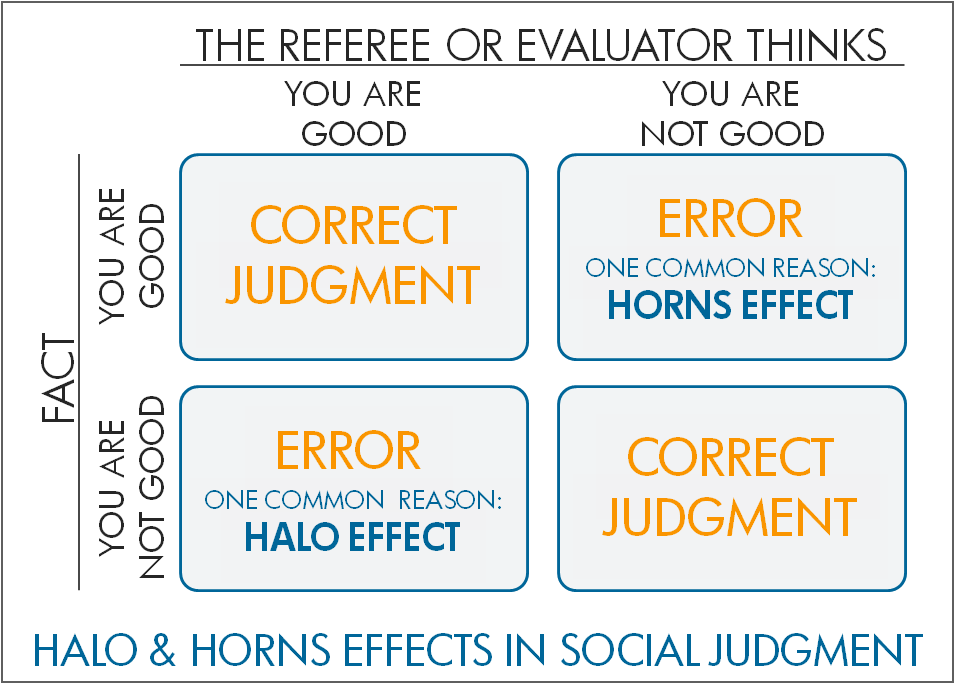
The “halo effect” is the concept by which a person who is judged positively on one aspect is automatically judged positively on several other aspects without much evidence. For instance, as a result of the halo effect,

  • attractive people are often judged as competent and sociable. Film stars and other celebrities are assumed pleasant and sharp-witted,
  • inexperienced interviewers tend to pay less attention to a candidate’s negative traits after discerning one or two positive traits in the first few minutes of a job interview,
  • charismatic professionals tend to get noticed and move up the corporate ladder faster, irrespective of their technical and leadership skills,
  • articulate speakers are likely to be more influential on their audiences even if their messages are poor in form and content.

Halo Effect Generated by Apple's iPod Politicians, film and TV stars, sportspersons, celebrities and brand managers have learned to construct a halo effect and later capitalize on their perceptible reputations. Apple’s iPod generated positive impressions of other Apple products — the company capitalized on this halo effect and delivered excellent products in the iPhone and iPad. Renowned fashion designers can command higher price points even for ordinary clothes.

The Horns Effect

The “horns effect” or the “devil effect” is the concept by which a person who is judged negatively on one aspect is automatically judged negatively on several other aspects without much evidence. Clearly, this is the corollary to the halo effect.

  • For years, American car manufacturers have battled the mistaken public perception that cars made by Japanese companies are of significantly better quality even if American car manufacturers use identical components from the same suppliers and assemble their cars using identical manufacturing processes. Even today, Japanese brand cars resell for much higher prices than American brand cars.

Halo and Horns Effects in Social Judgment

Call for Action

  • Reflect on your decision-making process to steer clear of biases. As human beings, we are incessantly forming an opinion of people, objects, and events, both consciously and subconsciously. However, our judgment is rarely free of biases and our measures are not always comprehensive enough. Before reaching any important decision, be sure to collect all the relevant facts and reflect if your thought processes are free of the common biases.
  • Understand that perception is reality and be conscious of the image you are projecting. People judge the proverbial book by its cover. Your friends and family, workplace and the society has a certain perception of who you are and what you can do, irrespective of the reality. As much as you would prefer to be evaluated based on who you actually are and what you can actually do, understand that your identity and prospects are based on the perception that other people have about you. Do everything you can to connect people’s perception to the reality. Look and play your role. Begin by reading the seminal article on the topic of personal branding, “The Brand Called You,” written by renowned management author, Tom Peters.

Recommended Reading

***See other articles related to social judgment, rating errors, biases and prejudices, decision process, problem solving, Brand You

Posted in Sharpening Your Skills, The Successful Manager | Leave a comment

[Rating Errors] Beware of the Recency Bias

Preamble: This is a first of a series of articles on common mistakes in judgment. Even if the focus of these articles is on performance assessment of employees, the discussions hold in all forms of social judgment.

Common mistakes in social judgment

Recency Bias in Performance Assessment

Suppose that you have executed a project effectively and exceeded all expectations during the first ten months of a year. If your manager has overlooked all these achievements and rated you poorly based on a major roadblock your project encountered in November, then you are subject to a Recency Bias. Your manager is in effect evaluating excessively positively or negative, depending on what is most recent.

Many managers tend to rate an employee’s job performance based on a “what has he done lately” mindset. They do not weigh the employee’s performance from earlier in the year (or quarter, if their organizations use a quarterly review system) and tend to rely more on the employee’s performance in the period immediately preceding the performance evaluation deadline. Consequently, achievements and events that happened lately tend to bear more influence on the employee’s performance rating than achievements and events from earlier in the evaluation period.

The cognitive bias (positive or negative) where judgment is founded only on readily recallable recent experiences is termed the ‘Recency Bias’ or ‘Recency Effect.’ This is analogous to people tending to recall items that are at the end of a list rather than items that are in the start of the list. (See Wikipedia’s entry on serial position effect.)

Some employees may exploit the recency bias by being more resourceful and trying to stay in the boss’s good graces in the period leading to performance reviews. I know of a manager who every year organizes community service events at his boss’s favorite non-profit during November and stay in the boss’s good graces ahead of his annual performance review in December. I have also identified wily employees who underperform earlier in a year and shape-up in the months before a performance evaluation is due.

To Avoid Recency Bias, Maintain a Performance Log

If you are a manager, maintain an informal log or diary where you can record each employee’s accomplishments, contributions, praises, and comments from peers and management. When a performance evaluation is due, review all the significant and relevant examples of employee performance you have recorded and write an objective performance summary report. This ensures that you keep yourself informed of your employee’s work and demonstrates that you care about his/her current work and achievements.

As an employee, you can maintain your own log or diary of your achievements. Review this information with your employee once every week. Whether your organization requires a self-assessment or not, refer to this log at the end of the evaluation period, summarize your achievements and submit a concise report to your manager.

Recommended Reading

***See other articles related to social judgment, rating errors, performance appraisal, performance review, performance evaluation, succeeding as a manager, biases and prejudices

Posted in Sharpening Your Skills, The Successful Manager | Leave a comment

Inspirational Quotations #321

There is a courageous wisdom; there is also a false reptile prudence, the result, not of caution, but of fear.
* Edmund Burke

Even insignificant things can be grouped together and can effectively be used to accomplish great tasks. A rope made of hay sticks controls a powerful elephant by firmly binding it.
* Subhashita Manjari

What is now proven was once only imagined.
* William Blake

Happiness is a thing to be practiced, like the violin.
* John Lubbock

There are things of deadly earnest that can only be mentioned under the cover of a joke.
* J. J. Procter

Happiness is the only good. The time to be happy is now. The place to be happy is here. The way to be happy is to make others so.
* Robert G. Ingersoll

Money is not the point. It is an indication that I have succeeded in the grand adventure of understanding reality.
* George Soros

To know what we know what we know, and that we do not know what we do not know, that is true knowledge.
* Confucius

True happiness comes from the joy of deeds well done, the zest of creating things new.
* Antoine De Saint-Exupery

And when mistakes occur, let them become instructive, not destructive.
* Neal A. Maxwell

Small opportunities are often the beginning of great enterprises.
* Demosthenes

Visit www.Inspiration.RightAttitudes.com for my compilation of inspirational quotations by author and topic. You may also subscribe to the weekly newsletter of inspirational quotations by sending a blank email to iqml-subscribe@yahoogroups.com.

*Keyword(s): Inspiration, Quotations

Posted in Inspirational Quotations | Leave a comment

If You Pay Peanuts, You Get Monkeys [Hiring]

If You Pay Peanuts, You Get Monkeys During the economic slowdown last year, a manager had a choice between two consultants for a critical project to turnaround the prospects of his division. The first candidate was five years out of business school; his billing rate was $370 an hour. The second, more experienced candidate’s was $510 an hour. Without much deliberation, the manager hired the first candidate because he would fit in the manager’s budget. Things did not work out as well as the manager had expected. Three months later, after considerable delays and missed opportunities, the manager fired his consultant and recruited the second candidate anyway. This consultant had an earlier experience similar to the situation at hand and succeeded in his mission in due course.

The best don’t come cheap

Recruiting is the toughest responsibility of a manager. Prudent hiring processes start with a realization that talented professionals are the heart of successful organizational endeavors. Many managers simply do not take in this fact and signup those who cost the least instead.

Economic downturn or lower project budgets are no reasons for careless hiring decisions. It is exactly during though times that managers should recruit the best people. And, the best don’t come cheap.

Now, I am not saying that high-priced consultants and employees are necessarily good. The converse is not automatically true either. Market demand for talent often dictates billing rates and compensation of skilled professionals. There is often a strong reason for them being in demand and commanding premium fees. No manager dare overlook such considerations.

Suggested Reading

***See other articles related to recruiting, hiring, managerial skills, interviewing

Posted in Managing People | Leave a comment

Inspirational Quotations #320

A disciplined conscience is a man’s best friend. It may not be his most amiable, but it is his most faithful mentor.
* Austin Phelps

You cannot govern the creative impulse; all you can do is to eliminate obstacles and smooth the way for it.
* Kimon Nicoliades

Coaches who can outline plays on a blackboard are a dime a dozen. The ones who win get inside their players and motivate.
* Vincent T. Lombardi

The ideal of beauty is simplicity and tranquility.
* Johann Wolfgang von Goethe

The fox knows many things, but the hedgehog knows one big thing.
* Archilochus

All humanity is one undivided and indivisible family, and each one of us is responsible for the misdeeds of all the others. I cannot detach myself from the wickedest soul.
* Mohandas K Gandhi

Every gift from a friend is a wish for your happiness.
* Richard Bach

The real glory is being knocked to your knees and then coming back. That’s real glory. That’s the essence of it.
* Vincent T. Lombardi

Zeal will do more than knowledge.
* William Hazlitt

The grand essentials to happiness in this life are something to do, something to love, and something to hope for.
* Joseph Addison Light

Take yourself as you are, whole, and do not try to live by one part alone and starve the other.
* Janet Erskine Stuart

Visit www.Inspiration.RightAttitudes.com for my compilation of inspirational quotations by author and topic. You may also subscribe to the weekly newsletter of inspirational quotations by sending a blank email to iqml-subscribe@yahoogroups.com.

*Keyword(s): Inspiration, Quotations

Posted in Inspirational Quotations | Leave a comment

Learn from the Top Performers in Every Field [Skills for Success]

Learn from the Top Performers in Every Field

During Q & A at a career-planning workshop that I led recently, a member of the audience asked me, “Where could I get the best education in life?” This article elaborates my response.

You learn best from imitating the techniques of the successful

“What the outstanding person does, others will try to do. The standards such people create will be followed by the whole world.”
* The Bhagavad Gita

The best way to educate yourself is by observing the top performers in every field and by identifying and applying their effectiveness techniques to your circumstances. Your inspiration may be somebody you interact with, somebody you can hear about in the media or a fictional character from a novel or movie.

Try to imitate the best performers in a discipline to be successful in that discipline. Study their educational and professional backgrounds, their work style, successes, and failures. Identify how they go about conducting their everyday affairs. Try to copy the stock picking and capital allocation skills of Warren Buffett to become a successful investor. Piggyback on the thinking of the best mutual fund managers; replicate their portfolios to benefit from their stock selection process.

Read about the techniques of Sherlock Holmes to improve your reasoning and problem-solving skills. Impersonate your favorite stand-up comedian ahead of a presentation or public speech to improve your delivery. Study the footprints of the leaders in your organization if you want to follow their lead.

Imitate different attributes of people you encounter every day: the cheerfulness of an administrative assistant, the persuasion skills of a seasoned negotiator, the resourcefulness of a car mechanic, and the dexterity of a customer service agent.

Role models are inspirational

Role models are inspirational

Looking up to others is rather instinctive. As kids, you looked up to your siblings, parents, or family members. At work, you learn from observing your colleagues and bosses.

When we learn of role models, read their stories or watch of them on TV or in the movies, we identify in them a part of ourselves; we associate with their struggles and victories, their hopes and despairs.

When we identify with a role model who has accomplished what we seek yourselves, we not only learn from them but also become more confident in our abilities.

This technique has its limitations

Naturally, the influence of role models is neither always practical nor necessarily productive. Your perception of popular role models (sportsmen, artists, businesspeople and other celebrities) is often incomplete and based on cursory assessments of them. Media accounts of their trappings of wealth, fame, and success or their unseemly lifestyles can just as easily turn them into negative role models. Excesses and faults are as common in everyday life as they are in the news. Exercise judgment in what you identify and implement. Hence the corollary: Learn from the shortcomings of the unsuccessful.

Call for action

  • When people make a positive impression on you, reflect on what they did and how they did to impress you. Explore what you can learn from them.
  • Identify the top performers in your field. Seek to understand and adopt their techniques. Improve or tailor them to your personal circumstances and improve yourselves.
  • Study the biographies and memoirs of your favorite historical leaders. Read news stories and case studies of people you admire. Learn their techniques.
  • Think of personal and professional skills that you would like to improve upon. Identify one or two people in your organization who are especially skilled in these areas. Observe them or ask them for advice.

Learn everything you can from others, implement what appeals to you, and discard the rest.

Recommended Reading

***See other articles related to role models, skills for success, education, learning from mentors

Posted in Career Development, Great Personalities, Self Development | Leave a comment

Inspirational Quotations #319

The art of progress is to preserve order amid change and to preserve change amid order.
* Alfred North Whitehead

A determined soul will do more with a rusty monkey wrench than a loafer will accomplish with all the tools in a machine shop.
* Robert Hughes

The first virtue is to restrain the tongue; he approaches nearest to the gods who knows how to be silent, even though he is in the right.
* The Younger Cato

To live is to change, and to be perfect is to have changed often.
* John Henry Newman

Greed is the root cause of all sins. Greed is the cause of all problems that one faces. Greed fuels the growth of enemies. Excessive greed destroys one’s life.
* Subhashita Manjari

Creativity represents a miraculous coming together of the uninhibited energy of the child with it apparent opposite and enemy, the sense of order imposed on the disciplined adult intelligence.
* Norman Podhoretz

The point of the teachings is to control your own mind. Restrain your mind from greed, and you will keep your body right, your mind pure and your words faithful. Always thinking of the transiency of your life, you will be able to desist from greed and anger and will be able to avoid all evils.
* Gouthama Buddha

When you are in doubt, be still, and wait. When doubt no longer exists for you, then go forward in courage.
* White Eagle

Only your real friends will tell you when your face is dirty.
* Sicilian Proverb

Visit www.Inspiration.RightAttitudes.com for my compilation of inspirational quotations by author and topic. You may also subscribe to the weekly newsletter of inspirational quotations by sending a blank email to iqml-subscribe@yahoogroups.com.

*Keyword(s): Inspiration, Quotations

Posted in Inspirational Quotations | Leave a comment

The Easier Way to Build Wealth

The Easier Way to Build Wealth It is amazing that most people just do not seem to accumulate enough wealth despite making a comfortable living. Many live from paycheck to paycheck, even with steadily rising incomes. Borrowers often fall behind on their mortgage payments. Credit card and consumer debt is growing at an alarming pace. Employees in the prime of their lives are not setting aside anything significant for retirement. As a result, many baby boomers cannot stop working at the usual retirement age because they are not ready to fund the rest of their lives.

Every dollar you make equals LESS than a dollar you can spend

Building Wealth Are you sometimes disappointed at not realizing your dreams of building wealth or becoming financially secure? The overwhelming odds are that at the root of your feeling of financial insufficiency is how you tend to spend.

A common folly is to assume that every dollar you make equates to a dollar you can spend. In reality, you need to make much more than a dollar to spend each dollar. Apply the following some simple arithmetic to calculate the true purchasing power of your income.

  • Suppose that you are employed in the United States and you are in the 28% tax bracket. If you pay 6.2% in Social Security deductions, 1.45% in Medicare deductions, and your state income tax rate is 4%, then your total deductions are 39.65% of your income. On every $1 you earn, you pay $0.3965 in deductions. Therefore, for every $1 you make, your purchasing power is just $0.6035. In other words, you have to earn $1.65 (1.65 = 1/0.6035) to spend every $1. For instance, you would have to earn $3,811 to buy a 47″ flat screen TV that costs $2,300.
  • When you invest your money, you do not pay Social Security or Medicare deductions on dividends and capital gains. If the tax rate on long-term gains and dividends is 15% and your state income tax rate is 4%, you will retain $0.81 of every $1 you make in long-term gains and dividends. Even then, you have to earn $1.23 in dividends and capital gains to spend $1.

Harness Your Purchasing Power

“Anything you do to make yourself more valuable will pay off in real purchasing power.”
* Warren Buffet

Harness Your Purchasing Power There are only two ways to get rich: make more money and spend less. The first method is relatively difficult: it is never easy to get a significant raise or a better job at a better place, win the lottery, take a second job, sustain a secondary source of income, or consistently make sizeable gains in the capital markets. It is easier to build some discipline in your spending habits.

  • Track all your expenses for a month. At the end of the month, analyze your cash flow. Scrutinize your expenses in terms of ‘wants’ and ‘needs.’ Happiness comes from matching your wants to your needs. Consider ideas for cutting costs and their consequences. Examine your discretionary spending. Scale down or dispose of unnecessary services or subscriptions, irrelevant utilities and features. Consider reprioritizing your expenditures with a medium- and long-term perspective.
  • Examine your spending instincts. Be mindful of the perils of consumerism and materialism. Do not let your rising income fuel increased spending. Simplify your life.
  • A one-time windfall, bonus, or tax refund is no excuse for indulgent spending. Be selective in your purchases without abandoning your plans for paying off debt, saving money or funding your retirement account.
  • Seek to be disciplined and prudent, not necessarily thrifty or frugal. Cultivate an appropriate financial discipline without hurting the quality of your life. Reward and treat yourself for your achievements. Invest in anything that makes you feel good, happy, or helps you realize your goals.

Recommended Reading

***See other articles related to building wealth, personal finance, investing, money

Posted in Personal Finance | Leave a comment

Inspirational Quotations #318

Happiness is a Swedish sunset; it is there for all, but most of us look the other way and lose it.
* Mark Twain

Science has heroes, but no gods. The great Names are not our superiors, or even our rivals, they are passed milestones on our road; and the most important milestone is the hero yet to come.
* Eliezer Yudkowsky

Do not let what you cannot do interfere with what you can do.
* John Wooden

A man who does not plan for long ahead will find trouble right at his door.
* Confucius

The gem cannot be polished without friction, nor man perfected without trials.
* Chinese Proverb

I don’t think anything is unrealistic if you believe you can do it. I think if you are determined enough and willing to pay the price, you can get it done.
* Mike Ditka

From success to failure is one step; from failure to success is a long road.
* Yiddish Proverb

There is work that is work and there is play that is play; there is play that is work and work that is play. And in only one of these lies happiness.
* Gelett Burgess

Shallow men believe in luck. Strong men believe in cause and effect.
* Ralph Waldo Emerson

Hatred is the sign of a secret attraction that is eager to flee from itself and furious to deny its own existence. That too is God’s play in His creature.
* Sri Aurobindo

This is mine, that belongs to others, this is how narrow-minded people think. Broad minded people consider this whole world to be one family.
* Subhashita Manjari

Visit www.Inspiration.RightAttitudes.com for my compilation of inspirational quotations by author and topic. You may also subscribe to the weekly newsletter of inspirational quotations by sending a blank email to iqml-subscribe@yahoogroups.com.

*Keyword(s): Inspiration, Quotations

Posted in Inspirational Quotations | Leave a comment